
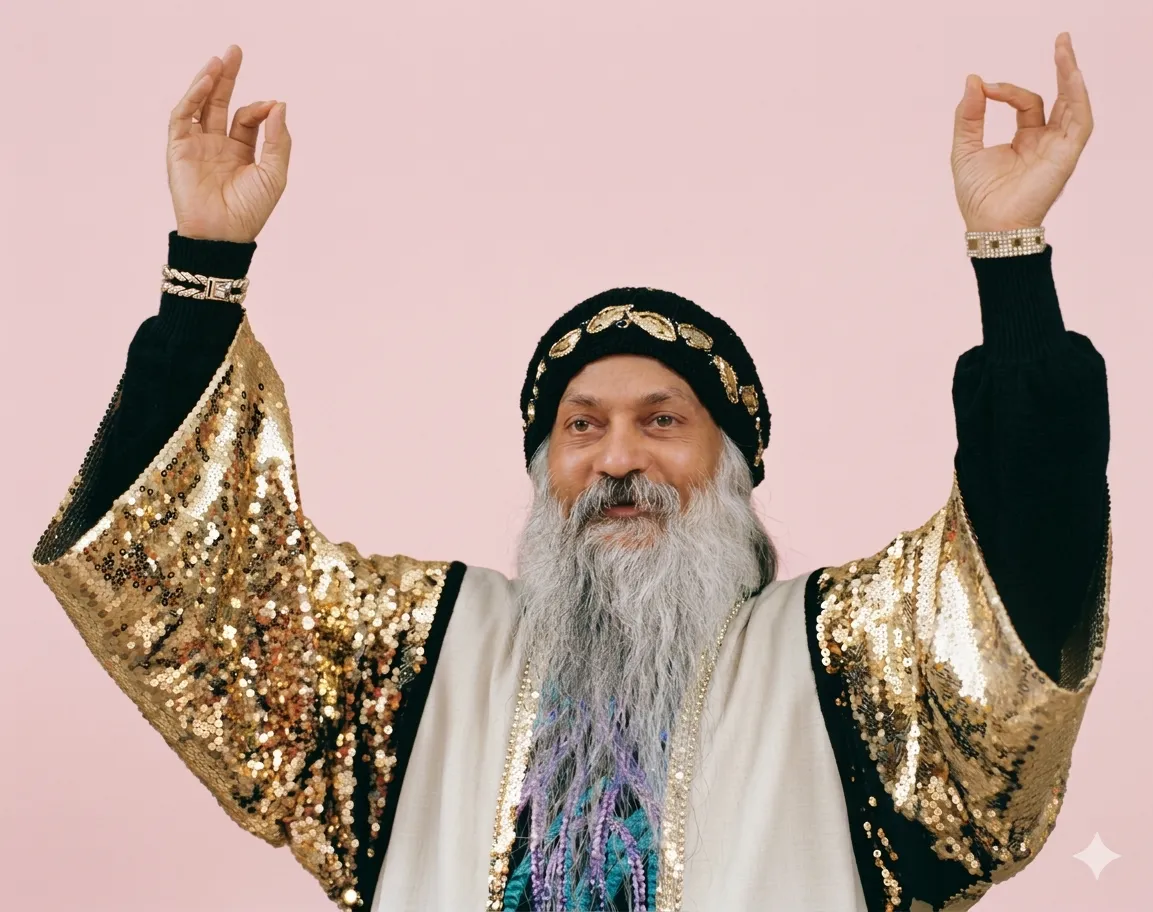
Monasteries are about trying hard alone; ashrams are about relaxing together like a family and enjoying life to meet the divine.
From the Discourses
Passages where Osho speaks to this question — each links to the complete discourse.
What is the difference between waiting for godot and waiting for god?
It is as if the sun has risen in the morning and you are sitting in your room with closed doors and windows, in darkness. Open the doors, you become available to the sun. The sun was already available -- just the meeting happens. You cannot wait for God. All waiting is for Godot. Godot means the one who never comes, who CANNOT come, whose arrival is impossible. And the only impossible thing is that which has already happened -- how can it happen again? You are alive, and you are waiting for life, Now, this is ridiculous. The real man of religion does not think in terms of God. He thinks in terms of life or, even better, of living -- because life can again become an abstract idea. Living, moment-to-moment living. In that very living, one knows what God is, because one knows who one is. Your idea…
Question: AFTER THIS THE SEEKER ENTERS THE THIRD STAGE OF YOGA WHICH IS KNOWN AS NONATTACHMENT. HE FIXES HIS MIND UNWAVERINGLY ON THE MEANING OF SCRIPTURAL WORDS. HE LIVES IN THE MONASTERIES, ASHRAMS, OF SAINTS WELL ESTABLISHED IN AUSTERITIES. HE OCCUPIES HIMSELF WITH THE DISCUSSION OF THE SCRIPTURES AND SLEEPS ON A ROCKY BED. THUS IT IS THAT HE LIVES HIS LIFE. BECAUSE HE HAS ATTAINED PEACE OF MIND, THE MAN OF GOOD CONDUCT SPENDS HIS TIME IN THE ENJOYMENT OF PLEASURES THAT COME NATURALLY TO HIM FROM HIS EXCURSIONS INTO THE FOREST. HE REMAINS DETACHED HOWEVER, FROM THE OBJECTS OF DESIRES. THROUGH THE RITUAL OF MERITORIOUS DEEDS AND THE CULTIVATION OF RIGHT SCRIPTURES, HE ATTAINS THAT CLARITY OF VISION WHICH SEES REALITY. ON COMPLETING THIS STAGE, THE SEEKER EXPERIENCES A GLIMPSE OF ENLIGHTENMENT. ... So don't try this method on modern writings, you will go mad.
Osho, our commune is not like any of the traditional ashrams or monasteries. Would you talk to us more about the function of your commune?
IT is necessary first to understand the traditional structure of an ashrama, and also of a monastery. It will give you the background to understand the meaning of my commune. The ashrama is an Eastern concept based on renouncing society, its comforts, conveniences. An ashrama is a group of people living together in austerity, self-imposed poverty, starvation in the name of fasting; torturing the body in order to have control over the physical by the spiritual; doing all kinds of exercises so that they become able to concentrate on the idea of God if they are Hindus, or on the idea of the ultimate growth of human consciousness if they are Buddhists and Jainas. But the goal is far away for all the three -- you can call it God, you can call it the Buddha, you can call it the Jina. They are different words signifying nothing, but pointing…
Beloved Osho, in the west, most of our growth methods tend to be group-oriented -- like encounter groups and psychodrama. In the east, although there are ashrams where seekers live together, the stress seems to be on the individual. Would you tell us about the two approaches?
In the East, people are in the community too much. So whenever they want to be religious, they want to go to the Himalayas. Society is too much around. They are not fed up with themselves, they are fed up with the society. This is the difference. In the West, you are fed up with yourself and you want some bridge, how to be communicative with the society, with others; how to create a bridge, how to move to the other, so you can forget yourself. In the East, people are fed up with the society. They have lived with it so long, and the society is all around so much that they don't feel any freedom. So whenever somebody wants to be free, to be silent, he runs to the Himalayas. In the West, you run to the society; in the East, people run from the society. That's why…
Beloved master, what is the difference between rimu -- rajneesh international meditation university -- and rajneesh academy?
The Rajneesh International Meditation University is an educational institution. It teaches you everything about meditation. It makes you knowledgeable about the art of meditation, but it is not existential or experiential. It is educational -- just the way all other universities are. There are universities of different kinds in the world. They give you knowledge about the subject. And the meditation university gives you degrees according to your knowledge, your acquaintance with all the literature about meditation. Let me emphasize: it is about meditation, but it is not meditation. Rajneesh Academy is an existential, experiential institute. It does not give you knowledge about meditation; it gives you the experience of meditation. From the university we can create teachers of meditation, writers, Ph.Ds, scholars, D.Litts. But as far as they themselves are concerned, they have not tasted anything of meditation. There are one hundred and twelve methods of meditation; they were…