
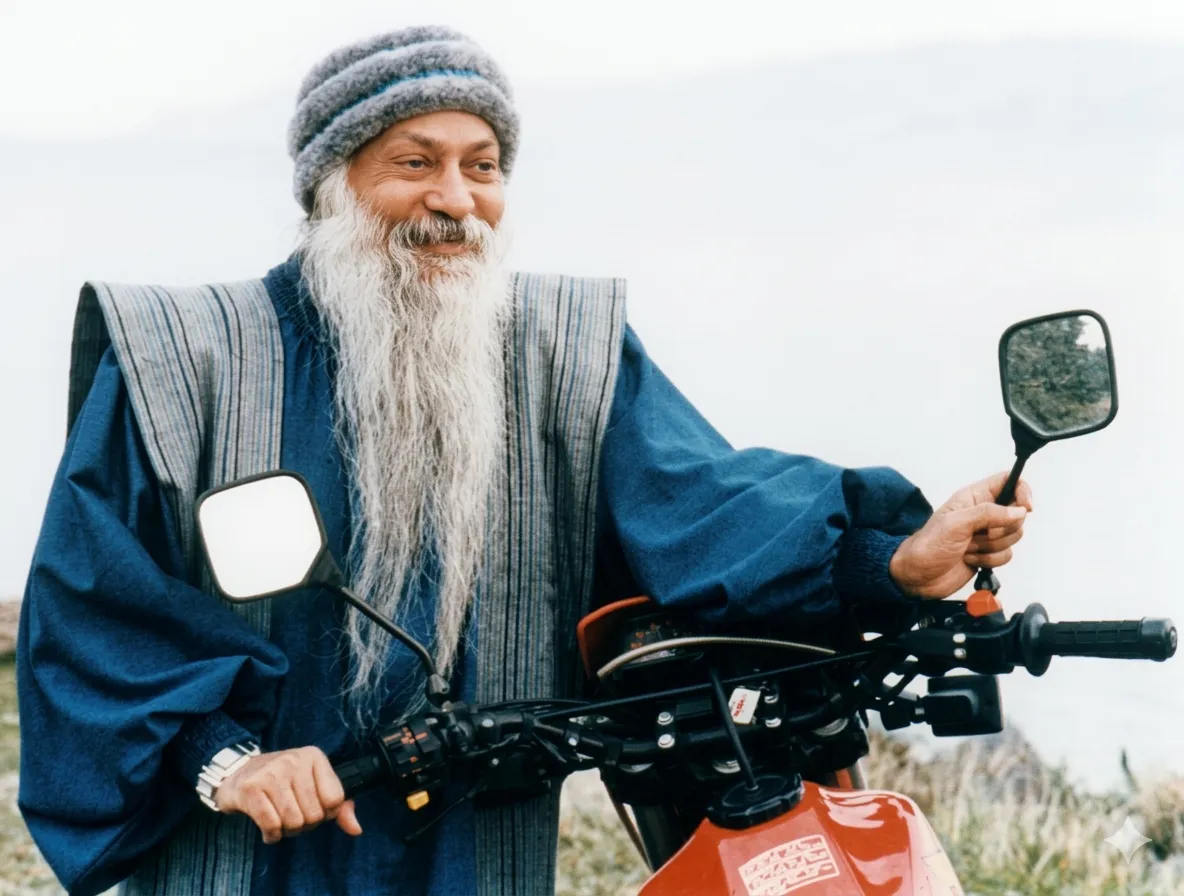
Osho's position on God confounds both believers and atheists. He denied the God of the theologians — the creator-person, the judge, the jealous father — as flatly as Nietzsche did, yet he spent his life pointing at what he called godliness: a quality saturating existence, tasted in meditation rather than argued into being. 'God is not a person,' he said again and again; worship is a category mistake.
These four passages show the full arc — the demolition of proofs, the death of the manufactured God, and the opening of the eye that sees the divine everywhere. Each links to its complete discourse.
Understanding Osho's Vision of God
The threads that run through his talks on god. The short notes are Osho Live's; the quoted passages are his own words, checked against the talk.
A Presence, Not a Person
Asked simply 'what is God?', Osho answered with the distinction that underlies everything else he said on the subject.
GOD is not a person. That is one of the greatest misunderstandings, and it has prevailed so long that it has become almost a fact. Even if a lie is repeated continuously for centuries it is bound to appear as if it is a truth. God is a presence, not a person. Hence all worshipping is sheer stupidity. Prayerfulness is needed, not prayer. There is nobody to pray to; there is no possibility of any dialogue between you and God. Dialogue is possible only between two persons, and God is not a person but a presence -- like beauty, like joy. God simply means godliness. It is because of this fact that Buddha denied the existence of God. He wanted to emphasize that God is a quality, an experience -- like love. You cannot talk to love, you can live it.
God across the years
When Osho spoke about god: talks where it comes up at least 5 times, counted from 6,627 dated talks on Osho Live.
Where he speaks of it most: Es Dhammo Sanantano · Maha Geeta · Tao Upanishad
| Year | Talks about it | Dated talks that year |
|---|---|---|
| 1964 | 10 | 13 |
| 1965 | 13 | 19 |
| 1966 | 4 | 7 |
| 1967 | 25 | 33 |
| 1968 | 19 | 30 |
| 1969 | 65 | 110 |
| 1970 | 76 | 131 |
| 1971 | 47 | 111 |
| 1972 | 111 | 223 |
| 1973 | 104 | 205 |
| 1974 | 224 | 271 |
| 1975 | 247 | 303 |
| 1976 | 461 | 700 |
| 1977 | 489 | 679 |
| 1978 | 597 | 702 |
| 1979 | 619 | 683 |
| 1980 | 565 | 674 |
| 1981 | 86 | 122 |
| 1984 | 54 | 63 |
| 1985 | 226 | 356 |
| 1986 | 185 | 369 |
| 1987 | 284 | 486 |
| 1988 | 121 | 276 |
| 1989 | 47 | 61 |
More in his words
All Proofs Fail
Osho had no patience for theology's arguments — he shows how the classic proof of a creator commits suicide the moment an atheist asks one question.
There have been people who offered proofs, and all their proofs are futile. No proof works. All the proofs for God so far are not worth a penny. Someone says: everything that is made must have a maker; such a vast world—surely it must have a maker. But that proof commits suicide; the moment it meets an atheist, it goes lame. The atheist says: If every made thing must have a maker, if God is needed to make the world, then who made God? With that he tightens the noose around your neck. Who made God? You protest: No, no one made God. Then the atheist says: If God can be without being made, why can’t the world be without being made? The argument collapses; it falls flat.
The God That Died
Asked how we know God has died, Osho pointed not at philosophy but at us: human misery itself is the evidence of a broken connection.
By looking at human beings it becomes clear that God has died. You won’t find God’s corpse anywhere by searching. Nor will you find a tombstone saying he was buried here. And even if you scour every corner of the earth, you won’t discover witnesses before whom he died. No; we ourselves are the testimony—each and every person! What is so much suffering in life, so much darkness, so much pain and restlessness a sign of? It tells us that the source of bliss, the source of light in life, has been cut off from us. The connection has broken.
Open Your Eyes
To a disciple complaining that God appears nowhere, Osho reversed the search: stop seeking the object and repair the instrument.
Open your eyes. You are trying to see with your eyes shut, trying to hear with your ears closed, with the doors of the heart barred—then it is impossible to see God. When the eye is open, there is light. The very opening of the eye is light. Keep the eye closed and even if not one but a thousand suns were to rise, there will still be darkness, a moonless night. But this is not only your mistake; it is almost everyone’s. When God does not appear, people conclude: perhaps there is no God—hence He is not seen. Rarely does someone wonder: perhaps my eyes are closed—hence I do not see. Those rare ones, sooner or later, become able to see the Divine. So the first and the last sutra is this: drop the search for God; learn the alchemy of opening your eyes.
From the discourses
Passages where Osho speaks on god, each linked to the exact place in the talk.
Osho, how do we know that God has died?
By looking at human beings it becomes clear that God has died. You won’t find God’s corpse anywhere by searching. Nor will you find a tombstone saying he was buried here. And even if you scour every corner of the earth, you won’t discover witnesses before whom he died. No; we ourselves are the testimony—each and every person! What is so much suffering in life, so much darkness, so much pain and restlessness a sign of? It tells us that the source of bliss, the source of light in life, has been cut off from us. The connection has broken. One night a blind man was a guest at a house. After midnight, when he was about to leave, the family said, “The road is dark, it’s a moonless night—take a lantern with you.” The blind man laughed, as was natural. He said, “What difference will it make whether I…
पूछा है: ओशो, यह कैसे पता चला है कि यह ईश्र्वर मर गया?
मनुष्य को देख कर यह पता चलता है कि ईश्र्वर मर गया है। कहीं खोजने से ईश्र्वर की लाश नहीं मिलेगी। और किसी कब्र पर लगा हुआ पत्थर नहीं मिलेगा कि यहां वह दफनाया गया है। और न जमीन के कोने-कोने में खोज लेने पर यह पता लगेगा कि कौन से लोग गवाह हैं जिनके सामने वह मरा हो। नहीं; ईश्र्वर के मर जाने की गवाही तो हम सारे लोग हैं--एक-एक आदमी! जीवन में इतना दुख, जीवन में इतना अंधकार, जीवन में इतनी पीड़ा और इतनी अशांति किस बात की सूचना है? इस बात की कि जो आनंद का स्रोत था, जो जीवन में प्रकाश का स्रोत था, उससे हमारे संबंध विच्छिन्न हो गए हैं। वह संबंध टूट गया है। एक रात एक घर में एक अंधा आदमी मेहमान हुआ। आधी रात बीत जाने पर जब वह विदा होने लगा, तो घर के लोगों ने कहा: रास्ता अंधेरा है, अमावस की रात है, तुम एक लालटेन हाथ में लेते चले जाओ।
Osho, what is the proof of God’s existence?
And you still ask for proof? There have been people who offered proofs, and all their proofs are futile. No proof works. All the proofs for God so far are not worth a penny. Someone says: everything that is made must have a maker; such a vast world—surely it must have a maker. But that proof commits suicide; the moment it meets an atheist, it goes lame. The atheist says: If every made thing must have a maker, if God is needed to make the world, then who made God? With that he tightens the noose around your neck. Who made God? You protest: No, no one made God. Then the atheist says: If God can be without being made, why can’t the world be without being made? The argument collapses; it falls flat. You say: just as the potter makes the pot, so that Great Potter made this world.…
आखिरी प्रश्न: ओशो, ईश्वर-अस्तित्व का प्रमाण क्या है?
और तुम प्रमाण पूछ रहे हो? और प्रमाण देनेवाले लोग हुए हैं। और उनके सब प्रमाण व्यर्थ हैं। कोई प्रमाण कारगर नहीं है। अब तक जितने प्रमाण दिये गये हैं परमात्मा के, सब दो कौड़ी के हैं। जैसे कोई कहता है कि हर चीज को बनानेवाला होना चाहिए; इतना बड़ा जगत तो इसका बनानेवाला कोई होगा। मगर उसका प्रमाण आत्मघात कर लेगा, नास्तिक के सामने जाते ही हाथ-पैर उसके लंगड़ा जायेंगे। क्योंकि नास्तिक कहता है, अगर हर बनाई गयी चीज का बनानेवाला होना चाहिए, अगर संसार को बनाने के लिए परमात्मा चाहिए तो फिर परमात्मा को किसने बनाया? बस उसने अटका दी तुम्हारी फांसी! परमात्मा को किसने बनाया है? तुम नाराज होने लगे कि नहीं, परमात्मा को किसी ने नहीं बनाया। तो नास्तिक कहता है, जब परमात्मा बिना बनाये हो सकता है तो संसार क्यों नहीं हो सकता? टूट गया तर्क, पोचा निकला।
Osho, where is God? If we are to seek, where should we seek?
Is it a boat or the moon’s shadow upon the ocean’s waters? When will that boat of light touch the shore of night? Is that untouched lunar shade a frolicsome ripple, A fleeting kiss of light on parched, impatient lips? Dream, or ideal, or resolve—call it what you will— A jewel of a ray, a blossom on the body of dusk! Beyond the reach of clay—are all things false there? Are eyes, fixed on limits, chained to the horizon’s bar? How can literate eyes read what the heart hums within— What fragrance once inscribed as verse upon the gentle breeze! Let the unreachable become reachable—this is the abyss’s longing; Made vocal, written upon the deep heart of the ocean! What is that song of the Unseen the moon keeps writing— Boundless love on the boundless grief of the bounded! The quarters beat the drum, the sky is sound, Time sings,…
पहला प्रश्न: ओशो, परमात्मा कहां है, खोजें तो कहां खोजें?
स्वप्न या आदर्श या संकल्प, तुम कुछ भी कहो-- आभरण है किरण का वह फूल, तिमिर-शरीर पर! मृत्तिका की पहुंच के उस पार क्या सब झूठ है? टिके सीमा के न दृग क्या क्षितिज की जंजीर पर? नयन साक्षर कहां पढ़ पाए, जिसे मन गुन रहा;-- सुरभि ने था लिख दिया जो छंद मंद समीर पर!
Osho, what is god?
GOD is not a person. That is one of the greatest misunderstandings, and it has prevailed so long that it has become almost a fact. Even if a lie is repeated continuously for centuries it is bound to appear as if it is a truth. God is a presence, not a person. Hence all worshipping is sheer stupidity. Prayerfulness is needed, not prayer. There is nobody to pray to; there is no possibility of any dialogue between you and God. Dialogue is possible only between two persons, and God is not a person but a presence -- like beauty, like joy. God simply means godliness. It is because of this fact that Buddha denied the existence of God. He wanted to emphasize that God is a quality, an experience -- like love. You cannot talk to love, you can live it. You need not create temples of love, you need…
Question: OSHO, CANNOT ONE DECLARE THAT ONE HAS EXPERIENCED GOD? If you have experienced, your very existence will be the declaration, you need not declare. At least you need not ask. If the declaration comes it comes, what can you do? One who has experienced God will not decide anything, not even this -- whether he has to declare or not. One who has experienced God has dropped the mind. Now whatsoever happens he will be into it, he will be totally into it. If declaration comes it comes. It came to Mansoor. He declared, "ANA'L-HAQ, I am God." His master, Junnaid, told him, "Mansoor, this is not right. You will get into trouble. I also know but I have never declared because you know these Mohammedans who are all around -- they will kill you." But Mansoor said, "What can I do? When he declares what can I do?
Beloved Osho, why haven't other enlightened masters told the truth about god, jesus, heaven and hell?
"And if a man is capable of all this," Buddha thought, "even without me, sooner or later he will become enlightened. It may take a little more time, but that does not matter in the eternity of time." The story is beautiful.... In Buddhism it is said that gods came, after waiting seven days for Buddha to speak. In Buddhism there is no God, but there are gods. And gods are not creators of the world. They are just people like you who have earned so much virtue in their past life that they are given a holiday period in paradise. As they spend their virtue, they have to come back to the earth again, back into the misery, the suffering. Yes, they enjoyed the weekend in heaven.... Those people are called gods in Buddhism. The gods became very much afraid, because they were waiting for Buddha to speak. If…
It has been asked: Osho, why do we assume that the attainment of God is the goal of human life? Could it not be that human life has no goal—no purpose at all? Between these two points, the questioner must be seeing a contradiction. He has asked: Is the aim of human life to attain God? Or does human life have no aim at all?
And sit with a very light heart—no seriousness; you are not going to do some big task. We are going to spend a few moments, two or ten, in a playful mood, silently, in stillness. Keep no expectation that some great peace will come, some great bliss will be had. Keep no expectation. Drop all expectation. Become absolutely light; set aside the whole burden from the mind. And keep in mind, after closing the eyes, that there is no tension on the brain, the face is not drawn—leave it utterly loose. Let no furrow remain on the forehead—leave it utterly loose. Remember: as you were when you were a small child, sit just that light and buoyant. All right! Let the body be loose; let the eyes close. Become completely light, erase yourself—you are not. Now listen. There will be sounds all around: crickets are calling; the hush of the…
पूछा है: ओशो, हम ऐसा क्यों मानते हैं कि परमात्मा की प्राप्ति ही मानव-जीवन का ध्येय है? क्या यह नहीं हो सकता कि मानव-जीवन का कोई ध्येय न हो? प्रयोजन ही न हो? इन दोनों बातों में, जिसने पूछा है, उसे विरोध दिखाई पड़ता होगा। उसने पूछा है कि क्या मानव-जीवन का ध्येय परमात्मा को पाना है? या कि मानव-जीवन का कोई ध्येय ही नहीं है?
और बड़े हलके मन से बैठें, कोई गंभीरता नहीं, कोई बड़ा काम नहीं करने जा रहे हैं। एक मौज में दो, दस क्षण बिताने जा रहे हैं, चुपचाप मौन में। कोई अपेक्षा न रखें कि कोई बड़ी शांति मिल जाएगी, कोई बहुत आनंद मिल जाए। कोई अपेक्षा न रखें। सब अपेक्षा छोड़ दें। बिलकुल हलके हो जाएं, मन से सारा भार अलग कर लें। और खयाल कर लें, आंख बंद करने के बाद मस्तिष्क पर कोई तनाव न हो, चेहरा खिंचा न हो, बिलकुल ढीला छोड़ दें। माथे पर कोई बल न रह जाए, बिलकुल ढीला छोड़ दें। खयाल करें, जब आप छोटे-छोटे बच्चे रहे होंगे, वैसे ही हलके-फुलके होकर बैठ जाएं।
Osho, is god really dead, as friedrich nietzsche says?
Because the Jewish-Christian-Mohammedan idea of God is not of a very nice fellow; he is not a gentleman. The Jewish God who is at the root of both the Christian and the Mohammedan God says himself, "I am a very jealous God. Those who are against me, I will destroy them. Those who are not with me are against me. Those who are with me will have all the pleasures of heaven, and those who are not with me will suffer eternal hellfire.'' Nietzsche says, "Rejoice, God is dead! There is no heaven and no hell. Don't be afraid of hell and don't be greedy for heaven, because there is no God. God is dead, and man is absolutely free." This has been done in the East in a far more subtle, delicate way. Mahavira says there is no God -- for the same reason as Nietzsche. Mahavira says if…
A friend has asked: Osho, if God is in everyone, then why do you object to worshiping an idol in the temple?
I said, “God in everyone!” and immediately they remembered the temple idol: “If we worship that, what objection can you have?” If it is understood that God is in everyone, then the question of the temple idol doesn’t arise at all. The idol remains a question only so long as God is not seen in all; until then one keeps trying to see God in the temple idol. The day He is seen in everyone, then who is the temple idol and who is outside the temple? Who is an idol and who is not an idol? How will you tell then? How will you be sure that the beggar sitting at the door is not the temple’s idol, and the stone placed inside is God? No—there is then no way. But the temple idol is a substitute, and therefore it is dangerous. I say, do not worship the temple…
एक मित्र ने पूछा है कि ओशो, जब सभी में परमात्मा है, तो फिर मंदिर में मूर्ति की पूजा करें तो आपको एतराज क्या है?
अगर सभी में परमात्मा है, यह समझ में आ गया, तो मंदिर की मूर्ति का सवाल ही नहीं रह जाता। मंदिर की मूर्ति का सवाल तभी तक है जब तक सभी में परमात्मा नहीं है तब तक मंदिर की मूर्ति में परमात्मा देखने की चेष्टा चलती है। जिस दिन सभी में दिख गया तो फिर कौन मंदिर की मूर्ति है और कौन मंदिर के बाहर है? कौन मंदिर की मूर्ति है और कौन मंदिर की मूर्ति नहीं है? फिर कैसे पता चलेगा? फिर कैसे पक्का करोगे कि दरवाजे पर जो भिखारी बैठा है, वह मंदिर की मूर्ति नहीं है? और मंदिर के भीतर जो पत्थर रखा है, वह भगवान है? नहीं, फिर उपाय नहीं है। लेकिन मंदिर की मूर्ति सब्स्टीट्यूट है, इसलिए खतरनाक है।
Question: The last question: Osho, if one does not find God, what is the loss? There is no loss at all—because you can know what the loss is only after you have found God. Loss is felt only when something gained is then lost. What has never been gained—how could you know the loss of losing it? What you do not yet have—how can you even estimate whether gaining it would be a profit or a loss? If a little child asks, “What’s the loss if I never grow up?” what will you say? It’s hard to explain what the loss would be of not becoming young. If a blind man asks, “What’s the loss if I never get my eyes?”—he has never known light.
… जो मिला ही नहीं, उसके खोने का हर्ज तो पता कैसे चलेगा? जो तुम्हारे पास अभी नहीं है, उसे पाने से क्या होगा, लाभ होगा कि हानि होगी, अभी तो अनुमान भी नहीं किया जा सकता। छोटा बच्चा अगर पूछे कि जवान अगर न हुए तो हर्ज क्या है, तो क्या कहोगे? मुश्किल है समझाना कि जवान न हुए तो हर्ज क्या है। अंधा आदमी पूछे कि अगर आंखें न मिलीं तो हर्ज क्या है? प्रकाश को तो अंधे ने कभी जाना नहीं। तो उसे पता नहीं कि प्रकाश का साम्राज्य, प्रकाश के रंगों का जाल, इंद्रधनुष, सूरज, चांद-तारे, फूल, वृक्ष, यह सारा जो प्रकाश का अपूर्व संसार है, इससे वह वंचित है। …
Osho, God does not appear to me anywhere. What should I do?
Anand! Open your eyes. You are trying to see with your eyes shut, trying to hear with your ears closed, with the doors of the heart barred—then it is impossible to see God. When the eye is open, there is light. The very opening of the eye is light. Keep the eye closed and even if not one but a thousand suns were to rise, there will still be darkness, a moonless night. But this is not only your mistake; it is almost everyone’s. When God does not appear, people conclude: perhaps there is no God—hence He is not seen. Rarely does someone wonder: perhaps my eyes are closed—hence I do not see. Those rare ones, sooner or later, become able to see the Divine. So the first and the last sutra is this: drop the search for God; learn the alchemy of opening your eyes. Eyes open in two…
पहला प्रश्न: ओशो, परमात्मा मुझे कहीं भी दिखाई नहीं पड़ता है। मैं क्या करूं?
आनंद! आंखें खोलो। आंखें बंद किए देख रहे हो, कान बंद किए सुन रहे हो, हृदय के द्वार बंद हैं—तो परमात्मा दिखाई पड़ना असंभव है। आंख खुली हो तो रोशनी है। आंख के खुले होने में रोशनी है। और आंख बंद हो, तो एक नहीं हजार सूरज ऊग जाएं तो भी अंधेरा रहेगा, अमावस की रात रहेगी। लेकिन यह तुम्हारी ही भूल नहीं है, यह करीब-करीब सभी की भूल है। परमात्मा दिखाई न पड़े, तो लोग सोचते हैं, परमात्मा होगा नहीं, इसलिए दिखाई नहीं पड़ता। शायद ही कोई विरला कभी सोचता है कि हो सकता है मेरी आंख बंद हो, इसलिए परमात्मा दिखाई नहीं पड़ता। वैसे विरले एक न एक दिन परमात्मा को देखने में समर्थ हो जाते हैं।
Osho, the actions a person performs—are they not, in fact, done by God alone? Has it been rightly asked: are not the actions a person performs actually done by the Divine?
Second stage: Now we enter the second step. Keep the breathing deep, and let the body do whatever it wants—leave it to itself. Let the body make mudras, make postures; if the body starts trembling, whirling, crying—let it. Let the body go completely—breathing will remain deep, and you will let the body go. If the body falls, let it fall. If it rises, let it rise. If it begins to dance, don’t worry—let the body go. Let the body go completely. Breathing will remain deep, and the body will be left completely free. Let the body do whatever it wants. Do not stop it even a little; cooperate with it. Whatever the body wants to do, cooperate—if it whirls, let it whirl; if it sways, let it sway; if it falls, let it fall; if it cries, let it cry; if it laughs, let it laugh—let go—whatever happens, let it…
प्रश्न: ओशो, व्यक्ति जो कार्य करता है, वह परमात्मा ही द्वारा नहीं होता है क्या? यह सवाल ठीक पूछा है कि व्यक्ति जो कार्य करता है, वह परमात्मा ही द्वारा नहीं होता है क्या?
दूसरा चरण: अब दूसरे सूत्र में प्रवेश करना है। श्वास गहरी रखें और शरीर को जो करना हो--छोड़ दें, करने दें। शरीर मुद्राएं बनाए, आसन बनाए, शरीर कंपने लगे, घूमने लगे, रोने लगे--छोड़ दें शरीर को। शरीर को पूरी तरह छोड़ देना है--श्वास गहरी रहेगी और शरीर को छोड़ देना है.शरीर गिरे, गिर जाए.उठे, उठ जाए.नाचने लगे, चिंता न करें--शरीर को छोड़ दें। शरीर को पूरी तरह छोड़ दें.श्वास गहरी रहेगी और शरीर को पूरी तरह छोड़ दें.शरीर को जो करना हो, करने दें.जरा भी रोकेंगे नहीं, सहयोग करें। शरीर जो करना चाहता है, कोआपरेट करें, उसके साथ सहयोगी हो जाएं--शरीर घूमता है, घूमे.डोलता है, डोले.गिरता है, गिर जाए.रोता है, रोए.हंसता है, हंसे--छोड़ दें--जो भी होता है, होने दें.श्वास गहरी रहे और शरीर को छोड़ दें। श्वास गहरी रहे और शरीर को छोड़ दें।
Questions put to Osho about god
Each opens the talk at the moment the question was asked.
- Osho, how do we know that God has died? Kya Ishwar Mar Gaya Hai · Discourse 2 · 1967-03-21
- Osho, what is the proof of God’s existence? Mare He Jogi Maro · Discourse 4 · 1979-11-14
- Osho, where is God? If we are to seek, where should we seek? Sahaj Yog · Discourse 7 · 1978-11-27
- Osho, what is god? I Am That · Discourse 2 · 1980-10-12
- Beloved Osho, why haven't other enlightened masters told the truth about god, jesus, heaven and hell? From The False To The Truth · Discourse 8 · 1985-07-05
- It has been asked: Osho, why do we assume that the attainment of God is the goal of human life? Could it not be that human life has no goal—no purpose at all? Between these two points,... Sakshi Ki Sadhana · Discourse 3 · 1966-12-25
- Osho, is god really dead, as friedrich nietzsche says? Theologia Mystica · Discourse 8 · 1980-08-18
- A friend has asked: Osho, if God is in everyone, then why do you object to worshiping an idol in the temple? Jeevan Hi Hain Prabhu · Discourse 5 · 1969-12-11
- Osho, God does not appear to me anywhere. What should I do? Prem Panth Aiso Kathin · Discourse 15 · 1979-04-10
- Osho, the actions a person performs—are they not, in fact, done by God alone? Has it been rightly asked: are not the actions a person performs actually done by the Divine? Jin Khoja Tin Paiyan · Discourse 3 · 1970-05-03
Frequently asked
Short answers by Osho Live, based on the passages above.
Did Osho believe in God?
Not in God as a person or creator — he called that a human invention, born of fear. But he was not an atheist in the ordinary sense either: he affirmed godliness, a divine quality present in existence itself, and said it is encountered in deep meditation, not in belief.
Why did Osho say worship and prayer are useless?
Because dialogue requires two persons, and for Osho God is not a person. Ritual worship addresses a fiction and leaves the worshipper unchanged. What he endorsed instead was prayerfulness — a wordless gratitude toward existence — and meditation as the actual meeting point.
How did Osho respond to Nietzsche's 'God is dead'?
He largely agreed — the manufactured God of temple, church, and mosque deserved to die — but he refused the despair that followed. If God means life itself, godliness, then nothing has died; only the idol has fallen, leaving the reality it obscured available for the first time.