
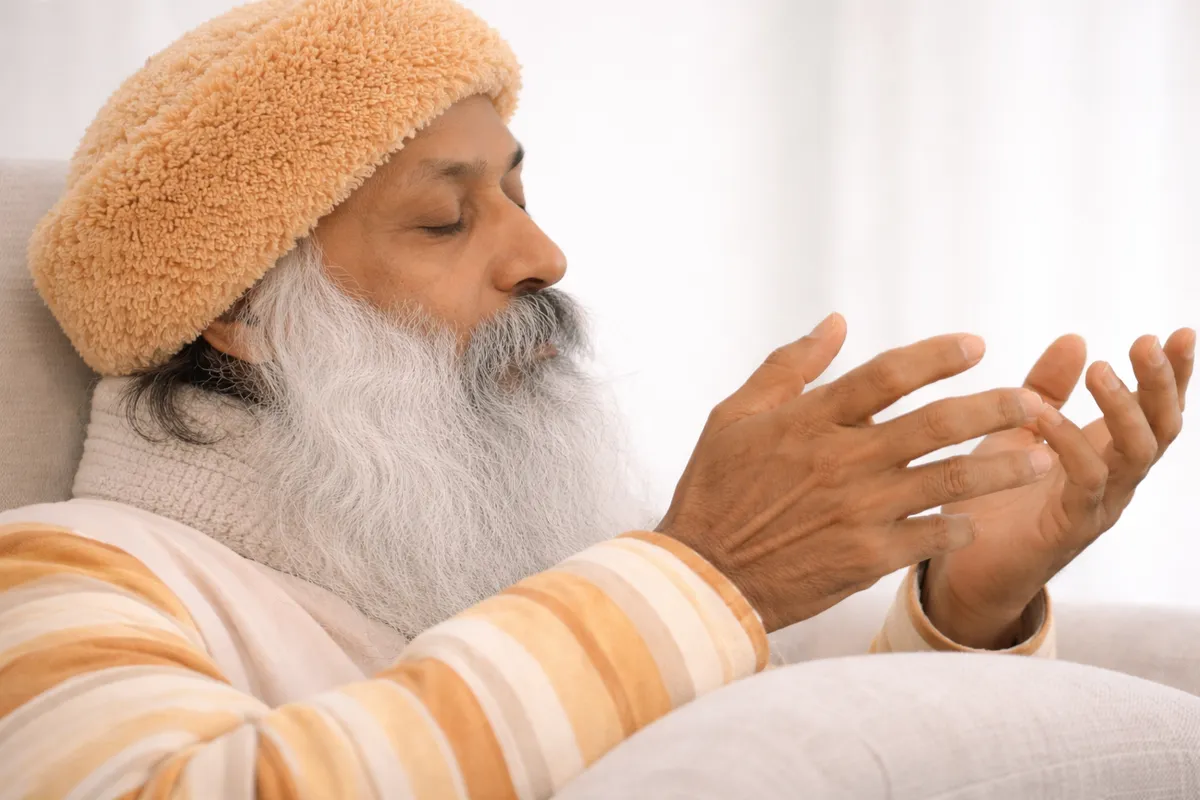
If Osho's work has a center of gravity, it is meditation. Across thousands of discourses he kept insisting that meditation is not a technique performed for twenty minutes a day but a quality of wakefulness that can soak into everything — walking, eating, even anger. It is not concentration, which narrows the mind, and not prayer, which addresses someone else; it is a settling back into one's own center until the watcher is all that remains.
The passages below follow that thread through his discourses — what meditation is, what it is not, and why he demanded intensity rather than routine from anyone attempting it. Each excerpt links into the full discourse it comes from.
“Meditation must be passionate, for it is the fire that dissolves the ego and transforms into compassion, allowing you to merge with the divine. Only in total intensity does the doer disappear, and pure energy and presence emerge.”
From the Discourses
Passages where Osho speaks on meditation — each links to the complete discourse.
Question: BELOVED OSHO, WHAT ARE THE ROOTS AND WHAT ARE THE WINGS OF A MEDITATOR? Meditation is a way of settling in oneself, at the innermost core of your being. Once you have found the center of your existence, you will have found both the roots and the wings. The roots are in existence, making you a more integrated human being, an individual. And the wings are in the fragrance that is released by being in contact with existence. The fragrance consists of freedom, love, compassion, authenticity, sincerity, a sense of humor, and a tremendous feeling of blissfulness. The roots make you an individual, and the wings give you the freedom to love, to be creative, to share unconditionally the joy that you have found. The roots and wings come together. They are two sides of one experience, and that experience is finding the center of your being.
Question: BELOVED OSHO, DO WE NEED SPECIAL MEDITATIONS FOR WOMEN? No. Meditation is concerned with your consciousness -- and consciousness is neither man nor woman. This is one of the fundamentals I want the world to be aware of. All the religions have denied the woman any possibility for spiritual growth, thinking that her body is different, her biology is different: she will not be able to reach to the ultimate flowering of consciousness. But it is strange that nobody down the centuries ever enquired: Who reaches the ultimate flowering -- the body, the mind or consciousness? The body is different. If the body was going into meditation, then there would be certainly a need of different meditations for women than for men. Because the body is not involved in meditation, there is no question of any difference.
Osho, please explain the interrelationship of meditation, samadhi, and love. When do the three become one?
I say to you as well: Life is a veena. But you must tune your own veena. Do not imitate others. They must tune theirs. There are many kinds of veenas. Every person has a veena of his own and a hidden music of his own. Svadharme nidhanam shreyah. If you die while playing your own veena, you will attain the great life. If you die carrying others’ veenas—no matter how beautiful a music they produce—you will come empty and go empty. There will be no treasure in your hands. You will have wasted your life. And the greatest danger in this world is that you may fall under someone else’s influence. You are all too ready to be influenced because tuning your own veena is a hard task. Borrowing another’s veena is easy. Seeking for yourself, practicing swadhyaya, is full of risk—mistakes can happen. Borrowing knowledge from another is…
Can meditation be useful for the common people to be healthy?
It is the best thing to help people to be healthy, because it gives you the taste of eternal life. It leads you into the shrine of your own being which has never known any death or any sickness. And when you become identified with it -- which you really are -- your resistance to sickness, to disease, even to death, is tremendously powerful. Yes, meditation can be a great help for people for health. Every medical institute or hospital must have a special section, a division for meditation. Anyone who is in hospital should also be meditating. While he is taking medicines he should also be meditating. By the way, you will be surprised to know that the words medicine and meditation both come from the same root, which means that which gives you health. Medicine is the physical way, meditation is the spiritual way. The spiritual is certainly…
Read 8 more passages on meditation
Osho, how is your meditation different from auto-suggestions and hypnosis? And if it is different, how? Please clarify.
It is not different from auto-hypnosis and hypnosis; it is more. As far as auto-hypnosis goes, the path of meditation goes along with it, on the same road. But where auto-hypnosis stops, this path goes beyond. And because of that going-beyond, even in the stretch where it runs alongside hypnosis there remains a fundamental difference. The very basis of hypnosis is that your conscious mind goes to sleep. To become stupefied, to fall into a trance, is hypnosis. The process of hypnotic suggestion takes you into drowsiness. The more drowsy you become, the more sleep-like you become, the more you can be hypnotized. Then in that hypnotic state anything can be made to happen through you, because your discrimination is asleep. In this process of meditation you are not to go into trance; in fact, you cannot—because the whole process is active. That is why a hypnotist will lay you…
Osho, the air we breathe contains not only oxygen; it also has nitrogen, hydrogen, and many other kinds of gases. Do all of them support meditation?
Absolutely, they will be supportive for meditation. Because whatever is present in the air—and there is a great deal, not only oxygen—all of it is meaningful for you, for life; that is why you are alive. On any planet or satellite where the air does not contain these things in such proportions, life cannot happen. All of it is the possibility of life. So there is no need to worry about it. There is no need to worry about it. And the more intensely you breathe, the more beneficial it is, because in that intensity oxygen will be able to enter in greater measure and become a part of you. The rest will be thrown out. And whatever things are there in whatever proportion, all of them are useful for your life; there is no harm in that. There is no harm in that. The experience of lightness and its…
Can meditation be passionate?
Yes, that is the only way for meditation to exist. Passion is energy, passion is fire, passion is life. If you are doing meditation just so-so, without any passion, without intensity, without fire, nothing will happen. If you are praying just as a formality and it is not love that has arisen in your heart, it is meaningless, it is absurd. If you are praying to God without passion there will be no connection between you and God. Only passion can become the bridge, the thirst, the hunger. The more thirsty you are, the more is the possibility. If you are utterly thirsty, if you have become just a thirst, your whole being is consumed by your passion, then only something happens -- in that intensity, in that moment of hundred-degree passion. Don't be lukewarm. People live a lukewarm life. They are neither this nor that, hence they remain mediocre.…
Osho, if parents meditate before conception and during pregnancy, what effect does it have on the child?
And if, for the full nine months, the mother carries the child in meditation—does nothing contrary to meditation, and does everything that supports meditation—then certainly, in these nine months, a Buddha can be born. These nine months are the formative moments of the child. And in these nine months let him have only the experience of love, of peace, of light. If in these nine months he has only one experience—the experience of his own inner power—then at birth he will not be an ordinary child; he will be extraordinary. We will have laid the foundation of his life, and the temple that rises on that foundation cannot be different from it. Therefore whenever parents come to me with complaints about their children, I have told them: you may feel hurt, but you are responsible. You must have laid the wrong foundation. Today your child is a bandit; today your…
Osho, if this energy is abundant, one shouldn’t feel tired; one should feel fresh.
No—at the beginning you will feel tired. Gradually you will feel a great freshness, a freshness you have never known. But at first there will be fatigue. The initial fatigue is because your identity is with the senses. You take them to be “I.” So when the senses get tired, you say, “I am tired.” This is exactly where your identity needs to break, isn’t it? It’s like this: your horse gets tired while you are sitting on it—but you have always believed, “I am the horse.” Now the horse is tired and you say, “We are finished, we are exhausted.” What we call “our” tiredness simply reflects where our identity lies. If I am the horse, then I am tired. The day you know “I am not the horse,” a very different kind of freshness will begin to arise. Then you will know: the senses are tired—but where am…
Osho, please explain how, in meditation practice, the dissolution and sublimation of violent tendencies—that is, dissolution and sublimation—take place?
Mahavira was standing near a village and some people came and beat him severely. Someone drove iron pegs into his ears. He stood watching. Later someone asked him, “You said nothing at all? You could at least have said, ‘Why are you beating me without cause?’” Mahavira said: “They were not beating me without cause. There must surely have been some cause in their minds to beat. Perhaps the cause was not related to me, but there was a cause within them. And I thought it would be better if they beat me; if they beat someone else, they would not return without receiving a return blow. Let their violence undergo nirjara. Better than me they would find it hard to find anyone.” Mahavira behaved like a pillow with those people. In meditation the nirjara of all suppressed surges takes place—whether of violence, of anger, of sex, or of greed—meditation…
Another friend has asked: Osho, how does sexual desire disappear through the practice of meditation?
It is not that sexual desire disappears; through meditation your energy begins to move in another dimension and direction. If someone says that by digging canals the river no longer floods, it does not mean floods stop coming because of the canals; floods still come, but their force is carried off through the canals, and the villages along the banks no longer need to be submerged. Meditation does not throw your sexual desire out. You have only one power—whether you expend it in sex or in meditation. Your energy is one; use it however you will—into anger or into forgiveness, into love or into hate—the power is the same. All expressions are uses of that one power. Meditation makes your energy upward-moving. It starts traveling on a higher path. Its outlets change. Where sex was the outlet, love becomes its path. If the energy flows downward—degrades—it finds sex as its…
A friend has asked: what is the relation between meditation and jati-smaran, past life remembering?
When one succeeds in recalling past lives and they begin to appear like dreams, immediately one's present life begins to look like a dream too. Those who have called this world maya have not done so just to propound a doctrine of philosophy. Jati-smaran -- recalling past lives -- is at the base of it. Whosoever has remembered his past lives, for him the whole affair has suddenly turned into a dream, an illusion. Where are his friends of past lives? Where are his relatives, his wife and children, the houses he lived in? Where is that world? Where is everything he took to be so real? Where are those worries that gave him sleepless nights? Where are those pains and sufferings that seemed so insurmountable, that he carried like a dead weight on his back? And what became of the happiness he longed for? What happened to everything he…
“Meditation is not a technique; it is the very process of unlearning, peeling away the layers of the mind until only the pure essence of being remains. In that silence, you discover a harmony that transcends all oppositions.”
Understanding Osho's Vision of Meditation
The threads that run through his discourses on meditation.
Roots and Wings
Asked what a meditator's roots and wings are, Osho gave one of his most complete definitions of meditation — finding the center of your own existence, from which both belonging and freedom grow.
Meditation is a way of settling in oneself, at the innermost core of your being. Once you have found the center of your existence, you will have found both the roots and the wings. The roots are in existence, making you a more integrated human being, an individual. And the wings are in the fragrance that is released by being in contact with existence. The fragrance consists of freedom, love, compassion, authenticity, sincerity, a sense of humor, and a tremendous feeling of blissfulness. The roots make you an individual, and the wings give you the freedom to love, to be creative, to share unconditionally the joy that you have found. The roots and wings come together. They are two sides of one experience, and that experience is finding the center of your being.The Osho Upanishad, Chapter 9 →
Medicine and Meditation Share a Root
Asked whether meditation could help ordinary people stay healthy, Osho pointed at the etymology itself: both words mean that which restores health.
It is the best thing to help people to be healthy, because it gives you the taste of eternal life. It leads you into the shrine of your own being which has never known any death or any sickness. And when you become identified with it -- which you really are -- your resistance to sickness, to disease, even to death, is tremendously powerful. Yes, meditation can be a great help for people for health. Every medical institute or hospital must have a special section, a division for meditation. Anyone who is in hospital should also be meditating. While he is taking medicines he should also be meditating. By the way, you will be surprised to know that the words medicine and meditation both come from the same root, which means that which gives you health. Medicine is the physical way, meditation is the spiritual way.Socrates Poisoned Again After 25 Centuries, Chapter 20 →
Not Hypnosis — Full Wakefulness
Challenged that his meditations were just auto-suggestion, Osho drew the line precisely: hypnosis puts the conscious mind to sleep, while meditation cannot — its whole process is active.
It is not different from auto-hypnosis and hypnosis; it is more. As far as auto-hypnosis goes, the path of meditation goes along with it, on the same road. But where auto-hypnosis stops, this path goes beyond. And because of that going-beyond, even in the stretch where it runs alongside hypnosis there remains a fundamental difference. The very basis of hypnosis is that your conscious mind goes to sleep. To become stupefied, to fall into a trance, is hypnosis. The process of hypnotic suggestion takes you into drowsiness. The more drowsy you become, the more sleep-like you become, the more you can be hypnotized. Then in that hypnotic state anything can be made to happen through you, because your discrimination is asleep. In this process of meditation you are not to go into trance; in fact, you cannot—because the whole process is active.Jo Ghar Bare Aapna, Chapter 8 →
Meditation Needs Passion
To someone asking if meditation can be passionate, Osho answered that passion is the only way it exists at all — lukewarm sitting produces nothing.
Yes, that is the only way for meditation to exist. Passion is energy, passion is fire, passion is life. If you are doing meditation just so-so, without any passion, without intensity, without fire, nothing will happen. If you are praying just as a formality and it is not love that has arisen in your heart, it is meaningless, it is absurd. If you are praying to God without passion there will be no connection between you and God. Only passion can become the bridge, the thirst, the hunger. The more thirsty you are, the more is the possibility. If you are utterly thirsty, if you have become just a thirst, your whole being is consumed by your passion, then only something happens -- in that intensity, in that moment of hundred-degree passion. Don't be lukewarm.The Diamond Sutra, Chapter 4 →
“In the fifth body, the meditator transcends thought entirely, entering a profound silence that is not merely the absence of noise, but a state of pure being beyond all comparison.”
Questions Osho Answered on Meditation
330 questions in the library — the most sought-after:
Feeling pushback to meditate just means change is coming; keep gently cleaning your inner room, forget chasing “God,” and as you grow, what God means shows up by itself.
Seeing colors means your mind is still splitting inner light; keep meditating calmly until the colors fade and a single, clear light shows up.
When you’re very quiet inside, you can hear the universe’s hum (Om); don’t react—just listen warmly and it will deepen.
When you get very, very calm inside, your body needs less air, so breathing gets soft and slow and may pause by itself; don't force it or be scared.
Do your job with honest, caring attention, see each person as divine, and drop the 'I am spiritual' ego.
Just be fully here, right now, without trying to do a technique—that’s meditation.
Meditation is when you stop turning life into words and, with loving silence, feel everything directly.
Sit up straight, relax, let your belly gently rise and fall as you breathe, and just notice each breath without trying to control it.
“Meditation transcends gender; it is the pure awareness of consciousness, unbound by the distinctions of body and mind.”
Frequently Asked
Not a mental exercise but a state of pure witnessing — settling into the innermost core of your being and watching body, thought, and feeling without identifying with them. In his definition, meditation is what remains when doing stops: awareness without effort, without object, without choice.
He argued that the modern mind is too restless and too repressed to sit silently from the start. His active methods begin with deliberate catharsis — chaotic breathing, movement, expression — to exhaust the accumulated tension first, so that the silence which follows is real rather than suppressed.
Ultimately a state — he called it a knack rather than a skill. Techniques are scaffolding: useful to create the situation in which meditation can happen, but the happening itself is effortless. That is why he said meditation cannot be 'done'; you can only remove what prevents it.