
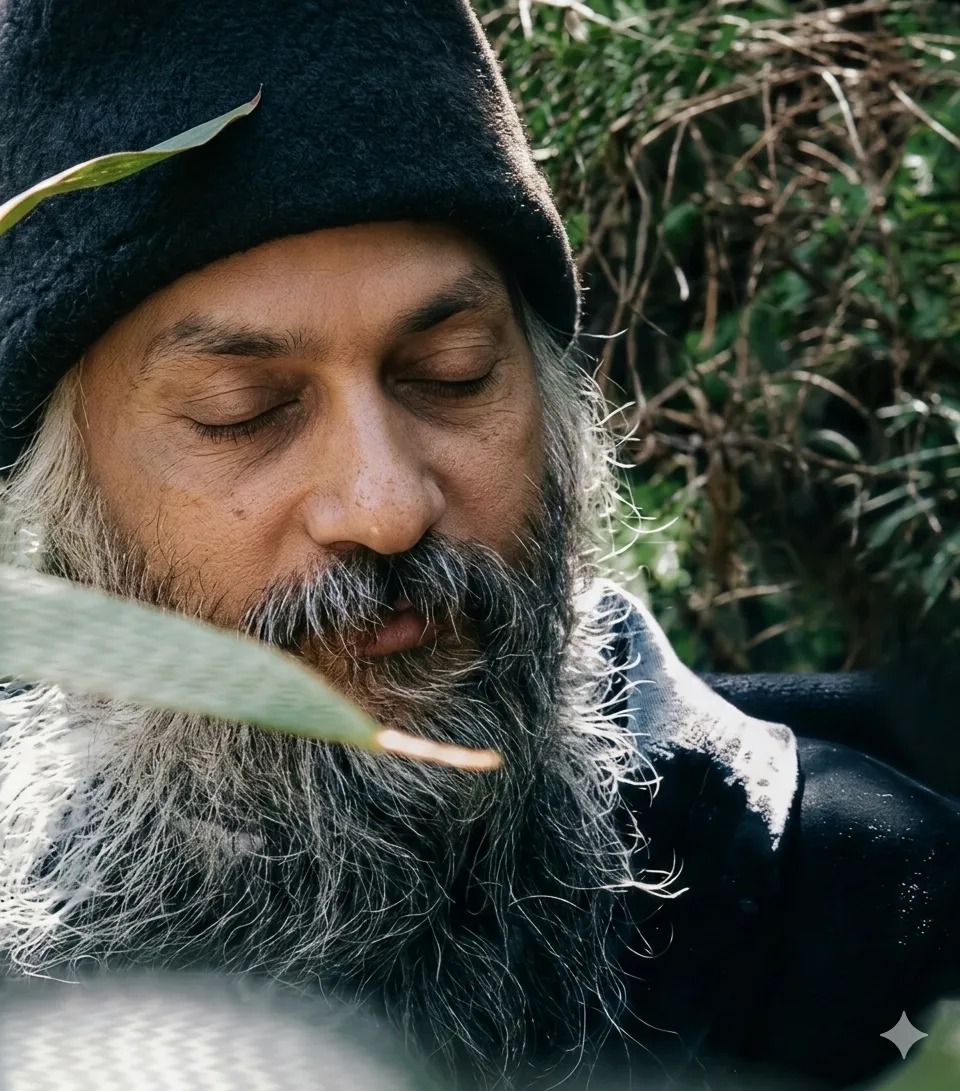
Osho's psychology begins with a demotion: the mind is not a thing but a process — thought-traffic, memory replaying itself, the past posing as the present. It is a superb servant and a catastrophic master, and nearly all human misery, he argued, comes from the second arrangement. His entire work aims at no-mind: not mindlessness, but consciousness freed from compulsive thinking.
The passages below carry the essential moves of that argument — the mind as function, as fossil, as unkillable-by-itself, and witnessing as the one lever that works. Each links to its full discourse.
“The mind is both the creator of bondage and the key to liberation; when it learns nonattachment, it transcends itself and opens the door to true peace.”
From the Discourses
Passages where Osho speaks on mind — each links to the complete discourse.
Beloved Osho, is it possible for a man's mind to become like the mind of the newborn baby?
Definitely. A lake is absolutely calm, peaceful, but with the incoming breeze the waves start rising. But if the breeze stops, the waves will also stop and the lake will become calm. It will again become like a mirror. The lake is clean; with the falling of the leaves it becomes dirty, but when the leaves settle down the lake will again become clean and fresh. A child is born -- the lake was still clean, there were no ripples, there were no leaves of thought, no waves of desire. Then with the advent of youth storms arose, strong winds blew and the lake was full of waves. The mirror got lost. There was a terrific onset of passion. Then old age came and the storm was over -- the lake was calm again. A little understanding -- let the leaves settle down. A little understanding -- let the winds…
Beloved Osho, what is a contemporary mind?
Contemporary mind is a contradiction in terms. Mind is never contemporary, it is always old. Mind is past -- past and past and nothing else; mind means memory. There can be no contemporary mind; to be contemporary is to be without mind. If you are herenow, then you are contemporary with me. But then, don't you see, your mind disappears; no thought moves, no desire arises: you become disconnected with the past and disconnected with the future. Mind is never original, cannot be. No-mind is original, fresh, young; mind is always old, rotten, stale. But those words are used -- they are used in a totally different sense. I can understand your question -- in that sense, those words are meaningful. The mind of the nineteenth century was a different mind; the questions they were asking, you are not asking. The questions that were very important in the eighteenth century…
Osho, what is mind?
As I see it, mind is not an object—it is only a function. This fan is running. There is the fan’s moving state and there is its still state. When the fan stops, we do not ask where the “movement” went, because movement was not an object. Movement was simply an activity of the fan. The fan that was moving has become still. The being within us—its moving state is the mind, and its still state is the soul.
Beloved master, is it true that analysis and synthesis are both mind processes, and in the end neither can help very much?
Yes, both are mind processes, analysis and synthesis both. What can help is witnessing -- witnessing the mind and its activities. And witnessing is the real miracle. The more you witness, the less thoughts are there in the mind -- in exact proportion. If your witnessing is only ten percent, then there are ninety percent thoughts. If your witnessing is ninety percent, there are only ten percent thoughts. If your witnessing is one hundred percent, then there is no mind, there are no thoughts at all. So Sigmund Freud, who talks about psychoanalysis, and Assagioli, who talks about psychosynthesis, are in the same boat. They are both talking about mind; neither of them is talking of going beyond mind. Witnessing simply takes you beyond mind. And to be beyond mind is the whole of religion, the true religion. I call it pure religiousness.
Read 8 more passages on mind
Can the mind commit suicide?
THE MIND CANNOT COMMIT SUICIDE, because whatsoever the mind can do will strengthen the mind. Any doing on the part of the mind makes the mind more strong. So suicide is impossible. Mind doing something means mind continuing itself -- so that is not in the nature of things. But suicide happens. Mind cannot commit it -- mm? -- let me make it absolutely clear: mind cannot commit it, but suicide happens. It happens through watching the mind, not by doing anything. The watcher is separate from the mind, it is deeper than the mind, higher than the mind. The watcher is always hidden behind the mind. A thought passes, a feeling arises -- who is watching this thought? Not the mind itself -- because mind is nothing but the process of thought and feeling. The mind is just the traffic of thinking. Who is watching it? When you say,…
Osho, what will happen if the eastern mind meets with the western mind?
The officer-in-charge took pity on him and he said, 'I can understand your difficulty, but now only one thing can be done. That too is not regular, but for you I will make a concession. You can choose either the indian hell or the german hell.' 'But what is the difference?' the man asked. 'In the german hell,' explained the officer-in-charge, 'you spend half your time eating all the food you want, listening to music and disporting yourself with girls. in the other half of the time you are pinioned to the wall and beaten mercilessly. Your nails and teeth are pulled out and boiling oil is poured over you.' 'And in the indian hell?' 'In the indian hell you spend half your time eating all the food you want, listening to music and disporting yourself with girls. In the other half of the time you are pinioned to the…
Osho, is it possible for a man's consciousness to become like that of a newborn child?
Certainly. A lake is all quiet. Then waves arise, gusts of wind come—the lake trembles. When the gusts pass, the lake again becomes still, becomes a mirror again. The lake is pure. Leaves fall, it becomes dirty. The leaves will settle to the bottom; the lake will again be fresh and clear. When the child is born, the lake is still clear—there are no ripples, no leaves of thoughts, no waves of desire. Then everything becomes wave-tossed—storms arise, the mind trembles, the mirror is lost. Youth comes; everything turns stormy; nothing remains settled; the wild, tempestuous surges of great desires arrive. Then old age comes; all the rubbish, the stones, the ruins lie about. But what was there at the source is still there. A little understanding—to let the leaves settle; a little understanding—to let the winds of desire stop. The lake will become the same again; the nature of…
Osho, the mind does not settle in the crowd, and sheer loneliness also makes the heart panic. Is this a symptom of madness? Kindly explain.
A few things about solitude should be understood. Solitude has three forms. First: what we call loneliness. Second: aloneness. And third: kaivalya. Loneliness is negative. Loneliness is not true aloneness; the memory of the other keeps tormenting you—if only the other were here; the other’s absence hurts, a thorn pricks; the mind is entangled in the other. To outward eyes you are alone, but not within; inside, a crowd is present. Someone may find you sitting by yourself, yet you know you are not alone: someone comes to mind; your heart is set on someone; you are sending out a call to someone; weaving dreams of someone; a cry is going on within—if only someone were here, I would not be alone! You are not reconciled to loneliness. Far from joy, there is not even peace in it. You are restless, agitated. Soon you will find some entanglement: you will…
Osho, if the mind is dreamlike, then whatever is done through the mind will also be dreamlike, won’t it! Then is sadhana also dreamlike, and sannyas too?
Exactly so. Sadhana is a dream, and sannyas too. But there are differences between dream and dream. A thorn gets lodged in your foot; you use another thorn to remove the first. The second is also a thorn—remember that. One thorn is already stuck, so you take it out with another. Don’t imagine the second thorn is not a thorn—otherwise you’ll make a great mistake. And when the first thorn is out, what do you do? You throw away both thorns. You don’t wrap up the second thorn and put it in a safe, you don’t worship it. The world is a thorn. Sannyas is also a thorn. With one thorn you remove the other. Then both are useless. In the ultimate state, even sannyas is not. That Brahmin who asked Buddha, “Are you a deva, a gandharva, a human being?” forgot one thing; he should have asked, “Are you…
Osho, I have undoubtedly set out on the path, and the path itself is becoming the destination. But when I sit in discourse, my mind keeps collecting what you say so I can tell it to others. Why is there such eagerness in me to expound it before others—especially before my loved ones?
It is natural. Those whom we love—we want to give them what we have received, that in which we have known joy, in which we have caught a hint of truth. The taste we have savored, we want our loved ones to taste. We want to make them partners in it. Completely natural. Share! Whatever seems right to you, say it. Who knows—someone else may also find it right. Just keep one thing in mind. The eagerness to share is fine; insistence is not. Don’t sit on anyone’s chest saying, “I have accepted it, you must accept it too—because you are my wife; if you don’t agree with me, that’s not okay; or you are my husband.” Do not be insistent—non-insistence! Give full freedom to accept or not. But if a feeling rises in your heart, don’t suppress it either. If you feel joy, if you taste the essence, share…
"in which way does the modernized original mind become identified with the dust of the past knowledge and experience?"
Religion starts when you become frustrated, totally frustrated, with the world of name and form and when the whole thing looks meaningless. It is! Ultimately it IS meaningless. This feeling of meaninglessness of the world that is created around name and form makes you uneasy. That uneasiness is the beginning of a religious search. You become uneasy because with this label you cannot become totally identified. The label remains a label; you remain what you are. This label covers you a little, but it cannot become your totality. And sooner or later you become fed up with this label. You want to know who you really are. And the moment you ask sincerely, "Who am I?" you are on a different journey; you are transcending. This identification is natural. There is another reason why it is so easy to become identified. This is a room. If I say to you,…
Question: BELOVED OSHO, DOES PSYCHOLOGICAL THERAPY HELP TO GO BEYOND THE MIND? Vijen, psychological therapy can help you to understand the mind, but it cannot lead you beyond the mind. Only one thing leads you beyond the mind and that is meditation. Meditation has nothing to do with psychotherapy, but psychotherapy can create a ground by giving you a better understanding of your mind to go into meditation. It cannot lead you directly into the transcendental, but it can be a help, just the way you prepare a garden. First, you prepare the soil, but that is not the garden. And just preparing the ground, removing the weeds, the grass, any wild growth, stones, roots, still it is not the garden -- this much psychotherapy can do. Now you will have to put seeds, give nourishment to those seeds, care and love and protection.
“The mind cannot commit suicide; it only strengthens itself through struggle. True cessation arises when the watcher observes without attachment, allowing thoughts to dissolve into the silence of awareness.”
Understanding Osho's Vision of the Mind
The threads that run through his discourses on mind.
A Function, Not a Thing
Asked point-blank 'what is mind?', Osho reached for a fan: when it stops, nobody asks where the movement went.
As I see it, mind is not an object—it is only a function. This fan is running. There is the fan’s moving state and there is its still state. When the fan stops, we do not ask where the “movement” went, because movement was not an object. Movement was simply an activity of the fan. The fan that was moving has become still. The being within us—its moving state is the mind, and its still state is the soul.Kya Sove Tu Bavri, Chapter 3 →
The Mind Is Never Contemporary
'Contemporary mind', Osho says, is a contradiction in terms — mind is memory, and memory is always yesterday.
Contemporary mind is a contradiction in terms. Mind is never contemporary, it is always old. Mind is past -- past and past and nothing else; mind means memory. There can be no contemporary mind; to be contemporary is to be without mind. If you are herenow, then you are contemporary with me. But then, don't you see, your mind disappears; no thought moves, no desire arises: you become disconnected with the past and disconnected with the future. Mind is never original, cannot be. No-mind is original, fresh, young; mind is always old, rotten, stale.The Book of Wisdom, Chapter 23 →
The Mind Cannot Kill Itself
Whatever the mind does strengthens the mind — so how does it ever end? Osho's answer: not by doing, but by being watched.
THE MIND CANNOT COMMIT SUICIDE, because whatsoever the mind can do will strengthen the mind. Any doing on the part of the mind makes the mind more strong. So suicide is impossible. Mind doing something means mind continuing itself -- so that is not in the nature of things. But suicide happens. Mind cannot commit it -- mm? -- let me make it absolutely clear: mind cannot commit it, but suicide happens. It happens through watching the mind, not by doing anything. The watcher is separate from the mind, it is deeper than the mind, higher than the mind.The Discipline of Transcendence Vol 3, Chapter 2 →
Witnessing Is the Real Miracle
Analysis and synthesis both stay inside the mind, Osho told a questioner — only witnessing goes beyond it, and it works in exact proportion.
What can help is witnessing -- witnessing the mind and its activities. And witnessing is the real miracle. The more you witness, the less thoughts are there in the mind -- in exact proportion. If your witnessing is only ten percent, then there are ninety percent thoughts. If your witnessing is ninety percent, there are only ten percent thoughts. If your witnessing is one hundred percent, then there is no mind, there are no thoughts at all. So Sigmund Freud, who talks about psychoanalysis, and Assagioli, who talks about psychosynthesis, are in the same boat. They are both talking about mind; neither of them is talking of going beyond mind. Witnessing simply takes you beyond mind.From Bondage to Freedom, Chapter 38 →
“The mind is the whirring of consciousness, a function of thought; when it ceases, what remains is the stillness of the witnessing soul.”
Questions Osho Answered on Mind
117 questions in the library — the most sought-after:
Don’t call feelings bad or try to push them away; watch them completely and they transform into helpful energy.
Your mind is the part that quickly reacts to outside events, like water making waves when the wind blows.
Don’t battle the noisy thoughts—calmly ignore them and give your care to joy, love, and quiet so the noise shrinks on its own.
If you’re battling and judging your thoughts, that’s repression; if you calmly watch them come and go without taking sides, that’s true discipline.
Your memories don’t vanish when you die; they’re covered like dust and can be carefully uncovered with a very calm mind.
A calm mind helps you do what really matters better, while the messy, stress-made habits drop off on their own.
Being mature means trusting your awareness and meeting each moment fresh instead of acting from old ideas.
Your thinking can’t make real happiness; you find joy only when you step outside your busy, borrowed mind.
“Transcending the mind is not about erasing memories, but about disidentifying from them and living fully in the present. When you master your mind, memories serve you, rather than enslave you.”
Frequently Asked
Not unconsciousness or stupidity but consciousness without thought-traffic — the lake without ripples. Thinking remains available as a tool to be picked up and put down; what ends is its compulsiveness. No-mind is mind's silence, and in Osho's teaching it is the door to everything sacred.
No — Osho called it a beautiful servant and a dangerous master. The problem is not thought but identification with thought. His methods do not attack the mind (which only strengthens it) but build the witness that stands behind it, after which the mind falls into its proper place.
Western psychology, he said, studies the mind from inside the mind — analyzing, synthesizing, adjusting people to normality. His interest was the dimension it ignores: the consciousness that can watch the mind altogether. He summed it up as the difference between the psychology of pathology and the psychology of the buddhas.