
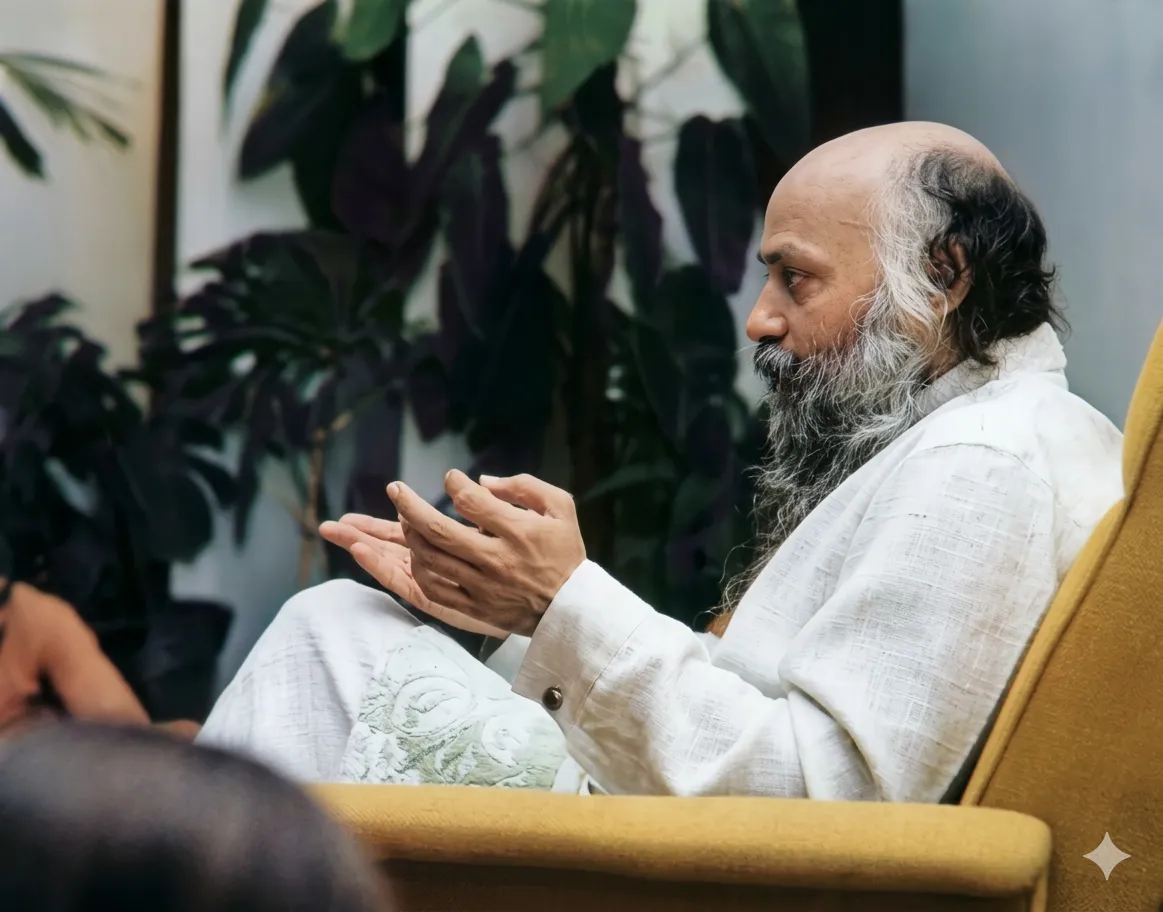
Whatever the question — anger, sex, greed, fear, death — Osho's answer circled back to one word: awareness. Not concentration, which chooses an object, and not judgment, which takes sides, but a choiceless, effortless witnessing that transforms whatever it touches without force. He called it the only real morality, because a fully aware person cannot harm.
These passages lay out the mechanics of that teaching — what choicelessness means, how awareness changes action, and where the ladder of witnessing finally ends. Each links to the full discourse.
Understanding Osho's Vision of Awareness
The threads that run through his talks on awareness. The short notes are Osho Live's; the quoted passages are his own words, checked against the talk.
Choiceless by Its Very Nature
Is choiceless awareness itself a choice? Osho dissolves the paradox: the moment choosing begins, awareness has already gone to sleep.
No, choiceless awareness is not a choice. Choiceless means we do not make any choice, we do not select any option; we simply awaken. In that awakening we do not decide, “This is right, that is wrong; this should be accepted, that should be dropped.” We make no decision. We simply look, awake. In this awakened seeing there is no choice at all. And as long as there is choice, we cannot see with awareness. “Awareness with choice”—there is no such thing. Awareness, as such, is without choice. Awareness by its very nature is choiceless.
Awareness across the years
When Osho spoke about awareness: talks where it comes up at least 5 times, counted from 6,627 dated talks on Osho Live.
Where he speaks of it most: Es Dhammo Sanantano · Vigyan Bhairav Tantra, Vol 2 · Vigyan Bhairav Tantra, Vol 1
| Year | Talks about it | Dated talks that year |
|---|---|---|
| 1964 | 5 | 13 |
| 1965 | 6 | 19 |
| 1966 | 3 | 7 |
| 1967 | 14 | 33 |
| 1968 | 6 | 30 |
| 1969 | 26 | 110 |
| 1970 | 34 | 131 |
| 1971 | 28 | 111 |
| 1972 | 97 | 223 |
| 1973 | 91 | 205 |
| 1974 | 113 | 271 |
| 1975 | 165 | 303 |
| 1976 | 270 | 700 |
| 1977 | 207 | 679 |
| 1978 | 203 | 702 |
| 1979 | 218 | 683 |
| 1980 | 245 | 674 |
| 1981 | 36 | 122 |
| 1984 | 21 | 63 |
| 1985 | 104 | 356 |
| 1986 | 98 | 369 |
| 1987 | 184 | 486 |
| 1988 | 63 | 276 |
| 1989 | 32 | 61 |
More in his words
Awareness Changes Everything It Touches
Notice your breath and it deepens; watch your walk and it becomes graceful. Osho explains why this is not self-deception but the whole method.
It is natural. Whenever you become aware of anything you bring a new quality to it, it changes. If you become aware of your breathing, the breathing will change its rhythm. You don't try to change it, there is no need to make any effort; you simply become alert that you are breathing in and out and there will be a change felt, the rhythm will not be the same, because now you are consciously breathing. First you were unconsciously breathing, now something new has come into it -- consciousness. You walk; ordinarily you walk unconsciously, there is no need, the body is like a mechanism; but then you walk consciously, bring consciousness to it -- suddenly you will see that your walk has taken a different quality: it is more graceful, more aesthetic, more beautiful, and you are not dragging -- rather, deep down you have started dancing.
Consciousness, Witnessing, Awareness
Osho lays out the ladder precisely: consciousness is practiced, witnessing follows as its shadow, and awareness is the end beyond which there is nothing to achieve.
Witnessing comes as a consequence of consciousness. You cannot practice witnessing; you can only practice consciousness. Witnessing comes as a consequence, as a shadow, as a result, as a byproduct. The more you become conscious, the more you go into witnessing, the more you come to be a witness. So consciousness is a method to achieve witnessing. And the second step is that witnessing will become a method to achieve awareness. So these are the three steps: consciousness, witnessing, awareness. But where we exist is the lowest rank: that is, in unconscious activity. Unconscious activity is the state of our minds. Through consciousness you can achieve witnessing, and through witnessing you can achieve awareness, and through awareness you can achieve "no achievement." Through awareness you can achieve all that is already achieved. After awareness there is nothing; awareness is the end.
Innocence Helps, Knowledge Hinders
Does esoteric knowledge help on the path of awareness? Osho's answer is one of his bluntest.
No knowledge -- esoteric or otherwise -- plays any role on the path except that of hindrance. Innocence helps, knowledge hinders. Be a child -- full of wonder, without knowing anything.
From the discourses
Passages where Osho speaks on awareness, each linked to the exact place in the talk.
Osho, is choiceless awareness also a kind of choice? It seems to come down to a paradox.
No, choiceless awareness is not a choice. Choiceless means we do not make any choice, we do not select any option; we simply awaken. In that awakening we do not decide, “This is right, that is wrong; this should be accepted, that should be dropped.” We make no decision. We simply look, awake. In this awakened seeing there is no choice at all. And as long as there is choice, we cannot see with awareness. “Awareness with choice”—there is no such thing. Awareness, as such, is without choice. Awareness by its very nature is choiceless. So awareness can never be together with choice, because choice means bias has begun; sleep has begun. There are so many people sitting here: if I say, “Bacchu-bhai is a fine man,” then I cannot be aware in relation to Bacchu-bhai either, because my attachment has begun. Nor can I be aware in relation to…
ओशो, च्वाइसलेस अवेयरनेस, यह भी कोई च्वाइस नहीं है? यही बात आती है, पैराडॉक्स की ही बात आती है।
… च्वाइसलेस का मतलब है कि हम कोई चुनाव नहीं करते हैं, हम कोई विकल्प नहीं चुनते हैं, हम सिर्फ जागते हैं। उस जागने में हम कोई निर्णय नहीं लेते कि यह ठीक है, यह गलत है; यह मानना चाहिए, यह छोड़ना चाहिए। हम कोई निर्णय नहीं लेते। हम सिर्फ जाग कर देखते हैं। इस जाग कर देखने में कोई भी चुनाव नहीं है। और जब तक चुनाव है तब तक हम जाग कर नहीं देख सकते हैं। यानी अवेयरनेस विद च्वाइस, ऐसी कोई चीज नहीं होती। अवेयरनेस ऐज सच इज़ विदाउट च्वाइस। अवेयरनेस होती ही च्वाइसलेस है। तो अवेयरनेस कभी भी च्वाइस के साथ नहीं हो सकती है। क्योंकि च्वाइस का मतलब है कि रस शुरू हो गया, नींद शुरू हो गई। …
When I become aware of my thoughts or my breathing, they immediately change. Is this natural, or an ingrained habit of subtly not accepting what is?
It is natural. Whenever you become aware of anything you bring a new quality to it, it changes. If you become aware of your breathing, the breathing will change its rhythm. You don't try to change it, there is no need to make any effort; you simply become alert that you are breathing in and out and there will be a change felt, the rhythm will not be the same, because now you are consciously breathing. First you were unconsciously breathing, now something new has come into it -- consciousness. You walk; ordinarily you walk unconsciously, there is no need, the body is like a mechanism; but then you walk consciously, bring consciousness to it -- suddenly you will see that your walk has taken a different quality: it is more graceful, more aesthetic, more beautiful, and you are not dragging -- rather, deep down you have started dancing. When…
Osho, are “just awareness,” mere alertness, and tathata the same?
In fact, when we say “just awareness,” mere alertness, there is a slight difference between that and tathata. And there is also a slight difference between that and the witness. Think of “just awareness” as the link between the witness and tathata—when you pass from witnessing to tathata, this will be the link in between: just awareness. In witnessing, the sense that “I am and you are” is firm. In just awareness there is only “am”; the sense of “you” has been forgotten—only the sense of being. In tathata, it is not only the sense of being; my being and your being are one being. Because as long as there is just awareness, as long as there is only the sense of being, there will be a boundary outside that sense of being—something I am not, from which I am separate. In tathata there is no boundary. There is only…
ओशो, जस्ट अवेयरनेस, केवल होश और तथाता एक ही बात है?
… और इसमें और साक्षी में भी थोड़ा-सा फर्क है। अगर ऐसा समझें कि साक्षी और तथाता के बीच की कड़ी--जब तुम साक्षी से गुजरोगे तथाता तक, तब यह बीच की एक कड़ी होगी--जस्ट अवेयरनेस। साक्षी होने में मैं हूं और तू है, इसका भाव पक्का है। जस्ट अवेयरनेस में सिर्फ हूं; तू का भाव भूल गया है। सिर्फ होने का भाव। तथाता में सिर्फ होने का भाव ही नहीं है। यह मेरा होना और तेरा होना एक ही होना है। क्योंकि जब तक जस्ट अवेयरनेस भी है, जब तक सिर्फ होने का भाव भी है, तब तक होने के भाव के बाहर एक सीमा होगी, जो कि मैं नहीं हूं, जहां से मैं अलग हूं। तथाता में कोई सीमा नहीं है। …
Does Mahavira regard this very awareness as manliness and the Kshatriya dharma, or is there some other manliness too?
Only this. There is no greater manliness than this. There is no manliness greater than breaking the slumber.
प्रश्न: महावीर इस जागरूकता को ही पौरुष और क्षात्र धर्म मान रहे हैं या कोई और भी पौरुष है?
इसको ही। इससे बड़ा कोई पौरुष नहीं है। नींद तोड़ने से बड़ा और कोई पौरुष नहीं है।
Beloved Osho, modest though my experience of awareness is, when it is happening I feel intoxicated. It is a far more subtle, but headier drunkenness than anything that makes one unconscious. Is this a case of illusion or a case of divine wine?
You may have heard about sleepwalkers who get up in the middle of the night and without waking, with open eyes, without stumbling, reach directly to the kitchen, find the fridge, open it, eat anything to their heart's content, and in the day they are dieting! And the doctor is puzzled and they themselves are puzzled -- "What is the matter? The more I diet the more my weight is going up." And there are almost ten percent of people capable of somnambulism. They can walk in their sleep, they can do things, and in the morning they will be disturbed: "Who has done this?" And not just ordinary people; there are cases on record of very great geniuses. Madame Curie, one of the first women ever to receive a Nobel Prize, was struggling for three years to solve a mathematical problem, and was becoming almost hopeless. Every angle, every…
Question: what is the difference between awareness and witnessing?
Witnessing comes as a consequence of consciousness. You cannot practice witnessing; you can only practice consciousness. Witnessing comes as a consequence, as a shadow, as a result, as a byproduct. The more you become conscious, the more you go into witnessing, the more you come to be a witness. So consciousness is a method to achieve witnessing. And the second step is that witnessing will become a method to achieve awareness. So these are the three steps: consciousness, witnessing, awareness. But where we exist is the lowest rank: that is, in unconscious activity. Unconscious activity is the state of our minds. Through consciousness you can achieve witnessing, and through witnessing you can achieve awareness, and through awareness you can achieve "no achievement." Through awareness you can achieve all that is already achieved. After awareness there is nothing; awareness is the end. Awareness is the end of spiritual progress; unawareness is…
Osho, we feel that to penetrate and transform the deeper layers of the unconscious only through awareness is difficult and not enough. What else should one do other than the practice of awareness? Please explain more about the practical dimensions on this matter.
Silence is energy. Brahmacharya is energy. Not to be angry is energy. But this is not suppression. If you suppress anger, you have used energy again. Don't suppress -- observe and follow. don't fight -- just move backwards with the anger. This is the purest method of awareness. But certain other things can be used. For beginners certain devices are possible. So I will talk about three devices. One type of device is based on body awareness. Forget anger, forget sex -- they are difficult problems. And when you are in them, you become so mad that you cannot meditate. When you are angry you cannot meditate; you cannot even think about meditation. You are just mad. So forget it; it is difficult. Then use your own body as a device for awareness. Buddha has said that when you walk, walk consciously. When you breathe, breathe consciously. The Buddhist method…
You said a cat is as aware as a buddha. But why is a cat not willing to give a discourse every morning like you?
Cats are always willing -- but you have to be ready to be mice. Cats can speak only to mice. Become rats, and cats will deliver discourses. They always will, but the whole point is of your being receptive at that level. Trees are speaking: become a tree and you understand. Birds are speaking: become a bird and you understand. And you cannot understand me if you don't become a buddha. I am delivering the discourse but don't be deceived by it, don't think that you are understanding it also. I am talking -- that is certain. But are you hearing me? That is not so certain. You appear to listen to me, but that's more or less appearance. Sometimes I talk for one and a half hours, but rarely you listen -- sometimes for a single second or two seconds or three seconds, then again you are fast asleep.…
Question: OSHO, IS AWARENESS A HIGHER VALUE THAN LOVE? Virendra, THE HIGHEST PEAK IS THE CULMINATION of all the values: truth, love, awareness, authenticity, totality. At the highest peak they are indivisible. They are separate only in the dark valleys of our unconsciousness They are separate only when they are polluted, mixed with other things. The moment they become pure they become one; the more pure, the closer they come to each other. For example, each value exists on many planes; each value is a ladder of many rungs. Love is lust -- the lowest rung, which touches hell; and love is also prayer -- the highest rung, which touches paradise. And between these two there are many planes easily discernible. In lust, love is only one percent; ninety-nine percent are other things: jealousies, ego trips, possessiveness, anger, sexuality.
Osho, how to see what is?
Akam, THERE IS NO HOW TO SEE WHAT IS, because if you are carrying a how you will distort it. That which is needs no method, technique, to see it -- just silence, a transparent stillness, no thought in the mind, not even the thought of a certain method. No strategy, because all strategies are bound to distort. In fact, no mind is needed to see that which is. Mind means thoughts. And if there is a traffic of thoughts, you will never be able to see what is, you will see something else. You will see what your thoughts allow you to see. Your thoughts prevent much reaching you. You will be surprised to know what modern psychological researchers have come to know: ninety-eight percent of the reality is not allowed to enter in your being; the mind only allows two percent. So whatsoever you see is only two…
Osho, but this seems a bit paradoxical. In unconsciousness there is no awareness—how did he come to know that?
It is always known afterward, always afterward—after the event has passed. Suppose you became angry. While you are in anger you have no awareness at all. But when the anger is gone, you look back and say, “Ah, what have I done! I would never have done that if I had been aware.” It’s a matter of a second, isn’t it? It’s not as if months have passed. Just a second!
ओशो, मगर यह थोड़ा पैराडॉक्सिकल है। बेहोशी में, होश नहीं है, यह कैसे मालूम पड़ा उसको?
वह हमेशा पीछे मालूम पड़ता है, हमेशा पीछे, घटना के बीत जाने के बाद। जैसे तुमने क्रोध किया। जब तुम क्रोध में हो तब तुम्हें कुछ होश नहीं है। लेकिन क्रोध गया, तब तुम लौट कर देखते हो और कहते हो, अरे, यह मैंने क्या कर लिया! यह तो मैं कभी करता ही नहीं अगर मुझे होश होता तो। एक सेकेंड की बात है न! कोई ऐसा थोड़े ही है कि महीनों बीते हैं। एक सेकेंड!
Beloved Osho, does knowledge of the esoteric play any role on the path of awareness?
No. No knowledge -- esoteric or otherwise -- plays any role on the path except that of hindrance. Innocence helps, knowledge hinders. Be a child -- full of wonder, without knowing anything. One Indian saint was very much respected in India. There were only two men in India who were called mahatma. One was Mahatma Gandhi -- `mahatma' means `the great soul' -- and the second was Mahatma Bhagwandin. This second man used to stay with me whenever he passed the city I was living in. I used to go for a morning walk, for a night walk, and he was also very much in love with going for a walk. He was an old man, but immensely knowledgeable; he knew the names of all the trees -- Latin names, Greek names -- all the flowers. He was almost a walking encyclopedia. I told him, "You have wasted your whole…
Questions put to Osho about awareness
Each opens the talk at the moment the question was asked.
- Osho, is choiceless awareness also a kind of choice? It seems to come down to a paradox. Naye Samaj Ki Khoj · Discourse 16
- When I become aware of my thoughts or my breathing, they immediately change. Is this natural, or an ingrained habit of subtly not accepting what is? Tao The Three Treasures Vol 3 · Discourse 10 · 1975-08-20
- Osho, are “just awareness,” mere alertness, and tathata the same? Main Mrityu Sikhata Hun · Discourse 15 · 1970-08-06
- Does Mahavira regard this very awareness as manliness and the Kshatriya dharma, or is there some other manliness too? Mahaveer Meri Drishti Mein · Discourse 10 · 1969-09-22
- Beloved Osho, modest though my experience of awareness is, when it is happening I feel intoxicated. It is a far more subtle, but headier drunkenness than anything that makes one... The Invitation · Discourse 15 · 1987-08-28
- Question: what is the difference between awareness and witnessing? Meditation The Art Of Ecstasy · Discourse 14
- Osho, we feel that to penetrate and transform the deeper layers of the unconscious only through awareness is difficult and not enough. What else should one do other than the practice of... The Ultimate Alchemy Vol 1 · Discourse 18 · 1972-06-06
- You said a cat is as aware as a buddha. But why is a cat not willing to give a discourse every morning like you? Tao The Three Treasures Vol 2 · Discourse 8 · 1975-06-28
- Osho, how to see what is? The Fish In The Sea Is Not Thirsty · Discourse 2 · 1979-04-12
- Osho, but this seems a bit paradoxical. In unconsciousness there is no awareness—how did he come to know that? Naye Samaj Ki Khoj · Discourse 12
- Beloved Osho, does knowledge of the esoteric play any role on the path of awareness? The Transmission Of The Lamp · Discourse 40 · 1986-06-15
Frequently asked
Short answers by Osho Live, based on the passages above.
What is the difference between awareness and witnessing in Osho's teaching?
He used them as rungs of one ladder: you can practice being conscious of body, thought, and feeling; witnessing then arises as a consequence, a growing distance from what is watched; and awareness is the culmination — witnessing become effortless and constant, with no watcher left standing apart.
How does awareness transform anger or desire without suppression?
By observation rather than opposition. Osho taught that anger watched cannot sustain itself — energy locked in the emotion is released and rises. Suppression buries the poison; indulgence feeds it; awareness alone transmutes it, which is why he spoke of awareness as the real alchemy.
Is Osho's awareness the same as mindfulness?
It is the same family — he drew directly on Buddha's sammasati, right remembrance. But Osho stressed choicelessness and totality over technique: not a practice slotted into the day but a fire meant to spread through the whole of living, until even sleep is lit by it.