
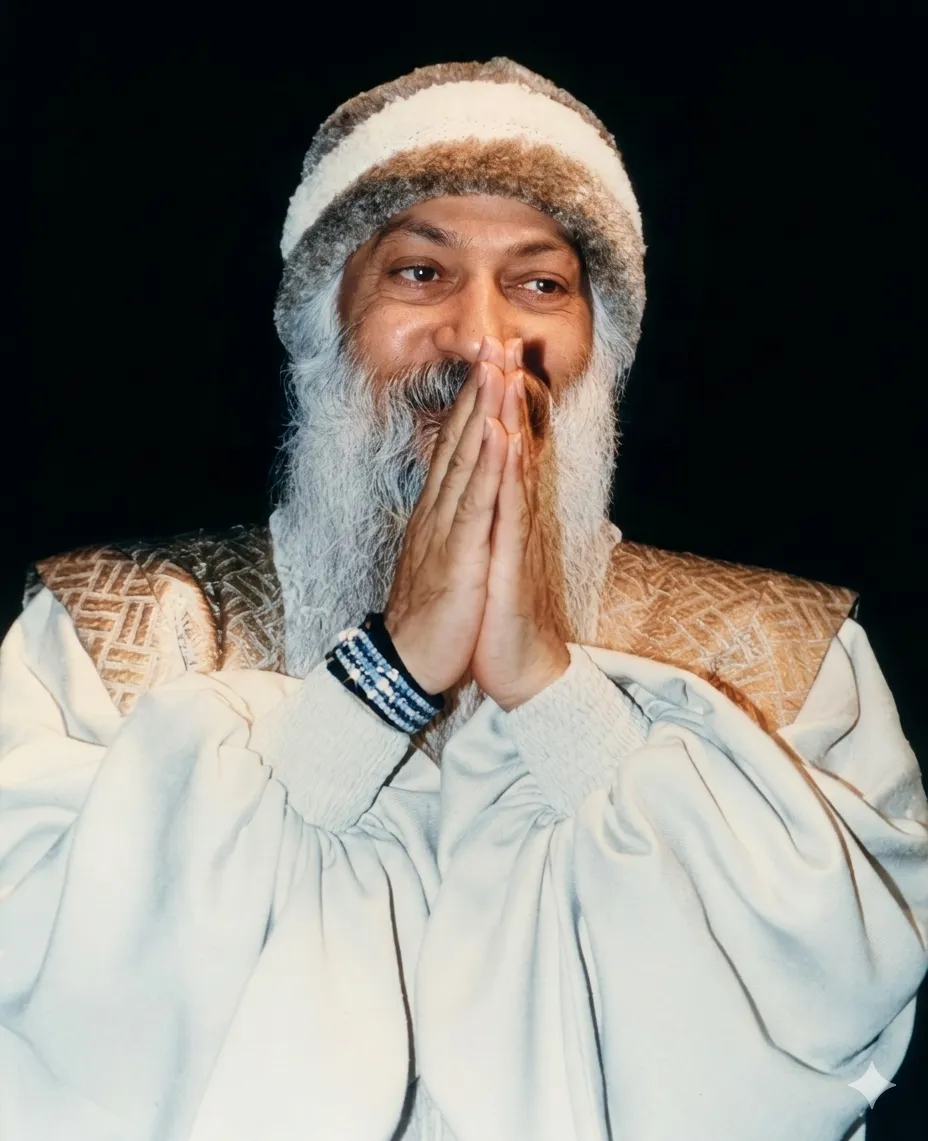
Love is the theme Osho returned to more often than any other: the corpus behind this library holds close to four hundred distinct questions people asked him about it. What he taught rarely matched what people expected to hear. Love, in Osho's vision, is not a relationship to be secured but a state of being to be grown into — closer to meditation than to romance, impossible for the ego to perform, and unteachable except by living it.
Below are the threads that run through his discourses on love, each anchored in an actual passage — with a link into the full discourse it comes from.
Understanding Osho's Vision of Love
The threads that run through his talks on love. The short notes are Osho Live's; the quoted passages are his own words, checked against the talk.
Love Begins With Yourself
Asked about Gurdjieff's advice to practice love on animals first, Osho reframed the whole question: love is not a skill practiced on others but a fullness that starts at home.
Start loving yourself; that has to be the beginning and that is also going to be the end. Then the circle is complete.
Love across the years
When Osho spoke about love: talks where it comes up at least 5 times, counted from 6,627 dated talks on Osho Live.
Where he speaks of it most: Tao Upanishad · Es Dhammo Sanantano · Maha Geeta
| Year | Talks about it | Dated talks that year |
|---|---|---|
| 1964 | 4 | 13 |
| 1965 | 11 | 19 |
| 1966 | 3 | 7 |
| 1967 | 24 | 33 |
| 1968 | 20 | 30 |
| 1969 | 56 | 110 |
| 1970 | 65 | 131 |
| 1971 | 55 | 111 |
| 1972 | 126 | 223 |
| 1973 | 131 | 205 |
| 1974 | 192 | 271 |
| 1975 | 248 | 303 |
| 1976 | 548 | 700 |
| 1977 | 538 | 679 |
| 1978 | 602 | 702 |
| 1979 | 602 | 683 |
| 1980 | 508 | 674 |
| 1981 | 86 | 122 |
| 1984 | 32 | 63 |
| 1985 | 274 | 356 |
| 1986 | 274 | 369 |
| 1987 | 374 | 486 |
| 1988 | 146 | 276 |
| 1989 | 53 | 61 |
More in his words
Why Love Feels Harder Than Hate
One of the sharpest observations in the discourses: love demands the one price the mind refuses to pay.
Love feels more illusory than hate because in love you have to drop the ego, and in hate the ego is strengthened. That's why people love less and hate more. Even the person they love — they find something to hate in him. You hate ninety-nine per cent, and one per cent you love.
Love Depends on the Lover, Not the Loved
Osho repeatedly turned attention away from the object of love back to its source — an escapist cannot love, he said, because there is not yet anyone home to do the loving.
The escapist cannot love because he has not yet been born; he is not yet there. Who will love? ... It does not depend on the one who is loved; it depends on the one who loves.
From Love to Devotion
Where does love lead? In the Bhakti Sutra discourses Osho describes love as the bud of which devotion is the flowering — the same energy, ripened.
The bud and the flower are both one and different. The beginning and the end are joined, and yet apart. A bud can remain a bud; to become a flower is possible, not inevitable. A seed can remain a seed; it could have become a tree.
From the discourses
Passages where Osho speaks on love, each linked to the exact place in the talk.
Should I take it, Osho, that an escapist cannot love and cannot be nonviolent?
Yes, an escapist can neither love nor be nonviolent. But an escapist may appear to love, and he can even put on the costume of nonviolence—and often he will do exactly that. The escapist cannot love because he has not yet been born; he is not yet there. Who will love? As I have said, it does not depend on the one who is loved; it depends on the one who loves. Only one whose individuality has dawned within, whose person has been born, can love. And the person is born out of struggle and challenge, by fighting every day—just as a sculptor chisels a stone. If the stone refuses to be cut and struck, no statue appears; it remains a rough rock. The struggles of life polish the statue within. If we refuse them, we remain stone. If individuality, soul, being, have not yet arisen within, who is there…
शुड आई मीन ओशो, दैट एस्केपिस्ट कैन नॉट लव एण्ड कैन नॉट बी ए नॉन-वायलेंट?
हां, पलायनवादी न तो प्रेम कर सकता है, न अहिंसक हो सकता है। लेकिन पलायनवादी प्रेम करता हुआ दिखाई पड़ सकता है और अहिंसक, अहिंसक पोशाक भी पहन सकता है! और अक्सर वह यही करेगा। पलायनवादी इसलिए प्रेम नहीं कर सकता कि वह पैदा ही नहीं हो पाया, वह है ही नहीं। प्रेम करेगा कौन? जैसा कि मैंने कहा, कि जिसे हम प्रेम करते हैं उस पर निर्भर नहीं है, जो प्रेम करता है, उस पर निर्भर है। तो प्रेम तो वही कर सकता है जिसके व्यक्तित्व का आविर्भाव हो गया है, भीतर इंडिविजुअलिटी आ गई, जिसके भीतर व्यक्ति पैदा हो गया। और व्यक्ति पैदा होता है संघर्ष और चुनौती में रोज लड़ने से। जैसे एक पत्थर पर एक मूर्तिकार छेनी से काटता है। पत्थर इनकार कर दे कटने-पिटने से, फिर मूर्ति पैदा नहीं होती, फिर पत्थर ही रह जाता है अनगढ़।
What really is the difference between a baul, a tantrika, a bhakta, and a sufi? Do they all belong to the path of love? They seem to be intermingled. Please enlighten.
THE boundaries are overlapping. They are all on the path of love, but still there are subtle distinctions. Even with overlapping boundaries they have something special: a Tantrika, a Baul, and a Bhakta. Sufi is not different from Bhakta. Sufi is the Bhakta on the Mohammedan path; Bhakta is the Sufi on the Hindu path. There is no difference between a Bhakta and a Sufi, so we will not discuss that The difference is only of terminology. The Sufis use the Mohammedan terminology, the Bhakta uses the Hindu terminology. The difference is not of any importance; it is just language. But these three: a Baul, a Tantrika and a Bhakta have to be understood. Love has three possibilities: sex, the lowest; love, higher than sex; and prayer, the highest. The Tantrika remains sex-oriented. The Tantrika in fact avoids love, because love will become an entanglement. He remains a pure technician…
Why does love feel more illusory than hate?
Yes it feels so. Love feels more illusory than hate because in love you have to drop the ego, and in hate the ego is strengthened. That's why people love less and hate more. Even the person they love -- they find something to hate in him. You hate ninety-nine per cent, and one per cent you love. And even that one per cent looks dreamlike because when the ego disappears in certain moments, you are not there. When the ego comes back the ego cannot remember exactly what happened, because it was not there; it looks like a dream, as if it never happened, you simply dreamed about it. Ego has no memory of love experience. If you are really in love, for that single moment an ecstasy happens; the ego is not there. Boundaries merge, mingle, meet, disappear into each other. After the experience when the ego is…
Osho, what is the meaning of gurdjieff's saying: "practice love to animals first, because they are more sensitive"?
Don't take it literally, because I know my people are dangerous people! He is talking metaphorically! But George Gurdjieff's statement is not complete; it has to be made complete so you don't misunderstand it. Start loving yourself; that has to be the beginning and that is also going to be the end. Then the circle is complete: you begin by loving yourself, because you are the closest to yourself. Of course, when you begin to love yourself your love is from the circumference towards the center, because you exist on the circumference. You turn in: you stand on the door which connects your inside and the outside. You look inwards -- you are still standing on the circumference -- and you fall in love with your center. This is the beginning. And the end will be that you have reached the center and you stand at the center and look…
Osho, both the love-intoxicated Meera and Socrates, who knew himself, drank poison. “Pivat Meera hansi re!”—drinking, Meera laughed! But Socrates passed away. Why? Kindly explain!
Umashankar Bharati, It only proves this much: even in Meera’s time, things didn’t come pure. The poison was adulterated—hence “Pivat Meera hansi re!” And in Greece, where Socrates was given poison, it was poison indeed. Socrates did not laugh. That wasn’t India. Here, everything is adulterated. Mulla Nasruddin wanted to die. He bought poison, drank it, and lay down to sleep. He kept thinking, “Now I’m dead, now I’m dead…” He opened his eyes again and again—same room, and his wife snoring beside him. What’s the matter? Eleven struck, twelve, one, two. He pinched himself to see whether he was alive or dead. The pinch hurt—clearly alive. He grew very puzzled. Then he felt like urinating. He said, “This is the limit—dead already, and I still need to pee! I thought once I died I’d be rid of all these hassles.” He held it for a while, but couldn’t. He…
दूसरा प्रश्न: ओशो, प्रेम-अनुरागी मीरा तथा स्वयं को जानने वाला सुकरात, दोनों विषपान किए। पीवत मीरा हांसी रे! लेकिन सुकरात का देहावसान हो गया। क्यों? बताने की अनुकंपा करें!
… वह कोई भारत थोड़े ही था। यहां तो हर चीज में मिलावट है। मुल्ला नसरुद्दीन मरना चाहता था। जहर खरीद लाया। पीकर सो गया। सोच रहा है कि अब मर गए, अब मर गए...। आंख खोल-खोल कर देखता है। मगर वही कमरा, वही बगल में पत्नी घर्राटे भर रही है। मामला क्या है? ग्यारह बज गए, बारह बज गए, एक बज गया, दो बज गया। अपने को चिकोटी काट कर भी देखी कि जिंदा हूं कि मर गया! चिकोटी भी काटी तो पता चला कि जिंदा हूं। बड़ी हैरानी मालूम होने लगी। तभी पेशाब भी लगी। उसने कहा कि हद हो गई, मर भी चुके और पेशाब भी लग रही है! …
Osho, is love the parent of devotion, or is devotion the parent of love? Is love the bud and devotion the flower? Or is love the beginning and devotion the end? Or are they different?
The bud and the flower are both one and different. The beginning and the end are joined, and yet apart. A bud can remain a bud; to become a flower is possible, not inevitable. A seed can remain a seed; it could have become a tree, but it is not necessary that it will. The seed is separate—it has its own existence—and it is also the possibility of the tree. But a tree can be only if there is a seed, first. And a tree can be only if the seed disappears, second. First it must be, and then it must die; only then can the tree be. If there is no love, there is no possibility of devotion. And if love remains only love and does not go beyond, then too there is no possibility of devotion. If love stops at love, devotion will never be born. And if…
पहला प्रश्न: ओशो, प्रेम भक्ति का जनक है या भक्ति प्रेम की? प्रेम कली है और भक्ति फूल? अथवा प्रेम आदि है और भक्ति अंत? या दोनों भिन्न हैं?
कली और फूल एक भी हैं और भिन्न भी। आदि और अंत जुड़े भी हैं और अलग भी हैं। कली कली भी रह जा सकती है; फूल बनना संभव है, अनिवार्य नहीं। बीज बीज भी रह जा सकता है; वृक्ष हो सकता था, जरूरी नहीं है कि हो। बीज अलग भी है--उसका अपना भी अस्तित्व है--और वृक्ष की संभावना भी है। लेकिन वृक्ष तभी हो सकेगा जब बीज हो, पहली बात। और वृक्ष तभी हो सकेगा जब बीज मिटे, दूसरी बात। पहले हो, और फिर मिटे भी तो ही वृक्ष हो सकेगा। प्रेम न हो तो भक्ति की कोई संभावना नहीं। और अगर प्रेम ही रह जाए, आगे न जाए, तो भी भक्ति की कोई संभावना नहीं। प्रेम प्रेम पर ठहर जाए तो भक्ति कभी पैदा न होगी। और अगर प्रेम हो ही न तो तो भक्ति के पैदा होने का सवाल ही नहीं है।
When I feel deep love I feel sad at the same time. Why?
A few things more.... The sadness that love brings is very potential, it is very deep, it is very healthy, it is helpful. It will lead you to God. So don't take it negatively, use it. It is a great blessing, that sadness felt in love. It simply shows that your aspiration is beyond the capacity of love, your aspiration is for the ultimate. Love can only give you a momentary satisfaction but not an eternal contentment. Feel grateful that love gave you that one momentary satisfaction and feel grateful that love made you aware of a tremendous sadness inside you. When people are together in love they feel very alone. Nobody else ever feels such aloneness as lovers feel. Can't you remember it? While sitting holding the hand of your beloved on a full moon night, have you not felt it? -- utterly alone. The other is there, you…
Beloved Osho, is there a possibility that the disciple's love for the master will not be the last barrier if love and awareness can grow together?
Prem Shunyo, the possibility is there, but it is one of the most difficult things in existence, to let love and awareness grow together. People find it difficult even to grow one. So ordinarily, people either choose the path of love or the path of awareness. But the possibility cannot be denied, because there is no intrinsic antagonism between awareness and love. In fact, my effort here is exactly for what Shunyo is asking. I want you to grow in your love and in your awareness together -- to be a Zorba and to be a Buddha, together. Zorba is love; Buddha is awareness. It is easier to grow one, but is far more juicy to grow both together. And if both together can be grown, then the master will not be the last barrier, because in love and awareness you will become one with the master. On the path…
Osho, are the deaths of meditation and of love different? Are their processes different as well?
Death is one and the same—whether through meditation or through love. But the processes, the paths, the methods that lead to that death are different. Through meditation, the same thing happens: you disappear. Through love, the same thing happens: you disappear. The dissolving happens in both cases, but the ways are very different. In the first stages of meditation, you do not vanish. At that stage, what is false in you is burned away and what is true is preserved. The inauspicious is removed; the auspicious is kept. Impurity is burned; purity is protected. Thus on the path of knowledge or meditation one begins to be purified. One does not disappear; one becomes refined, yet one remains. In the final leap, the refinement reaches a point where even purity appears impure. Where mere being appears impure, there, in the last jump, the meditator snuffs himself out. The devotee snuffs himself…
आखिरी प्रश्न: ओशो, ध्यान की मृत्यु और प्रेम की मृत्यु क्या भिन्न हैं? क्या उनकी प्रक्रियाएं भी भिन्न हैं?
मृत्यु तो एक ही है; ध्यान की हो कि प्रेम की। लेकिन प्रक्रियाएं, उस मृत्यु तक पहुंचने के मार्ग, विधियां भिन्न-भिन्न हैं। ध्यान से भी यही घटता है कि तुम मिट जाते हो। प्रेम से भी यही घटता है कि तुम मिट जाते हो। मिटना तो दोनों हालत में होता है, लेकिन दोनों के मार्ग बड़े अलग-अलग हैं। ध्यान के पहले चरण पर तुम नहीं मिटते। ध्यान के पहले चरण पर तो तुममें जो गलत है उसको मिटाया जाता है, सही को बचाया जाता है। अशुभ को मिटाया जाता है, शुभ को बचाया जाता है। अशुद्धि जलाई जाती है, शुद्धि बचाई जाती है। तो ज्ञान के मार्ग पर या ध्यान के मार्ग पर व्यक्ति शुद्ध होने लगता है। मिटता नहीं, परिशुद्ध होता है, लेकिन बचता है। आखिरी छलांग में परिशुद्धि ऐसी जगह आ जाती है, जहां कि शुद्धता भी अशुद्धि मालूम होने लगती है। …
Question: Last question: Osho, is love the most important event of life? Love is the most important event—and yet love is not an event. Love is life; all else is death. The one who has known love has known life. The one who has not known love has known only dying. His life is nothing but a long suicide—done slowly, slowly. He dies a little every day and does nothing else. Love is not an incident that happens in life—love is life’s very other name. And the day this understanding dawns in you, that love is another name for life, the Divine begins to dance within you. The skies give birth no more; for years no mad lover arises. For years no prophet rises out of the wilderness. Love is lost; therefore no prophet can be born. Love is lost; therefore even a true madman is no longer born.
प्रेम सर्वाधिक महत्वपूर्ण घटना है, मगर प्रेम कोई घटना नहीं है। प्रेम ही जीवन है, शेष सब मृत्यु है। जिसने प्रेम जाना उसने जीवन जाना। जिसने प्रेम नहीं जाना उसने सिर्फ मरना जाना। उसका जीवन सिर्फ एक लंबा आत्मघात है--आहिस्ता-आहिस्ता किया गया। वह रोज-रोज मरता है, और कुछ भी नहीं करता। प्रेम कोई घटना नहीं है जो जीवन में घटती है--प्रेम जीवन का ही दूसरा नाम है। और जिस दिन तुम्हारे भीतर यह बोध आ जाता है कि प्रेम जीवन का दूसरा नाम है, तुम्हारे भीतर परमात्मा नाचने लगता है।
Osho, Meera’s path was the path of love, but there was a gap of five thousand years between Krishna and Meera. How, then, could this love come to be? Please explain.
For love there is no distance of time and none of space. Love is the one alchemy that dissolves both time and space. With one you do not love, even if he sits right beside you, body touching body, you are thousands of miles apart. And the one you love—though seated far away among the moon and stars—is forever by your side. Love is the one experience in life where time and space both become futile. Love is the only experience that trusts neither the distance of space nor the distance of time; it erases them both. In the definition of the divine it is said: he is beyond time and space, timeless. Jesus has said, “Love is God”—for this very reason. In human experience only love is timeless and spaceless; through that alone a connection with the divine is possible. So it makes no difference that Krishna lived five…
चौथा प्रश्न: ओशो, मीरा का मार्ग था प्रेम का, पर कृष्ण और मीरा के बीच अंतर था पांच हजार साल का। फिर यह प्रेम किस प्रकार बन सका? कृपया समझाएं।
प्रेम के लिए न तो समय का कोई अंतर है और न स्थान का। प्रेम एकमात्र कीमिया है, जो समय को और स्थान को मिटा देती है। जिससे तुम्हें प्रेम नहीं है वह तुम्हारे पास बैठा रहे, शरीर से शरीर छूता हो, तो भी तुम हजारों मील के फासले पर हो। और जिससे तुम्हारा प्रेम है वह दूर चांद-तारों पर बैठा हो, तो भी सदा तुम्हारे पास बैठा है। प्रेम एकमात्र जीवन का अनुभव है जहां टाइम और स्पेस, समय और स्थान दोनों व्यर्थ हो जाते हैं। प्रेम एकमात्र ऐसा अनुभव है जो स्थान की दूरी में भरोसा नहीं करता और न काल की दूरी में भरोसा करता है, जो दोनों को मिटा देता है। परमात्मा की परिभाषा में कहा जाता है कि वह काल और स्थान के पार है, कालातीत। जीसस ने कहा है कि प्रेम परमात्मा है--इसी कारण। क्योंकि मनुष्य के अनुभव में अकेला प्रेम ही है जो कालातीत और स्थानातीत है। उससे ही परमात्मा का जोड़ बैठ सकता है।
Osho, you speak of unconditional love. Then why does Mahavira lay down conditions?
I say that love is always unconditional. Love is always unconditional, because wherever there is a condition, there is a bargain. Wherever we say, “I will love when such-and-such happens”—when I say, “I will love you if you do this, or become like that, or turn into this,” then I am binding love with a condition, and in doing so, I am losing love. The conditions Mahavira speaks of are not in relation to love. Mahavira does not say, “If the world does this, then I will love; if the world gives me food, then I will love.” No—that is not the point at all; it is not a matter of love. Mahavira is saying, “If the world has love for me, if existence has love for me, how am I to know it? How am I to know that this whole existence wants to preserve me, considers me useful,…
प्रश्न: ओशो, आप बेशर्त प्रेम कहते हैं। तो फिर महावीर शर्त क्यों लगाते हैं?
मैं कहता हूं कि प्रेम सदा बेशर्त है। प्रेम सदा बेशर्त है, क्योंकि जहां शर्त है, वहां सौदा है। जहां हम कहते हैं कि मैं तब प्रेम करूंगा, जब ऐसा हो। जब मैं कहता हूं कि मैं प्रेम करूंगा, जब तुम ऐसा करो या ऐसे हो जाओ, या ऐसे बनो, तब मैं तुम्हें प्रेम करूंगा, ऐसा आदमी प्रेम को शर्त से बांध रहा है और ऐसा आदमी प्रेम को खो रहा है। महावीर की जिन शर्तों की बात की है, वे प्रेम के संबंध में नहीं हैं। महावीर यह नहीं कहते कि जगत ऐसा करे तो मैं प्रेम करूंगा, जगत मुझे भोजन दे तो मैं प्रेम करूंगा। नहीं, यह बात ही नहीं है, प्रेम का मामला ही नहीं है। महावीर तो यह कहते हैं कि अगर जगत को मेरे प्रति प्रेम हो, अगर अस्तित्व को मेरे प्रति प्रेम हो तो मुझे कैसे पता चले? मैं कैसे जानूं कि यह सारा अस्तित्व मुझे बचाना चाह रहा है और उपयोगी मान रहा है और समझ रहा है कि मैं जीऊं एक क्षण और तो इसके लिए फायदा हो जाए? यह मुझे कैसे पता चले? इसे मैं कैसे जानूं? …
Questions put to Osho about love
Each opens the talk at the moment the question was asked.
- Should I take it, Osho, that an escapist cannot love and cannot be nonviolent? Shiksha Main Kranti · Discourse 17
- What really is the difference between a baul, a tantrika, a bhakta, and a sufi? Do they all belong to the path of love? They seem to be intermingled. Please enlighten. The Beloved Vol 2 · Discourse 2 · 1976-07-02
- Why does love feel more illusory than hate? Tao The Three Treasures Vol 3 · Discourse 8 · 1975-08-18
- Osho, what is the meaning of gurdjieff's saying: "practice love to animals first, because they are more sensitive"? The Wild Geese And The Water · Discourse 3 · 1981-02-13
- Osho, both the love-intoxicated Meera and Socrates, who knew himself, drank poison. “Pivat Meera hansi re!”—drinking, Meera laughed! But Socrates passed away. Why? Kindly explain! Preetam Chhabi Nainan Basee · Discourse 13 · 1980-03-23
- Osho, is love the parent of devotion, or is devotion the parent of love? Is love the bud and devotion the flower? Or is love the beginning and devotion the end? Or are they different? Bhakti Sutra · Discourse 8 · 1976-01-18
- When I feel deep love I feel sad at the same time. Why? Sufis The People Of The Path Vol 1 · Discourse 4 · 1977-08-14
- Beloved Osho, is there a possibility that the disciple's love for the master will not be the last barrier if love and awareness can grow together? The Razor S Edge · Discourse 23 · 1987-03-08
- Osho, are the deaths of meditation and of love different? Are their processes different as well? Jin Sutra · Discourse 59 · 1976-08-06
- Osho, Meera’s path was the path of love, but there was a gap of five thousand years between Krishna and Meera. How, then, could this love come to be? Please explain. Es Dhammo Sanantano · Discourse 8 · 1975-11-28
- Osho, you speak of unconditional love. Then why does Mahavira lay down conditions? Mahaveer Meri Drishti Mein · Discourse 15 · 1969-09-25
Frequently asked
Short answers by Osho Live, based on the passages above.
What did Osho say love actually is?
Osho taught that love is a state of being rather than a relationship — an overflow of inner fullness, not a need seeking satisfaction. In his framing, love and meditation are two doors to the same room: meditation empties you of the ego, and love is what naturally pours out of that emptiness.
Can love be taught or learned?
No — Osho was explicit that love cannot be taught, because it is not information or technique. What can be done is to remove the obstacles: fear, possessiveness, and the ego's bargaining. When those drop, love arises on its own, the way health returns when illness is treated.
What is the difference between love and attachment in Osho's teaching?
Attachment clings to the other for security and turns love into a contract; it is fear wearing love's face. Real love, for Osho, gives freedom — it wants the beloved to grow even away from oneself. His test was simple: if it makes you and the other more free, it is love; if it makes you both smaller and afraid, it is attachment.