
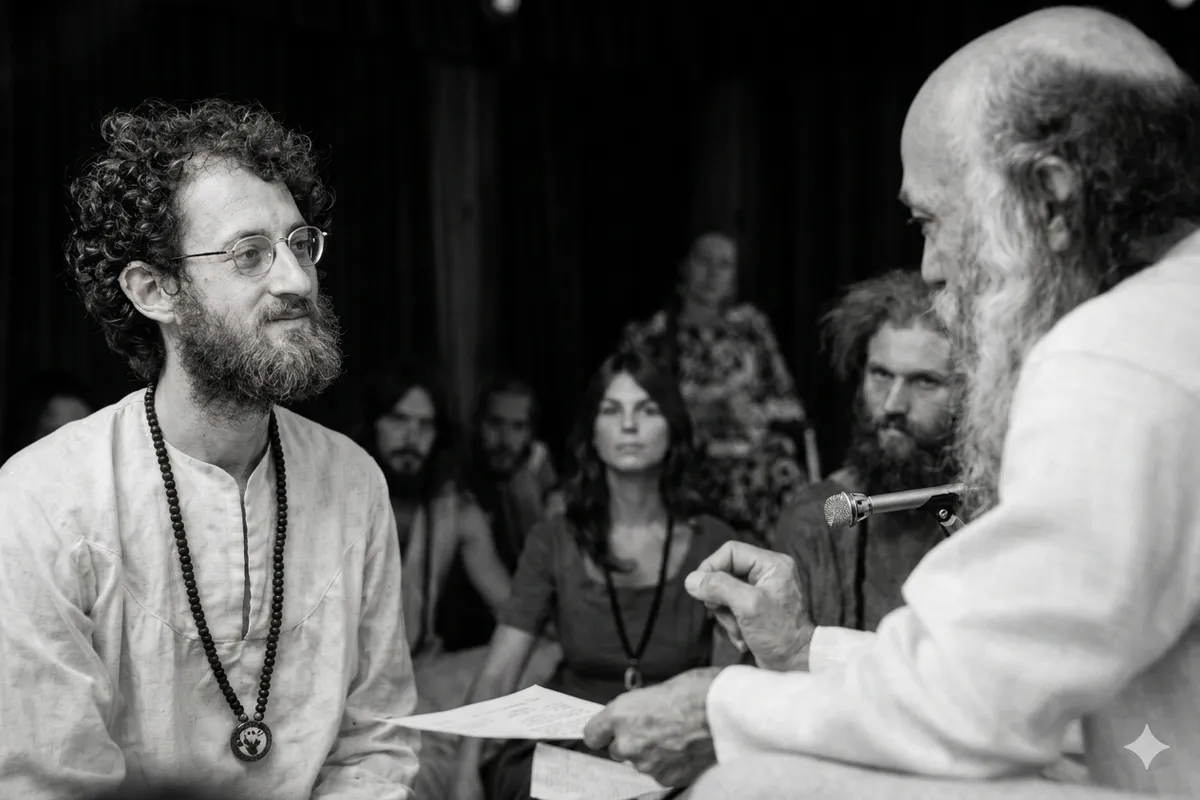
When Osho began initiating people into 'neo-sannyas' in 1970, he took an ancient Indian word for renunciation and deliberately reversed its meaning. His sannyasin does not leave family, work, or the marketplace; nothing is taken away and something is added — a quality of meditativeness, a declared commitment to inner search. The ochre robes and the mala were symbols of love and remembrance, not membership in an ascetic order.
The corpus holds close to three hundred questions people asked him about sannyas — whether to take it, what it demands, what it means. These four passages carry the heart of his answer, each linked to its full discourse.
Understanding Osho's Vision of Sannyas
The threads that run through his talks on sannyas. The short notes are Osho Live's; the quoted passages are his own words, checked against the talk.
Nothing Is Taken Away
To a seventy-five-year-old hesitating at the threshold, Osho distinguished his sannyas from the old renunciation in a single stroke: it subtracts nothing and adds a fragrance.
I am not telling you to leave anything. You will be the same, in the same world; everything will be the same. Just deep down, at the center of your being, a new quality will be added. I don't take anything from you, I give something to you. I make you more, not less. A quality of meditativeness will be added to you, a subtle fragrance of prayer will be added to you.
Sannyas across the years
When Osho spoke about sannyas: talks where it comes up at least 5 times, counted from 6,627 dated talks on Osho Live.
Where he speaks of it most: Es Dhammo Sanantano · Maha Geeta · Don't Let Yourself Be Upset by the Sutra, rather Upset the Sutra Yourself
| Year | Talks about it | Dated talks that year |
|---|---|---|
| 1964 | 2 | 13 |
| 1965 | 2 | 19 |
| 1966 | 0 | 7 |
| 1967 | 3 | 33 |
| 1968 | 2 | 30 |
| 1969 | 17 | 110 |
| 1970 | 30 | 131 |
| 1971 | 18 | 111 |
| 1972 | 22 | 223 |
| 1973 | 21 | 205 |
| 1974 | 53 | 271 |
| 1975 | 63 | 303 |
| 1976 | 290 | 700 |
| 1977 | 320 | 679 |
| 1978 | 343 | 702 |
| 1979 | 321 | 683 |
| 1980 | 399 | 674 |
| 1981 | 60 | 122 |
| 1984 | 9 | 63 |
| 1985 | 162 | 356 |
| 1986 | 95 | 369 |
| 1987 | 57 | 486 |
| 1988 | 19 | 276 |
| 1989 | 14 | 61 |
More in his words
A Lotus in the Marketplace
Osho admitted openly that his sannyas is harder than the old renunciation — because he refuses to let the seeker escape the world that tests him.
I am putting you in a very paradoxical arrangement: making you a sannyasin and not separating you from the home. You will sit at your shop in ochre robes—it will be a great awkwardness. In ochre you can sit in the forest—there is no trouble then. At a shop you do not sit in ochre—there is no trouble then. I am creating a contradiction in your life. I am saying: live in water and be like a lotus. The rose has no such difficulty; it doesn’t live in water. The lotus has the difficulty—to be in water and untouched by water. To be in the marketplace and untouched by the market.
Celebration Is Our Caste
Asked how sannyasins should introduce themselves, Osho compressed the whole spirit of neo-sannyas into two lines.
Celebration is our caste; bliss is our lineage! That is our brief introduction. But it is enough. In it are contained all the Upanishads, all the Bhagavad Gitas, the Bible, the Quran, the Dhammapada. In it are contained all the songs of the buddhas. In it are contained all the celebrations of the awakened ones.
The Journey Itself
What is the difference between a seeker and a sannyasin? None, Osho answered — sannyas is the name of the whole journey from the first step to its completion.
Without becoming a sannyasin, no one can be a seeker. “Seeker” means the beginning of sannyas. In fact, being a seeker means to practice sannyas. Sannyas is sadhana—what else will a seeker do? One has to: - go, in the world, gradually beyond all pleasures and pains and attain bliss; - go beyond the doer (karta) and realize the witness (sakshi); - go beyond the ego and realize the void (shunya); - go beyond matter and realize the Supreme (Paramatman). The collective name for all this is sannyas. “Seeker” means sannyas has begun; “siddha” means sannyas is complete. Between the two lies the journey—the journey of sannyas.
From the discourses
Passages where Osho speaks on sannyas, each linked to the exact place in the talk.
Osho, what is the difference between a seeker (sadhak) and a sannyasin? And can someone be a seeker without becoming a sannyasin?
Without becoming a sannyasin, no one can be a seeker. “Seeker” means the beginning of sannyas. In fact, being a seeker means to practice sannyas. Sannyas is sadhana—what else will a seeker do? One has to: - go, in the world, gradually beyond all pleasures and pains and attain bliss; - go beyond the doer (karta) and realize the witness (sakshi); - go beyond the ego and realize the void (shunya); - go beyond matter and realize the Supreme (Paramatman). The collective name for all this is sannyas. “Seeker” means sannyas has begun; “siddha” means sannyas is complete. Between the two lies the journey—the journey of sannyas. It is for sannyas that there is sadhana. So the very meaning of “seeker” is that he has set out in search of sannyas. But keep in mind what I mean by sannyas: my sannyas is of attainment, of gaining—each day the Vast,…
ओशो, साधक और संन्यासी में क्या फर्क है? और क्या बिना संन्यासी हुए कोई साधक नहीं हो सकता?
संन्यासी हुए बिना तो कोई साधक नहीं हो सकता। साधक का मतलब संन्यास की शुरुआत है। असल में साधक का मतलब संन्यास को साधना है। संन्यास साधना है, और क्या साधक करेगा? उसे जगत में धीरे-धीरे समस्त सुख-दुखों के पार होकर आनंद को उपलब्ध होना है, उसे कर्ता के पार होकर साक्षी को उपलब्ध होना है, उसे अहंकार के पार होकर शून्य को उपलब्ध होना है, उसे पदार्थ के पार होकर परमात्मा को उपलब्ध होना है। इन सबका इकट्ठा नाम संन्यास है। साधक का मतलब है, संन्यास शुरू कर रहा है वह। सिद्ध का मतलब है, संन्यास पूरा हो गया। साधक का मतलब है, संन्यास शुरू हुआ; सिद्ध का मतलब है, संन्यास पूरा हो गया। दोनों के बीच में जो यात्रा है वह संन्यास की यात्रा है। संन्यास के लिए ही तो साधना है। …
Osho, how should we introduce ourselves as sannyasins?
Celebration is our caste; bliss is our lineage! That is our brief introduction. But it is enough. In it are contained all the Upanishads, all the Bhagavad Gitas, the Bible, the Quran, the Dhammapada. In it are contained all the songs of the buddhas. In it are contained all the celebrations of the awakened ones. Celebration is our caste; bliss is our lineage! That is all for today.
ओशो, हम संन्यासियों का परिचय क्या?
उत्सव आमार जाति, आनंद आमार गोत्र! बस इतना ही छोटा सा परिचय। पर इतना काफी है। इसमें आ गए सब उपनिषद, आ गईं सब भगवद्गीताएं, आ गई बाइबिल, आ गया कुरान, आ गया धम्मपद। इसमें आ गए सब बुद्धों के गीत। इसमें आ गए सब जाग्रत पुरुषों के उत्सव। उत्सव आमार जाति, आनंद आमार गोत्र! आज इतना ही।
You have told many times why you call your male sannyasins "swami." can you explain why the women sannyasins are called "ma"?
The path of the masculine is that of awareness, and awareness brings you to a point where you become master of your own being. That is the meaning of SWAMI. The feminine path is that of love, and love brings you to an ultimate point where you can mother the whole existence. And that is the meaning of MA. A woman in her ultimate flowering becomes a mothering energy... she can mother the whole existence. She feels blessed, and she can bless the whole existence. When a man arrives at the ultimate point he does not become a father, he does not become a mother, he simply becomes a master: master of his own being. Love and awareness -- these are two paths. And when I say masculine I don't mean that all males are masculine, and when I say feminine I don't mean that all females are feminine. There…
Osho, is sannyas in my destiny or not?
No, sannyas has nothing to do with fate. But it seems you want to hide behind fate. You think, “If it is in my destiny, it will happen by itself; and if it isn’t, it won’t.” You want to avoid the issue. It will happen by your choosing it, not by destiny. Destiny is your excuse, your trick, your cover. Don’t deceive yourself. If you don’t want to take sannyas, don’t take it—but know that it is not a matter of fate; it isn’t written. Sannyas means going beyond fate, beyond predetermination, beyond the readymade. “To complain of destiny is meaningless—you simply do not consent to live. That you could not shape your own fate—no one is that helpless.” This gathering is of the lovers of the heart; here we are all drinkers, we are all cupbearers. To go seeking diversion among mere humans is not the custom of this…
ओशो, संन्यास मेरे भाग्य में है या नहीं?
नहीं, संन्यास का भाग्य से कोई संबंध नहीं है। लेकिन लगता यह है कि तुम भाग्य की आड़ लेना चाहते होओगे। तुम सोचते होओगे, भाग्य में होगा तो अपने से होगा। और नहीं होगा भाग्य में तो नहीं होगा। बचना चाह रहे हो। यह तुम्हारे लेने से होगा, भाग्य से नहीं होगा। यह भाग्य तुम्हारा बहाना है, यह तुम्हारी तरकीब है, यह तुम्हारी आड़ है। धोखा मत दो अपने को। संन्यास नहीं लेना है, मत लो। मगर जान कर कि यह कोई भाग्य की बात नहीं है, यह लिखा हुआ नहीं है। संन्यास का अर्थ ही है भाग्य के पार जाना, नियति के पार जाना, बंधे-बंधाए के पार जाना।
Osho, you have said that sannyas is the realization of truth. Then are ochre robes and the mala also essential for sannyas? And can a person not walk on your path without initiation? Kindly guide.
The day before yesterday a friend asked—he has taken sannyas, a simple-hearted man—he asked, “What is the scientific reason for this mala?” How can a mala possibly have a scientific reason? Its reason is religious, inward—not scientific. I told him, “If you want something ‘scientific,’ ask Laxmi.” A scientific reason? Does love ever have a scientific reason? A young man fell in love with Mulla Nasruddin’s daughter. He came and said, “I am in love with your daughter; please permit me to marry her.” Mulla said, “First prove it—what is the cause of your love?” The young man replied, “There is no cause, sir! Love has happened. Where there is a cause, can there be love? Where there is a cause, there is business, a bargain. Love is causeless.” Your love has happened with me; mine with you. Now some symbol becomes necessary. Think of this mala as the seven…
ओशो, आपने कहा कि संन्यास सत्य का बोध है। फिर क्या संन्यास के लिए गैरिक वस्त्र और माला भी अनिवार्य हैं? और क्या कोई व्यक्ति बिना दीक्षा लिए आपके बताए मार्ग पर नहीं चल सकता है? कृपाकर मार्ग-दर्शन करें।
परसों एक मित्र पूछते थे--संन्यास उन्होंने लिया, भाव वाले व्यक्ति हैं। सरलचित्त हैं--पूछने लगे, इस माला का वैज्ञानिक कारण क्या है? वैज्ञानिक कारण माला का हो ही कैसे सकता है? वैज्ञानिक कारण--और माला का! कोई भी कारण वैज्ञानिक नहीं हो सकता माला का--कारण धार्मिक है। कारण आत्मिक है, वैज्ञानिक नहीं है। तो मैंने उनसे कहा, वैज्ञानिक पूछना हो तो ‘लक्ष्मी’ से पूछ लेना। वैज्ञानिक कारण? प्रेम का कहीं कोई वैज्ञानिक कारण होता? मुल्ला नसरुद्दीन की लड़की के प्रेम में एक युवक पड़ गया। वह आया, उसने मुल्ला को कहा कि आपकी लड़की से मुझे प्रेम हो गया है, मुझे विवाह की आज्ञा दें। मुल्ला ने कहा, पहले सिद्ध करो, प्रेम का कारण क्या है? …
Questioner: what is the meaning of wearing orange clothes as a sannyasin?
It is not accidental that a book on sexology like the KAMASUTRA was not written in a country with a cold climate. It is the same with TALES OF THE ARABIAN NIGHTS; it is the product of a tropical climate. People living in tropical climates are more sexual because of the sun. Therefore people who were working on sannyas from many directions thought that sexuality could be calmed if the red color were kept away from sannyasins' bodies -- hence ochre was selected. You can ask why ochre was selected and not red. Pure red could well have been selected; it would have been more effective in calming sexuality. But there was a difficulty in choosing red, true out-and-out red; it would have totally prevented red from entering the body. But the body needs some amount of red rays to keep fit, so it would have been bad for the…
Osho, I want to take sannyas. Am I worthy, and has the auspicious moment arrived?
And because I don’t tell you to leave your home, there is an added difficulty. Mahavira did not give his people as much trouble as I am giving you. Buddha did not give as much trouble. I am putting you in a very paradoxical arrangement: making you a sannyasin and not separating you from the home. You will sit at your shop in ochre robes—it will be a great awkwardness. In ochre you can sit in the forest—there is no trouble then. At a shop you do not sit in ochre—there is no trouble then. I am creating a contradiction in your life. I am saying: live in water and be like a lotus. The rose has no such difficulty; it doesn’t live in water. The lotus has the difficulty—to be in water and untouched by water. To be in the marketplace and untouched by the market. To be in…
छठवां प्रश्न: ओशो, मैं संन्यास लेना चाहता हूं। क्या मैं पात्र हूं और क्या वह शुभ मुहूर्त आ गया है?
और फिर चूंकि मैं तुमसे घर छोड़ने को नहीं कहता, इसलिए मुसीबत और है। महावीर ने इतनी मुसीबत नहीं दी थी अपने लोगों को, जितनी मैं तुम्हें दे रहा हूं। बुद्ध ने इतनी मुसीबत नहीं दी थी। मैं तुम्हें एक बहुत ही बिगूचन की व्यवस्था में डाल रहा हूं। संन्यासी बना रहा हूं और घर से अलग नहीं कर रहा हूं। दुकान पर बैठोगे, गैरिक वस्त्रों में, बड़ी अड़चन होगी। गैरिक वस्त्रों में जंगल में बैठा जाता है, तब कोई अड़चन नहीं होती। और दुकान पर बैठना हो तो गैरिक वस्त्रों में नहीं बैठा जाता है, तब कोई अड़चन नहीं होती। मैं तुम्हारे जीवन में एक विरोधाभास पैदा कर रहा हूं। मैं तुमसे कह रहा हूं: जल में रहना और कमल की तरह रहना। गुलाब को इतनी अड़चन नहीं होती, वह जल में नहीं रहता। कमल को अड़चन होती है--पानी में और पानी न छुए। बाजार में रहना और बाजार न छुए। …
Osho, I am getting on seventy-.five, yet I hesitate to take sannyas. Why?
Why should you hesitate? The old sannyas certainly gives hesitation. In fact, no intelligent person would go into the old way, because it.is so against nature, against life; only stupid people can be victims of it. Hesitation is perfectly right if you are thinking to become an old Indian sannyasin. Then hesitation is perfectly right; that simply shows intelligence. But if you are hesitating to become MY sannyasin, that simply shows indecisiveness, not intelligence, because I am not telling you to leave anything. You will be the same, in the same world; everything will be the same. Just deep down, at the center of your being, a new quality will be added. I don't take anything from you, I give something to you. I make you more, not less. A quality of meditativeness will be added to you, a subtle fragrance of prayer will be added to you. You will…
Osho, I have heard that initiation into sannyas is not given to the unworthy. Why is that? Are the unworthy not deserving of the satguru’s compassion?
The unworthy is just the opposite. If the divine comes, he thinks, “All right, he came—as was my due. He had to come; if he hadn’t, I would have shown him.” “He has to come; it is my right; it is my entitlement.” If he does not come, the unworthy becomes upset: “This is great injustice. There is injustice in the world—some get it, some don’t; there is partiality, favoritism, nepotism.” The unworthy has his own language. The worthy too has a language. When the divine comes, the worthy says—“Prasad.” “I had no qualifications at all, and yet you came!” This is the language of the worthy—understand it; it is a very paradoxical language. The worthy says, “I was unworthy, and you came! I had no merit to even ask; there was no basis from which to demand—only your compassion, your love, your mercy. You are Rahim, you are Rahman,…
Is sannyas taken only by those who have become aware of the futility of life?
And who else would? Sannyas is not a pastime. Sannyas is not a child’s game. Those who have become aware of life’s futility, who have seen that no matter how much you run you arrive nowhere; no matter how much you accumulate, in the end all gaining turns out to be losing. Those who have seen that the drums sound sweet from afar but, when you come close, everything turns hollow; those who have recognized life’s mirage—only they become sannyasins. What does sannyas mean? Awareness of the futility of the world is sannyas. You ask quite an extraordinary question: “Is sannyas taken only by those who have become aware of the futility of life?” Those who still have hope in life—why would they take it! It’s a straightforward matter. A mechanic had been repairing the clock in a clock-tower for a long time. When he had finished, he climbed down…
चौथा प्रश्न: संन्यास क्या वे ही लोग लेते हैं जिन्हें जीवन की व्यर्थता का बोध हो गया?
और कौन लेगा? संन्यास कोई खिलवाड़ तो नहीं। संन्यास कोई बच्चों का खेल तो नहीं। जिन्हें जीवन की व्यर्थता का बोध हो गया है, जिन्हें यह बात दिखायी पड़ गयी कि जीवन में दौड़ो कितना ही, पहुंचोगे कहीं भी नहीं; कमाओ कितना ही, अंततः सब कमाना गंवाना सिद्ध होगा। जिन्हें यह दिख गया है कि यहां दूर के ढोल सुहावने हैं, पास आने पर सब व्यर्थ हो जाते हैं; जिन्हें जीवन की मृगमरीचिका का बोध हो गया है, वे ही तो संन्यासी होते हैं। संन्यास का अर्थ ही क्या है? संसार की व्यर्थता का बोध ही संन्यास है। तुम भी खूब अदभुत प्रश्न पूछ रहे हो, ‘संन्यास क्या वे ही लोग लेते हैं जिन्हें जीवन की व्यर्थता का बोध हो गया है?’ जिनको अभी जीवन में आशा है, वे तो लेंगे क्यों! यह तो सीधी-सीधी बात है।
Osho, I want to take sannyas, but can one take sannyas without taking permission from the family?
Sannyas—whose permission will you take? Are those from whom you’ll ask permission themselves sannyasins? If they could bless your sannyas with such joy, they would have become sannyasins already. Would they have waited until now? How will you ask their leave? And how will it be granted? Even for sannyas you will seek permission from the household? Then will you ever do anything that is truly yours? Or will you go on forever obeying others’ orders? Let there be at least something in life that is yours—utterly yours. Do not reduce sannyas to someone else’s command. Let it remain a movement of your own heart. If the wave has arisen, dive in. And don’t be afraid. Families come around. Even if you die, they reconcile. Then what is sannyas in comparison? Do you think if you die, they will weep for you forever? And my sannyas does not snatch you…
ओशो, मैं संन्यास लेना चाहता हूं, लेकिन क्या घर के लोगों की बिना आज्ञा लिए संन्यास लिया जा सकता है?
संन्यास को तो किसी की आज्ञा मत बनाओ। इसे तो तुम्हारे ही हृदय का भाव रहने दो। आ गई हो मौज, तो उतर जाना। और घबड़ाना मत। घर के लोग राजी हो जाते हैं। मर भी जाओगे तो भी राजी हो जाते हैं। तो संन्यास में तो क्या रखा है? अगर मर भी जाओगे तो क्या तुम समझते हो, घर के लोग सदा रोते रहेंगे तुम्हारे लिए?
Osho, is sannyas a human possibility or an ultimate destiny? Please tell us.
Those great knowers said “it will happen, it is going to happen” and emphasized it strongly to wake you from sleep: if it is going to happen anyway, then let it happen now. Why delay? Why postpone it till tomorrow? If it is going to happen tomorrow, let it happen today. Why suffer till tomorrow? Why endure anguish till tomorrow? Let it be today. Accept it today. If it is going to be anyway, why erect obstacles? All your obstacles will break and the event will occur. The wise said: do not create obstacles—that was their purpose when they said sannyas is destiny. And they also said it so that, if you understand destiny, you will be freed from the past. The moment you see that someone abused you yesterday and that it was bound to happen, then the abuser bears no responsibility. It had to be. That abuse was…
पहला प्रश्न: ओशो, संन्यास मनुष्य की संभावना है या कि आत्यंतिक नियति? कृपा करके कहिए।
उन महाज्ञानियों ने इसलिए कहा था कि होकर रहेगा, होने ही वाला है। यह इतना जोर इसलिए था ताकि तुम उठ आओ नींद से कि जो होने ही वाला है फिर उसे हो ही जाने दो। फिर देर क्यों? फिर कल के लिए क्यों टालना? जो कल होने वाला है, आज हो जाए। फिर कल तक क्यों दुख पाना। फिर कल तक क्यों संताप झेलना? फिर आज ही हो जाने दें। फिर आज ही उसे स्वीकार कर लें। होगा ही तो फिर हम बाधाएं क्यों खड़ी करें? हमारी बाधाएं तो सब टूट जाएंगी और घटना घटेगी। ज्ञानियों ने कहा था कि तुम बाधा मत खड़ी करना--यह प्रयोजन था जब उन्होंने कहा कि संन्यास नियति है। और ज्ञानियों ने इसलिए कहा था कि अगर तुम्हें नियति की समझ आ जाए तो तुम अतीत से मुक्त हो जाओ। जैसे ही तुम्हें यह समझ में आ जाता है कि कल किसीने गाली दी, वह होने ही वाली ही थी तो गाली देने वाले का कोई दायित्व नहीं रहा। होना ही था। यह गाली तुम्हें मिलनी ही थी। यह तुम्हारा भाग्य था। तो तुम्हारे मन में वैमनस्य नहीं उठता, क्रोध नहीं उठता, प्रतिशोध नहीं उठता क्योंकि जो होना था, हुआ। …
Questions put to Osho about sannyas
Each opens the talk at the moment the question was asked.
- Osho, what is the difference between a seeker (sadhak) and a sannyasin? And can someone be a seeker without becoming a sannyasin? Krishna Smriti · Discourse 22 · 1970-09-28
- Osho, how should we introduce ourselves as sannyasins? Utsav Amar Jati Anand Amar Gotar · Discourse 1 · 1979-06-01
- You have told many times why you call your male sannyasins "swami." can you explain why the women sannyasins are called "ma"? The Divine Melody · Discourse 6 · 1977-01-06
- Osho, is sannyas in my destiny or not? Santo Magan Bhaya Man Mera · Discourse 12 · 1978-05-23
- Osho, you have said that sannyas is the realization of truth. Then are ochre robes and the mala also essential for sannyas? And can a person not walk on your path without initiation?... Jin Sutra · Discourse 33 · 1976-07-11
- Questioner: what is the meaning of wearing orange clothes as a sannyasin? Krishna The Man And His Philosophy · Discourse 22 · 1970-09-28
- Osho, I want to take sannyas. Am I worthy, and has the auspicious moment arrived? Athato Bhakti Jigyasa · Discourse 18 · 1978-01-28
- Osho, I am getting on seventy-.five, yet I hesitate to take sannyas. Why? The Guest · Discourse 12 · 1979-05-07
- Osho, I have heard that initiation into sannyas is not given to the unworthy. Why is that? Are the unworthy not deserving of the satguru’s compassion? Es Dhammo Sanantano · Discourse 101 · 1977-11-21
- Is sannyas taken only by those who have become aware of the futility of life? Es Dhammo Sanantano · Discourse 66 · 1977-03-26
- Osho, I want to take sannyas, but can one take sannyas without taking permission from the family? Nahin Sanjh Nahin Bhor · Discourse 10 · 1977-09-20
- Osho, is sannyas a human possibility or an ultimate destiny? Please tell us. Kano Suni So Juth Sab · Discourse 10 · 1977-07-20
Frequently asked
Short answers by Osho Live, based on the passages above.
How is Osho's neo-sannyas different from traditional sannyas?
Traditional sannyas renounces the world — home, family, possessions. Osho's sannyas renounces only the unconsciousness with which the world is lived. His sannyasins stay in their jobs and marriages; the revolution demanded is inner: meditation, awareness, and a life of celebration rather than austerity.
Why did Osho's sannyasins wear orange and a mala?
As symbols, not credentials. For Osho the mala and the color were a gesture of love between master and disciple and a public declaration that one has staked oneself on the inner search. In later years he dropped even these requirements.
Did taking sannyas require leaving one's family or religion?
No. Osho explicitly refused permission-seeking and renunciation alike: sannyas was to be an individual's own movement of the heart, lived at the shop and in the household. He called it dying to the past, not to the world — the lotus stays in the water, untouched by it.