
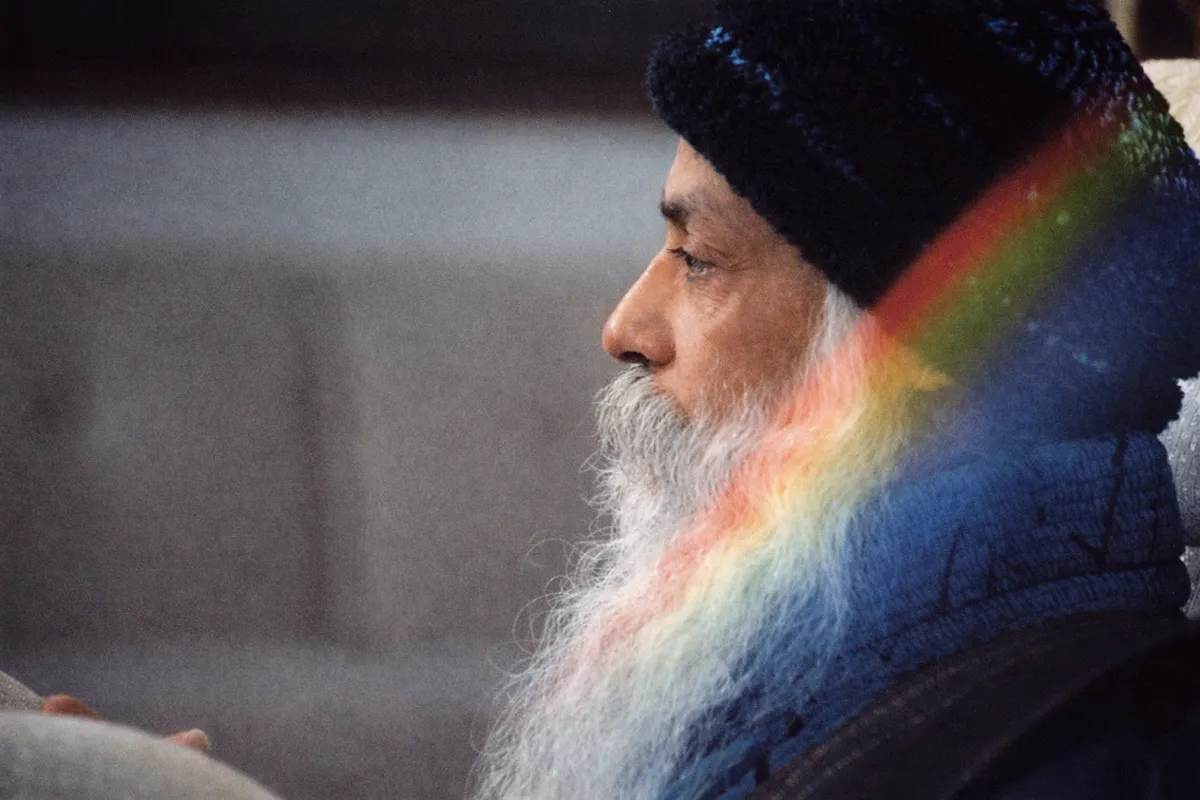
Osho scandalized his critics on the subject of relationships, but his actual teaching is austere: no relationship can succeed between people who cannot bear their own company. Out of loneliness we grasp, possess, and slowly strangle what we claim to love; out of aloneness — a settled, self-sufficient solitude — relating becomes an overflow rather than a bargain. Marriage he treated as a mirror, not a sacrament.
The four passages below carry those threads in his own words, each linked into its full discourse.
“Ideal couples are those who remain lovers even after marriage, nurturing affection and playfulness amidst the routine, for love thrives not in possession but in freedom and mutual respect.”
From the Discourses
Passages where Osho speaks on relationships — each links to the complete discourse.
Why am I always interested in married women?
The same is the case with a married man: he is far away. There is not much possibility that he will really enter into a love-relationship with you. I have heard... A young man went to a very wise old man, and the young man said 'I am lovesick, sir. Can you help me?' The wise man thought, and he said 'There is only one cure for love, and that is marriage. And if marriage cannot cure it, nothing can cure it! If you get married, you will be cured. Never again will you think about love!' Yes, marriage cures it so certainly, so absolutely, that if marriage cannot cure love, then nothing can cure it. Then you are incurable. It is good to fall in love with a married woman because then there is no possibility of cure; you remain lovesick. There are people who enjoy their lovesickness tremendously:…
Why does heterosexual relationship create trouble and is it something new or has it been the case always?
It creates trouble because it is hetero. It creates trouble because it is between two opposite polarities. It creates trouble because it is between two different kinds of species -- man and woman. Man is one kind of species and woman is a different kind of species. They exist in opposite directions -- hence the attraction. Opposites attract. The negative electricity is attracted by the positive electricity; the positive electricity is attracted by the negative electricity. If you put two positive poles of magnetism together they repel each other. They don't attract. The similar repels, the contrary attracts. The woman is attracted to the man, the man is attracted to the woman, because they are opposite -- yin, yang, day, night, life, death, earth, sky -- they attract. But remember, the very attraction is because of the opposition. They are opposite so they attract. When you come closer there are…
Is it possible for two people in a relationship to be bad for each other? Does it happen that two peoples energy just does not mix? How to know the difference between the thorns of a healthy relationship and an unhealthy relationship?
It happened, in one town I lived for ten years, and a person used to live just above me, but he never came TO see me. Thousands of people would come and go, but he never came. He was simply puzzled as TO why people came TO me. Then he was transferred -- he was a principal in a college -- he was transferred to another town. I visited the other town. I was invited to his college to speak to the students; then he heard me for the first time. He had to because he was the principal! Then he became more puzzled; he said, "Ten years I lived just on top of you, and I missed. I never came. And I never knew that you had something to share, that you had something to give to us." He started crying. I said, "Don't be worried. Just tell me,…
Beloved Osho, why it is so difficult for sannyasins to have deep relationships with non-sannyasins?
His father was working in a coal mine; his parents were really poor, and you cannot say anything against them. And Vincent van Gogh's first works are just coal sketches -- but they are tremendously beautiful. Now even those coal sketches have a value of millions of dollars. But his parents would not give him money for paints, for canvases, and finally they had to turn him out. One of his friends took pity on van Gogh and asked him to stay with him until he got some employment. And he fell in love with the sister of the friend -- just love at first sight. The first day in the house of the friend, he proposed to the girl. The girl simply laughed; they were more comfortably-off people -- better educated, middle class, higher than Vincent van Gogh and his family. She could not believe that this poor beggar…
Read 8 more passages on relationships
Osho, yesterday you said that jealousy is included in respect. I have immense respect for you, but the jealousy inherent in it keeps poisoning it, and I feel guilt and pain. Does reverence transcend this poison-laced respect?
It needs a little explaining—it's a delicate point. Whenever you respect someone, you do so because you see in that person something you do not have. You respect because you glimpse in the other something you would also like to possess. A beggar respects an emperor because he, too, longs to be an emperor. So on the one hand he respects, and inside he also envies. Because he is not yet an emperor but wants to be. You have attained what he wants to attain. He respects you as skillful, successful: “I stand far back in the line; you have gone ahead to where I should have been.” So you are powerful, clever, intelligent, strong—he respects you. But inside a fire of jealousy also burns—if he gets the chance, he would like to be in your place and push you aside. And if the beggar gets that chance, he will…
Osho, I find myself mostly attracted to women and very rarely deeply to a man. I am a little bothered about it. Could you please say something about it?
We create these conditionings so deeply that out of so much conditioning sometimes people start revolting against them. Sex should be taken VERY naturally -- we have been taking IT very seriously. Either we condemn IT as ugly, animalistic, or we raise it to something divine, but we never accept it as human and we never accept it as fun. Basically it is fun, it is a good sport! And humanity is going to remain burdened with ugly nonsense if we don't accept its beauty as a sport. It is good physical activity too, and the best of exercises. You can ask the heart specialists. Now they say sexual activity prevents heart attacks. One thing is certain, that no man has ever had a heart attack while making love. In every other kind of activity heart attacks have happened, but never making love. Have you ever heard that anybody had…
Osho, you say one thing and people understand something else. Why?
Narottam! If it were otherwise, that would be the surprise. You speak; the listener carries his past, his memory, his vested interests. The words are yours, but the meanings will be his. You cannot claim ownership over the meanings. Say what you have to say, but he will hear what he wants to hear—and even from that hearing, he will extract only the meaning he wants to extract. So don’t be annoyed. Present your point; then let him understand whatever he understands. What will you do? What can you do? If you say something more, he will take that too to mean something else. There is no end to it. Often it happens that you want to say something—with goodwill, with love, with compassion—and when you see the other has understood it all wrong, it hurts deeply. It feels as if he is being dishonest knowingly, as if he is…
It is true that in a very close relationship when one 'plays' the good, understanding, calm and relaxed one, it is only left for the other to be nervous, tense and angry? Please explain.
Yes, a certain kind of balancing always happens in relationship. If one is playing very calm and quiet and cool, the other will have to do all the work of being angry, nagging, miserable, fighting. Just a few days ago Chaitanya Hari had asked a question, "Why did Socrates continue to live with this naggy-daggy woman, Xanthippe?" The question is relevant, because he is also living with a naggy-daggy woman, Krishna. But remember, Socrates was responsible. He was playing too cool, too philosophical. Xanthippe was not as bad as she appears. If you go into the psychology of it, she was the victim of a philosopher. She had to do all the work, the poor woman. And so is the case with Krishna! Krishna was saying to me, "Osho, do you think this Chaitanya Hari is a saint?" He is not! He only pretends! Now Chaitanya Hari is also responsible…
Should one first come to terms with one's own loneliness before entering into relationship?
Two lonely people are always facing each other, confronting. Two people who have known aloneness are together, facing something higher than both. I always give this example: two ordinary lovers who are both lonely always face each other; two real lovers, on a full moon night, will not be facing each other. They may be holding hands, but they will be facing the full moon high in the sky. They will not be facing each other, they will be together facing something else. Sometimes they will be listening to a symphony of Mozart or Beethoven or Wagner together. Sometimes they will be sitting by the side of a tree and enjoying the tremendous being of the tree enveloping them. Sometimes they may be sitting by a waterfall and listening to the wild music that is continuously being created there. Sometimes, by the ocean, they will both be looking to the…
Question: BELOVED OSHO, I'M EXPERIENCING MORE AND MORE A HARMONY, A QUIETNESS, AN EASE, AN ABUNDANCE IN MYSELF, MOMENTS IN WHICH I FEEL SO VAST AND RICH, LIKE THE UNIVERSE, AND SO CLOSE TO YOU. I DIVE INTO IT AND DISAPPEAR, AND SEE THAT THIS AGAIN WAS JUST AN OPENING, A DOOR TO ANOTHER DIMENSION ON THIS ONGOING, NEVER-ENDING JOURNEY YOU ARE TAKING ME, MY BELOVED MASTER. AND I CAN FIND NO WORDS TO EXPRESS HOW MUCH I FEEL, THAT I CAN BE WITH YOU. BEING TOGETHER WITH A MAN I FIND THESE MOST BEAUTIFUL AND PRECIOUS MOMENTS SO RARELY; IT SEEMS MOST OF THE TIME IS WASTED IN LOVING AND FINDING OURSELVES AND EACH OTHER. WHY IS IT SO DIFFICULT FOR ME TO BE IN THIS HARMONY TOGETHER WITH A MAN, AND EVEN TAKE HIM WITH ME INTO THIS UNKNOWN?
Beloved Osho, you said to us this week that we should not concern ourselves with others. But most of us from the west have friends and relatives with whom we would like to share what we've found. What should we tell them about sannyas? What should we tell them about you? How can we explain the unexplainable?
But sannyas cannot be categorized. It is not a category. It is such an altogether different quality of being, there exists no category for it. It cannot be analyzed, it cannot be broken into fragments. It is not a mechanism; you cannot break it, take the pieces apart and put them together again. No, it is an organic unity. If you analyze it, it is no longer there, and you can never put it back together again. It is impossible. Sannyas is a live force -- organic, just like a flower. Analyze the flower, take each petal away, break it, look inside it, be satisfied that you have inquired, then try to put it back together. By that time, the flower is gone, the petals are dead and they can never be put back again in the same way, because it was an organic unity, it was not a mechanism.…
Gosa hoyen used to say: 'when people ask me what zen is like I tell them this story:'
NOTICING THAT HIS FATHER WAS GROWING OLD, THE SON OF A BURGLAR ASKED HIS FATHER TO TEACH HIM THE TRADE SO THAT HE COULD CARRY ON THE FAMILY BUSINESS AFTER HIS FATHER HAD RETIRED. THE FATHER AGREED, AND THAT NIGHT THEY BROKE INTO A HOUSE TOGETHER. OPENING A LARGE CHEST THE FATHER TOLD HIS SON TO GO IN _ AND PICK OUT THE CLOTHING. AS SOON AS THE BOY WAS INSIDE, THE FATHER LOCKED THE CHEST AND THEN MADE A LOT OF NOISE SO THAT THE WHOLE HOUSE WAS AROUSED. THEN HE SLIPPED QUIETLY AWAY. LOCKED INSIDE THE CHEST THE BOY WAS ANGRY, TERRIFIED, AND PUZZLED AS TO HOW HE WAS GOING TO GET OUT. THEN AN IDEA FLASHED TO HIM -- HE MADE A NOISE LIKE A CAT. THE FAMILY TOLD A MAID TO TAKE A CANDLE AND EXAMINE THE CHEST. WHEN THE LID WAS UNLOCKED THE BOY JUMPED…
“The autonomous partner you seek does not exist; true wisdom arises not from the absence of friction in relationships, but from embracing the challenges they bring.”
Understanding Osho's Vision of Relationship
The threads that run through his discourses on relationships.
First, Aloneness
Should one come to terms with loneliness before entering relationship? Osho's image of two kinds of couples answers it completely.
Two lonely people are always facing each other, confronting. Two people who have known aloneness are together, facing something higher than both. I always give this example: two ordinary lovers who are both lonely always face each other; two real lovers, on a full moon night, will not be facing each other. They may be holding hands, but they will be facing the full moon high in the sky. They will not be facing each other, they will be together facing something else.Come Follow to You Vol 4, Chapter 6 →
Marriage as a Mirror
Asked what is wrong with marriage, Osho surprised the questioner: nothing is wrong with it as a teacher — it shows you every face you have.
Learn something from marriage. Marriage represents the whole world in a miniature form: it teaches you many things. It is only the mediocre ones who learn nothing. Otherwise it will teach you that you don't know what love is, that you don't know how to relate, that you don't know how to communicate, that you don't know how to commune, that you don't know how to live with another. It is a mirror: it shows your face to you in all its different aspects. And it is all needed for your maturity.Tao: The Golden Gate Vol 2, Chapter 9 →
Love Brings Freedom
To a sannyasin astonished that love had made her independent, Osho stated his test for the real thing: love that does not free is domination wearing love's name.
Paritosh Lore, love brings freedom. And a love that does not bring freedom is not love. Love is not domination. How can you dominate someone you love? How can you make him dependent, and still be loving? But that's what goes on happening in the world in the name of love -- something else -- a lust to power, to dominate the other. Naturally independence cannot be allowed. Every effort is made that the other should be a carbon copy of you. You are afraid of the freedom of the other, because freedom is not controllable, and freedom is not predictable. So all so-called love tries in every way to destroy freedom -- and the moment freedom is destroyed, love dies.The Golden Future, Chapter 17 →
Respecting the Other's Space
In a darshan talk Osho gives the most practical relationship advice in the whole corpus: the fights of lovers are the revenge of trespassed space.
You have your space, she has her space. And one has to be respectful now, that the other's space should not be in any way interfered with; it should not be trespassed. If you trespass it, you hurt the other; you start destroying the other's individuality.Don't Look Before You Leap, Chapter 22 →
“Real relationships are born not from persuasion, but from the deep compassion and acceptance of our outsiderhood in a world that often cannot see.”
Questions Osho Answered on Relationships
58 questions in the library — the most sought-after:
Be happy and loving by yourself first; if two lonely people pair up, they just make each other’s sadness bigger.
You’ve changed how you see life, so talking with people still following old programs feels like speaking different languages—be kind, don’t force, and accept some distance.
Boys and girls are very different, so they like each other but often don’t understand each other, which makes fights normal and very old—not a new problem.
An ideal couple keeps loving like sweethearts even after the wedding, chores, and years together.
You like married women because your ego wants what others want, the challenge feels exciting, and dreaming about someone hard to get feels safer than real love.
If you act too perfect or calm, your partner gets forced into being the upset one; be real so you both share feelings fairly.
Relationships feel mixed-up because they’re a riddle you can’t solve by pushing; first find calm and clarity inside, then being together works better.
You don’t need to get your interest back—let it go and use the peace it brings to grow wiser and prepare calmly for life’s ending.
“Embrace the fading of sexual desire as a natural part of aging; it opens the door to deeper treasures of innocence, wisdom, and the readiness for the ultimate journey.”
Frequently Asked
He was against marriage as ownership — a legal cage substituting for love — but not against two people living together. He valued marriage as a mirror of one's immaturities and envisioned relating out of freedom and joy rather than contract: commitment as a living choice renewed daily, not a chain.
A relationship is a noun — fixed, settled, taken for granted; relating is a verb — a fresh meeting again and again. Osho urged lovers to stay in the verb: never presume you know the other, never reduce the mystery of a person to a role like husband or wife.
By seeing them as symptoms of inner poverty rather than proofs of love. Possessiveness turns a person into property and kills exactly what attracted you. His prescription was meditation: grow your own aloneness until you relate from fullness — then freedom given to the other becomes the deepest bond.