
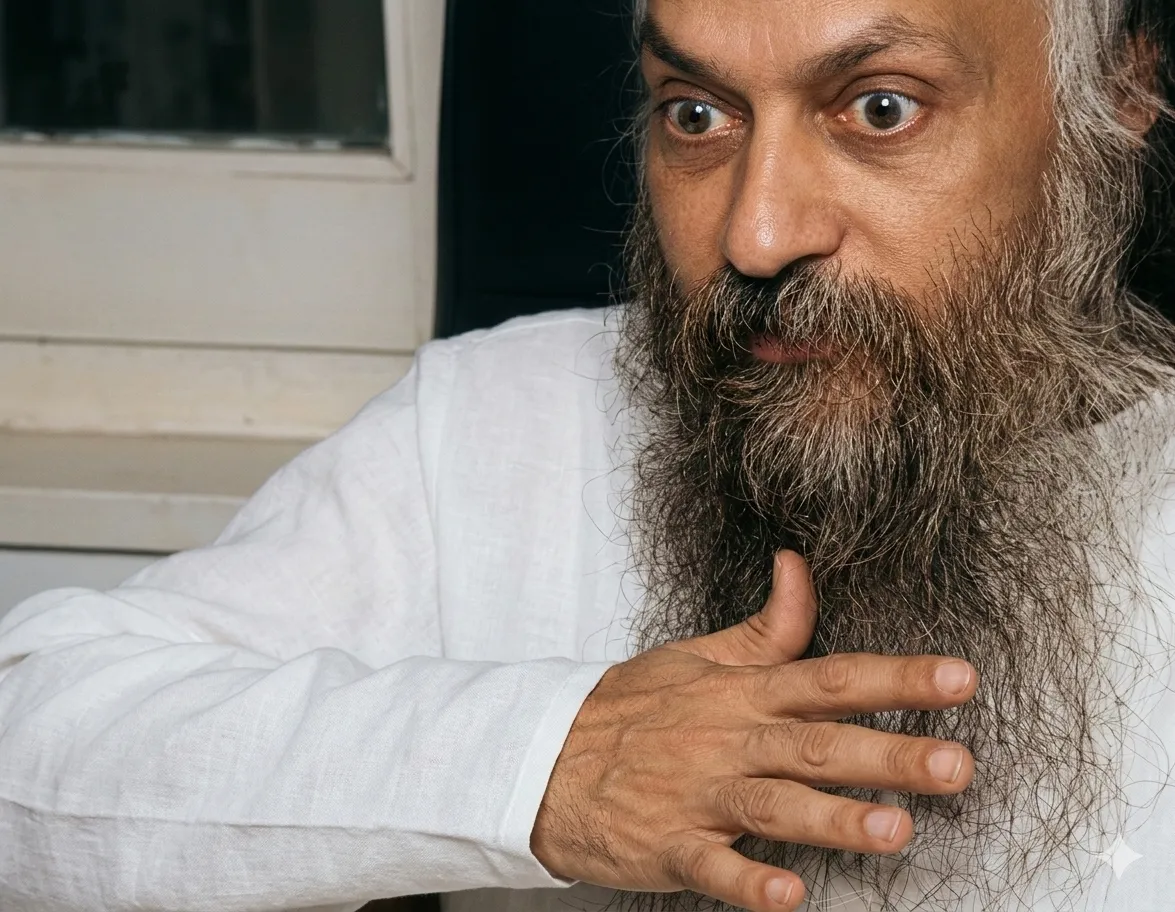
For a man who spoke for thirty-five years, Osho was relentless about silence. Words, he said, reach from throat to ear; silence reaches into the infinite. But the silence he meant is not soundlessness — no forest is quiet, and a cultivated hush is only suppression. Real silence is what remains when the mind dissolves: positive, musical, the center of the cyclone that no storm touches.
These four passages carry his teaching on silence from definition to experience, each linked to its full discourse.
Understanding Osho's Vision of Silence
The threads that run through his talks on silence. The short notes are Osho Live's; the quoted passages are his own words, checked against the talk.
Real Silence Cannot Be Practiced
Commenting on the Upanishadic sutra that stillness is worship, Osho separates cultivated quiet from the silence that arrives when the mind dissolves.
SILENCE is meditation and silence is basic for any religious experience. What is silence? You can create it, you can cultivate it, you can force it, but then it is just superficial, false, pseudo. You carl practise it, and you will begin to feel and experience it -- but your practice makes it auto-hypnotic. It is not the real silence. Real silence comes only when your mind dissolves: not through any effort, but through understanding; not through any practice, but through an inner awareness.
Silence across the years
When Osho spoke about silence: talks where it comes up at least 5 times, counted from 6,627 dated talks on Osho Live.
Where he speaks of it most: Es Dhammo Sanantano · Maha Geeta · Tao Upanishad
| Year | Talks about it | Dated talks that year |
|---|---|---|
| 1964 | 4 | 13 |
| 1965 | 3 | 19 |
| 1966 | 3 | 7 |
| 1967 | 10 | 33 |
| 1968 | 13 | 30 |
| 1969 | 34 | 110 |
| 1970 | 25 | 131 |
| 1971 | 34 | 111 |
| 1972 | 56 | 223 |
| 1973 | 67 | 205 |
| 1974 | 103 | 271 |
| 1975 | 90 | 303 |
| 1976 | 156 | 700 |
| 1977 | 161 | 679 |
| 1978 | 186 | 702 |
| 1979 | 185 | 683 |
| 1980 | 204 | 674 |
| 1981 | 40 | 122 |
| 1984 | 14 | 63 |
| 1985 | 107 | 356 |
| 1986 | 141 | 369 |
| 1987 | 234 | 486 |
| 1988 | 187 | 276 |
| 1989 | 53 | 61 |
More in his words
The Center of the Cyclone
Asked to speak about the positive quality of silence, Osho pointed past every circumstance to the one place weather cannot reach.
Your very center of being is the center of a cyclone. Whatever happens around it does not affect it; it is eternal silence.
Where Truth Is Known
In an early darshan diary Osho states the epistemology behind all his meditations: truth appears only in the pause where mind is not.
The truth is not known through mind and its turmoil. It is known through absolute silence, then the mind stops all its functioning, then the mind is no more. In that pause, in that silence, suddenly you become aware for the first time, of that which is -- call it truth, call it god, liberation, nirvana, moksha, different names for the same phenomenon. All that is needed is a deep silence.
Hearing the Silence
Can silence be heard? Osho describes the master's real work: undoing the wordy conditioning of society until the ear opens to what was always sounding.
That's the function of a Master: to undo all that the society has done to you, to help you to go beyond words. And you can experience it happening here -- you can hear the silence.
From the discourses
Passages where Osho speaks on silence, each linked to the exact place in the talk.
Why should silence be threatening?
In Zen they call it 'The Great Doubt'. It comes to everybody when they reach closer to satori: a great moment of doubt -- because the old is disappearing and the new you cannot even see. All that you have believed in is no more valid, and nothing is yet clear as to what is going to substitute it. You are left in limbo. In that trembling, anguish, anxiety, great doubt, you would like to go back; you would like to cling to the shore that you have left. But there is no way to go back! Once you have come to the moment of Great Doubt, there is no way to go back. You can only go ahead. Remember this basic dictum of human growth. growth of consciousness: that there is no way ever to go back. Whatsoever you have known, you have known as there is no way…
Question: OSHO, CAN SILENCE BE HEARD AND UNDERSTOOD? Only silence can be heard and understood. Words can be heard but only superficially, and can be understood -- but only intellectually. Silence is heard existentially and is understood from your innermost being. It is a total understanding. I can see why you have asked the question, because ordinarily we understand only words. We are prepared to understand only words, not silence. We are educated to understand language and all its complexities. Nobody helps us to go beyond language, to go beyond words, to reach the wordless space within us. The society is against it, because if you can hear silence you will not be a part of the crowd mind, of the collective mind. You will become an individual immediately. And an individual is a danger to the state, to the church, to the society.
Question: BELOVED OSHO, CAN YOU TALK ABOUT THE RELATIONSHIP BETWEEN SILENCE AND BLISSFULNESS? IS SILENCE ALL THAT IS NEEDED? DOES EVERYTHING ELSE FOLLOW? Prem Samarpan, there is no relationship between silence and blissfulness; they are two names of the same thing. Silence is blissfulness, not in the dictionaries, but in actual experience. And I don't see that in actual experience it can be different to different people. As you become silent, you cannot be worried, you cannot be tense; you cannot be miserable, you cannot be noisy, you cannot be chattering continuously. Otherwise, how can you be silent? And when all these stupid activities are gone, silence simply clears the ground for blissfulness to be discovered. They are almost the same phenomenon because they happen simultaneously. As you become silent, a certain sweetness, a certain fragrance, a certain beatitude spontaneously arises in you.
Beloved Osho, the other day you talked so beautifully about the sadness which follows the first experience of our innermost silence. Is it necessarily so, that when I first experience this silence, I also feel with my whole being that I am absolutely alone on my journey?
Aloneness is also one of the fundamental experiences as you enter silence. In silence there is nobody else, you are simply alone. The deeper your silence will be, thoughts will be gone, emotions will be gone, sentiments will be gone -- just pure being, a flame of light, burning alone. One can get scared because we are so much accustomed to living with people -- in the crowd, in the marketplace, in all kinds of relationships. You may not be aware that in all these relationships -- with friends, with your husbands, with your wives, with your children, with your parents -- you are basically trying to avoid the experience of aloneness. These are strategies so that you are always with somebody. It is a well-known fact, psychologically established, that if a person is left alone in isolation, after seven days he starts talking... a little like whispering. For seven…
the second alternative is to experience your aloneness, your silence that absolutely virgin spot inside your being where nobody can enter, nobody can trespass that is your true world knowing it, experiencing it, one is surprised that there was no need to escape from it it is one of the most ecstatic experiences even love is secondary the person who has known his aloneness also loves but his love has a tremendous beauty t is positive: he is not escaping from himself he is rooted in himself, centred in himself and because of that rootedness and centering he is so full of joy that he wants to share it his love is a sharing, it is not an escape his love is a gift the other is not being used as a means the other is dignified by his love ordinarily love reduces people into slaves into bondage, into possessiveness,…
We are not the body and we are not the mind either. Mind is also part of the body. The visible part is called body, the invisible part is called mind. It is a psychosomatic mechanism and we are the witness of it. We are in it but we are not it. This is the greatest experience. Once it has happened your life goes through a radical change. Then you are never the same again. It is a breakthrough. The whole effort here is to bring this breakthrough closer and closer. Every support, every technique and device is provided for this breakthrough so that you can see yourself as a witness of it all, as pure consciousness. To know oneself as pure consciousness is to be free of all bondage. It is to be free of birth and death, it is to be free of time.
Beloved Osho, when I sit in your lecture I feel your silence and feel I become part of it. This is a wordless process in melting more and more into silence. At the same time, there are words from you. I hear them, and suddenly a connection happens from the silence to the words, and I feel golden, golden gratefulness about your beloved, wonderful words. The silence and the words are one. Please can you say something about this process -- if it is really possible that words can say the wordless.
Yes, the word can say the wordless but only to the chosen few, only to those who are absolutely silent. The word coming out of silence carries around it the wordless silence. Now the question is at the receiving end -- if it is received by a mind full of words and chattering, then the silence and the wordlessness is destroyed, you only hear the word. But if you are silent, you hear the word and you also hear the wordless; you hear the sound, and you also experience the soundlessness. In Mahavira's life a strange thing is reported. It is very difficult to say that it can be factual, historical. Particularly in the outside world, it will look absolutely absurd and irrational. But here, I can tell you the story. And I can tell you that it may have happened -- because it is happening here, so there is…
She has asked: I have understood you to say that in the beginning was not the word, but silence. Is not silence the beginning, the end, and the continuum between beginning and end?
Yes, a thousand times yes. I have been speaking about the Bible, which says, "In the beginning, there was the word." Now that is sheer nonsense. How can the word be of itself? Somebody has to utter it. And what is a word if there is nobody to understand it? It becomes just a sound. But what is a sound if there is nobody to hear it? Certainly the Bible is wrong. In the beginning was silence, in the middle it is silence, in the end it is silence. Silence is the very soul of existence. Before we enter the silence, because it is an arduous journey to be in your very innermost core -- arduous and unknown and forgotten -- a few laughs will prepare you. I am using laughter to create a preparation for you to dive deep into silence. After laughter, it is simpler. Ace psychiatrist, Dr.…
And the great gifts of life are only for people who are ready to go totally into something, whether it is silence, freedom, truth -- it does not matter what it is. All the ultimate values require you to be a lover. Sannyas is a love affair with silence. The most unique experience of life is that of silence; otherwise life is very noisy. Outside there is noise, inside there is noise, and both together are enough to drive anybody crazy. They have driven the whole world crazy. One has to stop the inner noise -- the outer noise is beyond our control and there is no need either to stop it. But we can stop the inner noise.
Osho, when you sit silently, that silence doesn’t come within our grasp. But when you begin to speak, a glimpse of silence appears between two sentences, between two words. Yet in becoming so absorbed in understanding the meaning of your speech, that silence keeps slipping away. So please explain: when we listen, how should we listen to you?
It will be so—naturally. When I sit utterly silent, you are not able to sit silent; inside you the stream of thoughts flows, an undercurrent keeps moving—you start talking to yourself. The habit of inner talking has become so deep, so carved in stone, that not even for a moment do you find rest within. If I sit completely silent, you will simply forget me. Your inner stream becomes active, your old habit seizes you, you get absorbed in inner conversation. It’s a monologue—you speak alone, yet you do speak. Then even my silence is hard for you to see, because we can only see that which has its opposite as a background. A psychologist once did an experiment at a university. On a large black blackboard he drew a tiny white dot and asked the students, “What do you see?” Not one of them saw the big blackboard; all…
प्रश्न: ओशो, जब आप चुप बैठते हैं, तो वह मौन पकड़ में नहीं आता। लेकिन जब आप बोलने लगते हैं, तो दो वाक्यों के, दो शब्दों के बीच कुछ मौन की झलक मिलती है। लेकिन आपकी वाणी का अर्थ समझने में इतना मोह होता है कि वह मौन छूटता-छूटता जाता है। तो कृपया समझाएं कि जब हम सुनते हैं, तो आपको कैसे सुनें?
ऐसा होगा, स्वाभाविक है। जब मैं बिलकुल चुप बैठा हूं, तब तुम चुप नहीं बैठ पाते, तब तुम्हारे भीतर विचारों की धारा चलती है, अंतर-धारा बहती है, तब तुम अपने से बात करते हो। बात करने की आदत इतनी गहन हो गई है, इतनी पत्थर की लकीर की तरह हो गई है कि एक क्षण को भी भीतर तुम विश्राम को उपलब्ध नहीं होते। अगर मैं बिलकुल चुप बैठा हूं, तो तुम मुझे भूल ही जाओगे। तुम्हारे भीतर की धारा सक्रिय हो जाएगी, तुम्हारी पुरानी आदत तुम्हें पकड़ लेगी, तुम अंतर-वार्ता में लीन हो जाओगे। मोनोलॉग है, अकेले ही बोलते हो, लेकिन बोलते हो। फिर मेरा मौन भी तुम्हें दिखाई पड़ना मुश्किल है, क्योंकि वही हमें दिखाई पड़ता है, जिसकी पृष्ठभूमि में विपरीत मौजूद हो।
Bliss is a state of awareness, watchfulness, meditativeness, of profound silence, peace. Nothing stirs in you, all is quiet, and you are absolutely relaxed. Out of that relaxation something bursts forth at you very center, some energy that has always remained there starts flowing, becomes dynamic. It has been dormant because you were never looking at it. You never paid any attention, you were concerned with the body and the mind. Now, you have turned in. Your whole concern, your whole attention, has settled at the center. You have left the circumference far behind. When the energy is absolutely centered, at the center, bliss happens. Happiness has to move from pleasure to bliss. Bliss is always perfect. You can't have imperfect bliss, it is impossible. It is like you cannot have an imperfect circle: if it is imperfect it is not a circle.
A computer can know everything possible but it will remain a computer and it will repeat only that which is fed into it. It cannot be blissful either -- what bliss can a machine have? It cannot be loving either -- how can a machine be loving? It may say 'I love you, I love you very much, I am ready to die for you' -- it may say beautiful things, but they will be simply words. It can be taught to hug you and kiss you but there will be no love at all. And you will know that this is just foolish -- a machine kissing you and hugging you. You will look all around, embarrassed! A machine can be taught these things and the machine can do these things very efficiently. But millions of people are doing exactly that: functioning like machines, computers.
Questions put to Osho about silence
Each opens the talk at the moment the question was asked.
- Why should silence be threatening? Zen The Path Of Paradox Vol 3 · Discourse 8 · 1977-07-08
- Beloved Osho, the other day you talked so beautifully about the sadness which follows the first experience of our innermost silence. Is it necessarily so, that when I first experience... Beyond Enlightenment · Discourse 27 · 1986-10-30
- Beloved Osho, when I sit in your lecture I feel your silence and feel I become part of it. This is a wordless process in melting more and more into silence. At the same time, there are... Beyond Enlightenment · Discourse 21 · 1986-10-23
- She has asked: I have understood you to say that in the beginning was not the word, but silence. Is not silence the beginning, the end, and the continuum between beginning and end? Zen The Solitary Bird Cuckoo Of The Forest · Discourse 2 · 1988-06-28
- Osho, when you sit silently, that silence doesn’t come within our grasp. But when you begin to speak, a glimpse of silence appears between two sentences, between two words. Yet in... Nahin Ram Bin Thaon · Discourse 5 · 1974-05-29
Frequently asked
Short answers by Osho Live, based on the passages above.
What did Osho mean by silence being 'positive'?
That it is not merely the absence of noise but a presence with its own texture — he called it a music, a fragrance. Bodily quiet and mental quiet differ; real silence is beyond the mind, and once tasted it persists even in the marketplace.
Can silence be cultivated through practice?
Forced silence, Osho warned, is only repression — the noise goes underground and waits. What can be practiced is understanding: watching the mind until its chatter drops of its own accord. The distinction is between a silence you manufacture and a silence that descends when you are absent.
Why did Osho speak so much if silence is the goal?
He answered this often: he spoke to seduce people toward silence — words used as bait for the wordless. Talking was his device to keep seekers close until they could sit in the gaps between his sentences; the pauses, he said, carried the real message.