
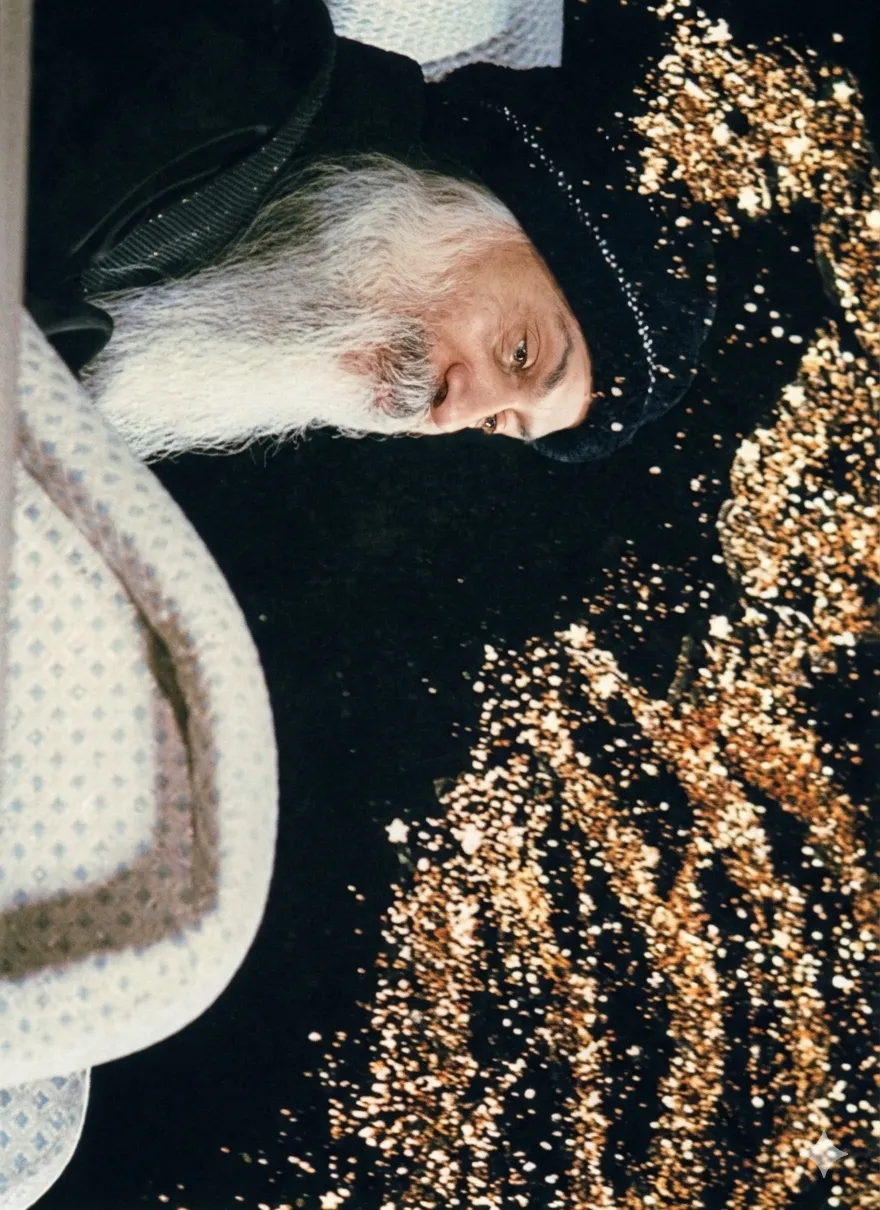
Stop trying to control everything; when you let go of the ego, life moves through you naturally and wisely.
From the Discourses
Passages where Osho speaks to this question — each links to the complete discourse.
Osho, are being a mere instrument (nimitta) and being spontaneous/free (swachchhand) only differences of expression? Please explain.
But if it doesn’t suit you, that doesn’t mean the Divine is narrow and reachable by only one road. If this doesn’t suit you, then what is its opposite—does that suit you? Does spontaneity suit you? Does rebellion suit you? Does it appeal to declare: Enough—I will live in my own way? Then live so. Shape yourself to your own cadence. Live in complete freedom. Do not become an instrument. Do not surrender. Live spontaneously. What Ashtavakra calls spontaneity, Mahavira calls asharan—without refuge. What Krishna calls becoming a mere instrument, Chaitanya and Mira call surrender. They are the same things. If I distill all this, I would say: one path is feminine, and one path is masculine. The masculine path means: he cannot surrender, cannot become an instrument; he will proclaim himself. The path of spontaneity, of being without refuge, will suit him. Feminine means: she will not proclaim herself—that’s…
Osho, you say, “As He wills, let us become mere instruments; whatever role in life we have been given, let us fulfill it.” But letting what happens happen—i.e., flowing along with the body, mind, and ego—gives rise to suffering. So should we keep applying the principle of instrumentality even in relation to the body, mind, and ego, and go on suffering? How do we solve the riddle between the principle of instrumentality and the continuous reality of suffering?
That supreme bliss is beyond both pleasure and pain. It is neither like night nor like day. It is twilight. The sun has set, night has not yet come; the light remains—very gentle, sweet, non-aggressive—that is twilight. Morning has come, the sun is not yet risen, the night has gone—such is the twilight. One who abides in that twilight—that is what we call prayer. That is why Hindus call their prayer sandhya. Sandhya means one who has stopped in between the dualities, who has found the truce between the two. Between pleasure and pain, love and hate, victory and defeat, night and day, life and death—one who has found the pact and stands in that concord. Seek that interval of conjunction. Krishna says, it is simple to find. If you cease to be the doer, you will find it instantly. It is only through your doer-ship that you keep missing.…
Osho, as we are right now, at best we can only enact the attitude of being a mere instrument. By acting out this instrumentality, will we someday attain the nimitta-bhava that Krishna speaks of?
Begin somewhere—acting will do. But this acting is unique. Imagine the real Rama got lost in the world and forgot that he is Rama. Wandering about for many days, he forgot. Then one day a Ramlila began in town, and someone said to the real Rama, “Why don’t you play the part of Rama in the Ramlila? You look exactly like Rama—your face, features, the way you carry yourself, these long arms, this chest. You should play Rama’s role.” So the Rama who had forgotten that he was Rama agreed to act Rama. But as he kept acting, the layers of unconsciousness began to crack, and a remembrance started surfacing: what I am saying, what I am doing—it feels as if it has been said before, done before; as if I have seen this sometime. It no longer feels like acting; some ancient memory has been revived. Acting and acting,…
Osho: would you please say something about the relationship between spontaneity and working on oneself? Shouldn't we be loving as much as we can? If there are certain things to do or ways to be to increase our capacity for joy, shouldn't we do them? Shouldn't we let our egos drop? Many good men have written that love can begin as an impulse of the will, and trying to be spontaneous seems to be a contradiction. Would you comment on this?
You have forgotten what real love is. You fall in love with the color of the hair -- now, what has that to do with love? After two days you will not look at the color of the hair at all. Or you fall in love with a certain shape of nose or a certain kind of eyes, but after the honeymoon these things are just boring! And then you have to go on managing somehow, pretending, cheating. Your spontaneity has been corrupted and poisoned, otherwise you would not fall in love with parts. But you only fall in love with parts. If somebody asks you, 'Why do you love this woman or this man?" your answer will be, "Because she looks so beautiful," or, "Because of her nose, eyes, proportion of the body, this and that" -- and all this is nonsense! Then this love cannot be very deep…
Osho, last night you spoke about witnessing as a method; other times I have heard you speak about becoming a thing totally, being totally involved in any given situation. Usually I am at a loss as to which of these two to follow: whether to stand back and witness in a detached why or to become something totally -- for example, when there is anger or love or sadness. Are these not two opposite paths? Are they both for different kinds of situations or for different types of people? When should one do which?
There are only two deep things in the body -- sex and food. Nothing is more than these two, because food is needed for individual survival and sex is needed for race survival. Both are survival mechanisms. The individual cannot survive without food and the race cannot survive without sex. So sex is food for the race and food is sex for the individual. These are the deepest things because they are concerned with your survival -- the most basic things. You will die without them. So if you are fasting and just witnessing, then you have touched the deepest sleep. And if you can witness without being identified or bothered -- the body is suffering, the body is hungry, the body is demanding and you are just witnessing -- suddenly the body will be different. There will be a discontinuity between you and the body; there will be a…