
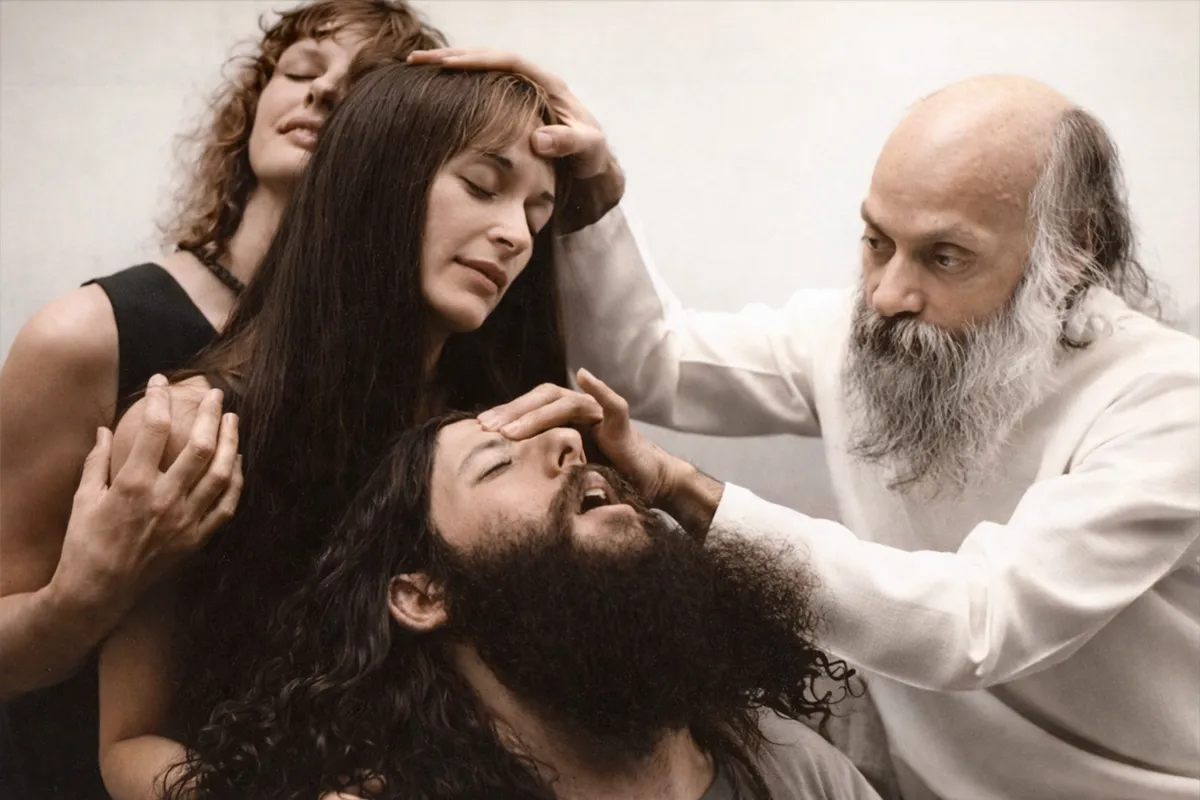
Don’t follow or rebel just because someone says so—pause, think for yourself, and do what truly feels right to you.
From the Discourses
Passages where Osho speaks to this question — each links to the complete discourse.
Osho, what is the difference between surrender and blind imitation?
So be careful: the freedom you allow yourself, allow the other too. You have no right to judge another as blindly credulous or as a surrendered being. Drop that concern. You cannot judge anyway—how will you enter another’s heart? How will you know? Think only about yourself. See within whether, up to now, you have lived by blind belief or by surrender. Decide only there; leave worrying about others. Otherwise, all your judgments will be wrong. Jesus said: Judge not; do not set yourself up as a judge in relation to another. To the friend who has asked: if you are asking for yourself, good. Drop worrying about others. Look within and see: whatever I have been clinging to till now—have I ever staked my life to hold it? Have I meditated for it? Have I loved for it? Or am I just clutching what culture, society, civilization handed me?…
On the one hand you are giving ultimate freedom to do whatsoever we want to do, and on the other hand you are giving responsibility. With responsibility, I cannot use the word 'freedom' as I want, hence I have to wait for the right meaning of freedom. The moment I get it, I get it with responsibility. Osho, when I understand I feel'thank you'. Otherwise, I would like to use, and I have already used it as a licence.
IT is one of the perennial questions of humanity: the question of freedom and responsibility. If you are free, you interpret it as if now there is no responsibility. Just a hundred years ago Friedrich Nietzsche declared, "God is dead, and man is free." And the next sentence he wrote is, "Now you can do whatsoever you want to do. There is no responsibility. God is dead, man is free, and there is no responsibility." There he was absolutely wrong; when there is no God, there is TREMENDOUS responsibility on your shoulders. If there is a God, he can share your responsibility. You can throw your responsibility on Him: you can say, "It is YOU who have made the world; it is YOU who have made me in this way; it is YOU who is finally, ultimately, responsible, not me. How can I be ultimately responsible? I am just a…
Beloved Osho, there is a story of a disciple who comes to see his master and asks him whether man is free. The master tells his disciple to stand up and to lift one of his feet off the ground. The disciple, standing on one leg -- and the other one in the air -- understands less than before. Now the master asks him to also lift the other foot off the ground. Osho, can you speak on the difference between freedom for and freedom from?
Freedom from is ordinary, mundane. Man has always tried to be free from things. It is not creative. It is the negative aspect of freedom. Freedom for is creativity. You have a certain vision that you would like to materialize and you want freedom for it. Freedom from is always from the past, and freedom for is always for the future. Freedom for is a spiritual dimension because you are moving into the unknown and perhaps, one day, into the unknowable. It will give you wings. Freedom from, at the most, can take away your handcuffs. It is not necessarily beneficial -- and the whole of history is a proof of it. People have never thought of the second freedom that I am insisting on; they have only thought of the first -- because they don't have the insight to see the second. The first is visible: chains on their…
A friend has asked, Osho, you say that if someone surrenders himself in every way to the divine—lets himself be absorbed, accepts it—then he attains the divine. Can worldly things also be obtained in the same way?
Don’t try that; you’ll get nothing! To get worldly things you have to employ means, you have to labor, you have to strive, you have to be restless, you have to be mad. The more mad a person is, the more successful he is in the world. A very eminent psychologist has just made a statement. He said that if the minds of the world’s great politicians were tested, they would be found deranged, because their success would be impossible if they were not utterly mad. That psychologist said that the reason for England’s great politician Winston Churchill’s success was that, in childhood, an astrologer told him—and then he got fixated on the notion—that he would not live beyond forty-five. From the day this idea took hold—“I will die at forty-five”—he plunged into competition like a madman. Others, who assumed they would live at least to seventy or eighty, were…
Question: BELOVED OSHO, AND AN ORATOR SAID, SPEAK TO US OF FREEDOM. AND HE ANSWERED: AT THE CITY GATE AND BY YOUR FIRESIDE I HAVE SEEN YOU PROSTRATE YOURSELF AND WORSHIP YOUR OWN FREEDOM, EVEN AS SLAVES HUMBLE THEMSELVES BEFORE A TYRANT AND PRAISE HIM THOUGH HE SLAYS THEM. AY, IN THE GROVE OF THE TEMPLE AND IN THE SHADOW OF THE CITADEL I HAVE SEEN THE FREEST AMONG YOU WEAR THEIR FREEDOM AS A YOKE AND A HANDCUFF. AND MY HEART BLED WITHIN ME; FOR YOU CAN ONLY BE FREE WHEN EVEN THE DESIRE OF SEEKING FREEDOM BECOMES A HARNESS TO YOU, AND WHEN YOU CEASE TO SPEAK OF FREEDOM AS A GOAL AND A FULFILMENT.