
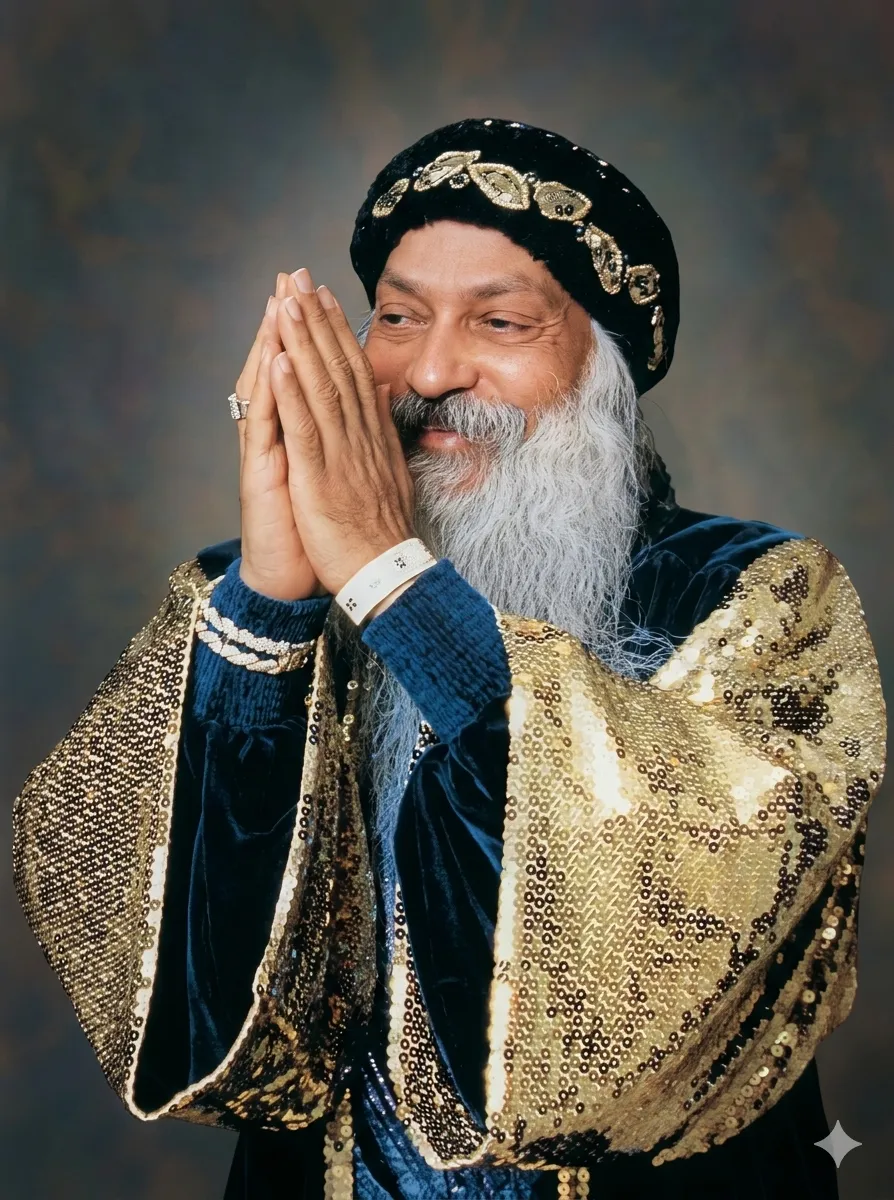
According to Osho, a child must have unconditional freedom to ask about birth and sex—and be met with plain, truthful, unembarrassed answers. Refusal and lies spring from fear, breed restlessness, obsession, and misinformation, and finally destroy trust and reverence for parents. When life raises a question, answer it simply; truth clarifies and the inquiry naturally ends.
Let kids ask where babies come from and tell them the simple truth without shame so they don’t get confused or misled.
From the Discourses
Passages where Osho speaks to this question — each links to the complete discourse.
Osho, do you feel that a child should be given the freedom to inquire about the facts of his birth and about sex?
The ignorance of our society and the traditional foolishness of parents is what spoils children. It is not obvious to us on the surface, because when children create such messes we want to make our old rules even stricter: “Look, everything is going wrong—tighten the old rules.” And we do not see that it is because of those very rules that the mess is happening. Make them stricter and the disorder will only increase. I want to give unconditional freedom to the whole of life. No one has the right to stop anyone. But freedom is not license. And the curious thing is: a free person is never licentious; only the dependent person becomes licentious. Dependence unnerves so much that dependence is one extreme. When the dependent man gets a chance, the other extreme is his licentiousness. He never pauses in the middle, where freedom is. If you lock a…
What do you say about sex education for small children?
Truth is truth, and nobody should be debarred from it. Just because children are small, do they have to be fed on lies? Is truth only for grown-ups? Does that mean truth is dangerous for the delicate consciousness of the child? Truth is never dangerous, untruth is dangerous. And if you tell an untruth to the grown-up he may be able to defend himself; it can be forgiven. But never tell an untruth to the child, because he is so helpless, so indefensible. He depends so much on you, he trusts so much in you -- don't betray him. This is betraying! Telling any lie means you have betrayed the child. And finally you will be in trouble. Sooner or later, the child will discover that you have been telling lies. That very day, all trust in you will disappear. If young people start rebelling against the parents, the responsibility…
Osho, should children be told all the facts of life, irrespective of their age?
IT HAS always been a problem down the ages -- what to tell children and what not to tell. Parents have been very much concerned. In the past the strategy was not to tell about the facts of life, to avoid it as far as possible, because people were very much afraid about the facts of life. The very phrase 'facts of life' is a euphemism; it simply hides a simple thing. Not to say anything about sex, even to avoid the word 'sex' they have made this metaphor, 'facts of life'. What facts of life? -- it is just not to say anything about sex. The whole past of humanity has lived with that deception, but the children discover sooner or later. And in fact they discover sooner than later, and they discover in a very wrong way. Because no right person is ready to tell them, they have…
Osho, does a child not have as much right to privacy and freedom from parental conditioning as the parents themselves expect?
Jimmy: 'Yes, Mum, there wasn't time to take them off.' The first-grade teacher was talking to her class about nature and she called it 'The World Around You'. She asked little Helen in the first row, 'Now, Helen, tell everyone in the class. Are you vegetable, animal or mineral?' 'I'm not any of those,' she replied promptly. 'I'm a real live girl!' A little fellow who was fishing off the end of a pier lost his balance while trying to land a fish and fell in the lake. Several men who also were fishing nearby rushed to his aid and pulled him out. 'How did you come to fall in?' one of the men asked him. 'I didn't come to fall in,' the kid said. 'I came to fish!' A large family was finally able to move into a more spacious home. Some time later an uncle asked his nephew,…
Osho, can children understand the truth?
RAJ, CHILDREN CAN UNDERSTAND THE TRUTH but cannot understand that they understand it. They understand more clearly than you can understand because they are more clean, more innocent; but they are so innocent that they cannot understand that they understand. Hence you need another childhood, a second childhood. First you have to lose your first childhood. That is the whole meaning of the biblical story of Adam and Eve losing paradise: that is losing the first childhood. It is a tremendously significant story. It has so many meanings, it is such a multi-dimensional parable, that I don't think there exists any other parable comparable to it. You can look at it from many aspects. It is losing the first childhood -- which is inevitable. Adam and Eve are not committing a sin. In fact, the word "sin" comes from a root which means forgetting, and that is a beautiful meaning:…