
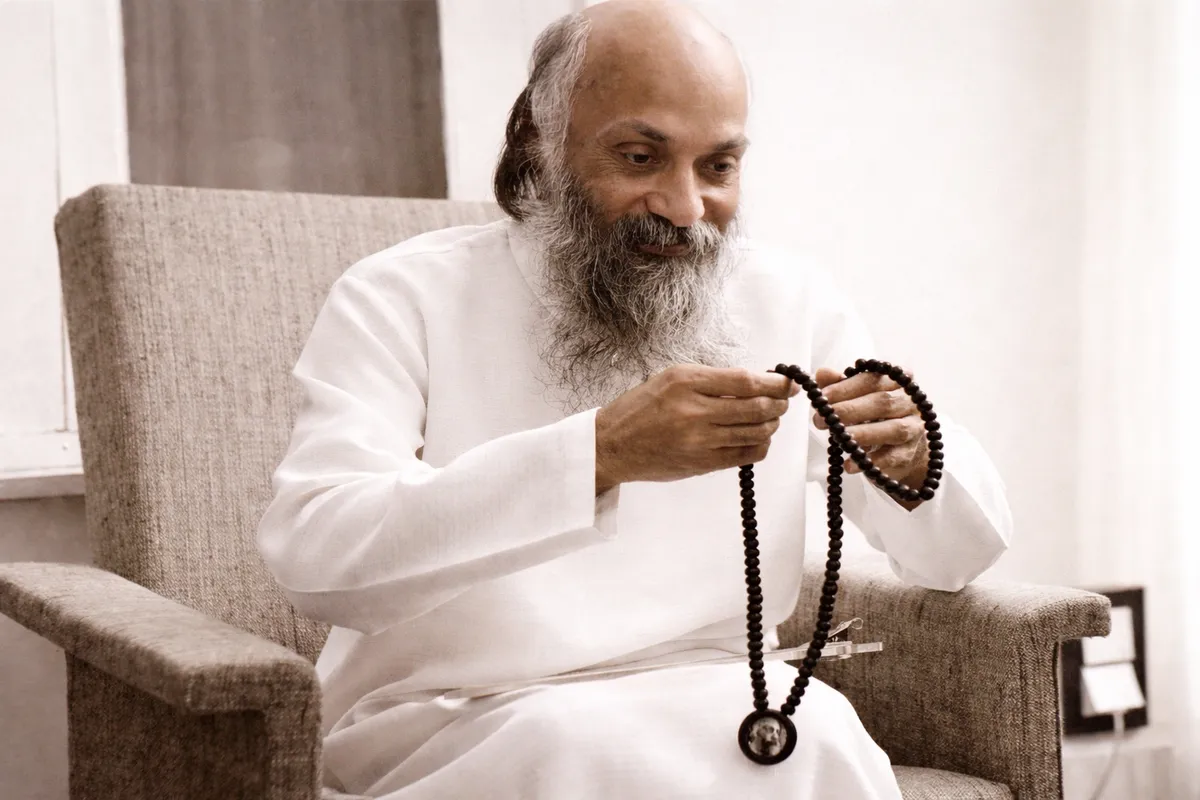
If you say no to life, you end up scared of death; welcome life, and death feels like part of the same trip.
From the Discourses
Passages where Osho speaks to this question — each links to the complete discourse.
Osho, why am I so much afraid of two groups here, the tantra and the encounter?
You see the stupidity? You are making conditions for me. You are trying to bribe me -- as if being called "Bhagwan" by Geet Govind is going to give me something, as if I am interested in being called "Bhagwan" by Geet Govind, or as if his sannyas is something immensely valuable for my existence. Reading his letter I was reminded of T.S. Eliot's lines: We are the hollow men We are the stuffed men Leaning together Headpiece filled with straw. Alas! If you are afraid to face your sexuality -- which is the beginning of your life, which is the source of your life -- and if you are afraid to face your death and the fear that it creates -- which is going to be the end of your life -- you are nothing but a "hollow" man, a "stuffed" man, a "headpiece filled with straw. Alas!" You…
Osho, in other religions death is almost never spoken of and when it is mentioned the tones are grave and fearful. In your religion, death is talked about freely and happily is this significant?
They said, "He has fallen sick. He is very sorry that he has not come, but don't be worried: he has talked about you to every man of any importance in Bombay. But we were expecting that you would be very old because of the way he described you and said,'Nobody speaks like this man.' We were not thinking of just a young man, a thirty -- year old." At that meeting naturally, among those twenty, thirty thousand people nobody knew about me. Chitrabhanu spoke first and he talked about one of the most significant things about Mahavira, the only things that can be called a miracle in Mahavira's life. A snake, a cobra, bites him; Mahavira is standing naked in meditation and a cobra bites him. Instead of blood, milk comes out of the wounds on his feet. Jainas have always believed that -- there is no problem. When…
Osho, why am I so much afraid of two groups here, the tantra and the encounter?
You see the stupidity? You are making conditions for me. You are trying to bribe me -- as if being called "Bhagwan" by Geet Govind is going to give me something, as if I am interested in being called "Bhagwan" by Geet Govind, or as if his sannyas is something immensely valuable for my existence. Reading his letter I was reminded of T.S. Eliot's lines: We are the hollow men We are the stuffed men Leaning together Headpiece filled with straw. Alas! If you are afraid to face your sexuality -- which is the beginning of your life, which is the source of your life -- and if you are afraid to face your death and the fear that it creates -- which is going to be the end of your life -- you are nothing but a "hollow" man, a "stuffed" man, a "headpiece filled with straw. Alas!" You…
To know death is certain,you said yesterday. This seems to be the approach of buddha, who was life-negative. But tantra's approach is life affirmative, not negative, so how can this death orientation be used in tantra?
Buddha focuses on the end - death. Tantra focuses on the beginning-life. That is why Buddha seems to be too much in love with death and tantra seems to be too much in love with sex, love, body, life. In the end there is death and in the beginning there is sex. Because tantra focuses itself on the beginning, sex becomes very important. So how to go deep and know what sex is, how to reveal the mystery of love, how to penetrate into the beginning, into the seed, so that you can go beyond -- that is tantra's approach. Buddha focuses on death, and he says to meditate deeply on death, move into it and know the whole reality of it. Both are two ends of the same thing. Sex is death, and death is very sexual. It will be difficult to understand. There are many insects which die…
Question: BELOVED OSHO, THEN ALMITRA SPOKE, SAYING, WE WOULD ASK NOW OF DEATH. AND HE SAID: YOU WOULD KNOW THE SECRET OF DEATH. BUT HOW SHALL YOU FIND IT UNLESS YOU SEEK IT IN THE HEART OF LIFE? THE OWL WHOSE NIGHT-BOUND EYES ARE BLIND UNTO THE DAY CANNOT UNVEIL THE MYSTERY OF LIGHT. IF YOU WOULD INDEED BEHOLD THE SPIRIT OF DEATH, OPEN YOUR HEART WIDE UNTO THE BODY OF LIFE. FOR LIFE AND DEATH ARE ONE, EVEN AS THE RIVER AND THE SEA ARE ONE. IN THE DEPTH OF YOUR HOPES AND DESIRES LIES YOUR SILENT KNOWLEDGE OF THE BEYOND; AND LIKE SEEDS DREAMING BENEATH THE SNOW YOUR HEART DREAMS OF SPRING. TRUST THE DREAMS, FOR IN THEM IS HIDDEN THE GATE TO ETERNITY.