
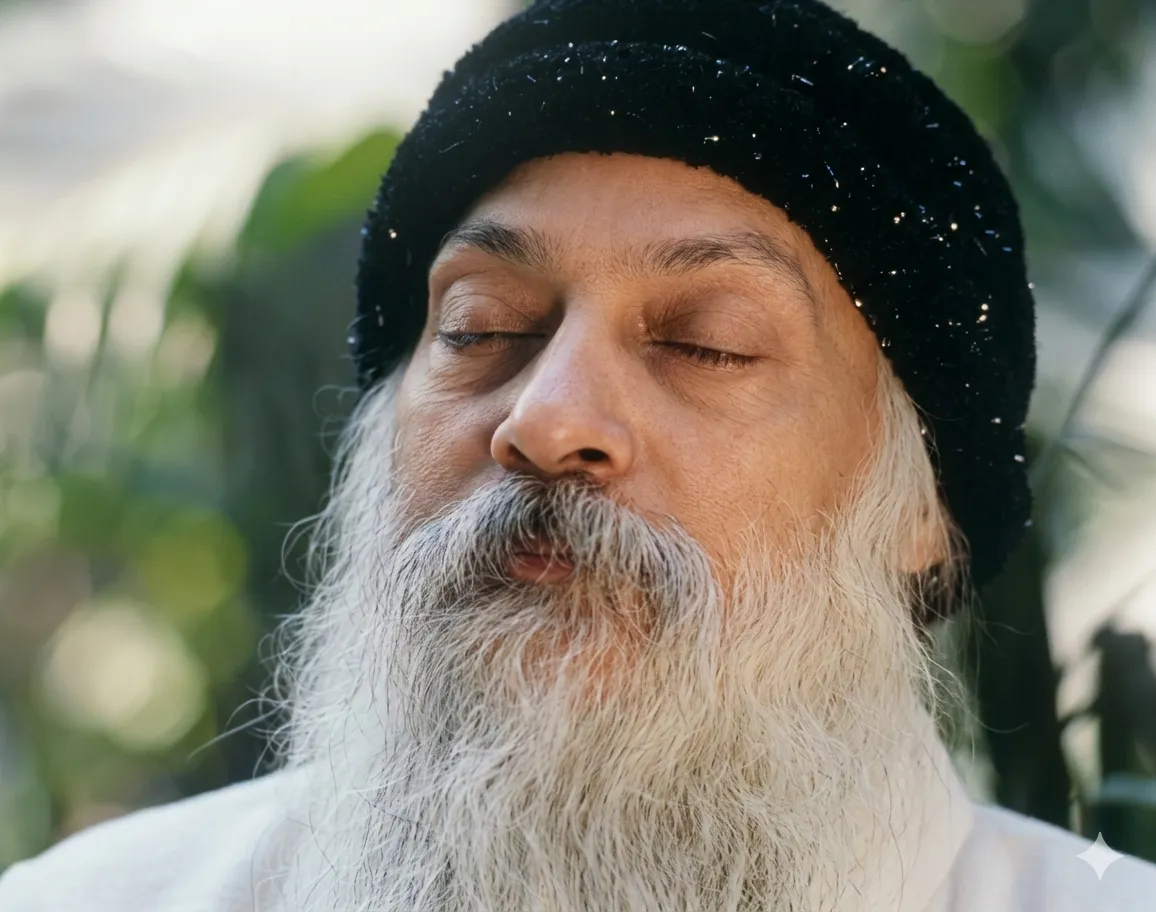
Osho says his father died awake and peaceful through meditation, turning death into a happy doorway to forever—and reminding us to practice letting go now.
From the Discourses
Passages where Osho speaks to this question — each links to the complete discourse.
Osho, would you say something about your father's death yesterday?
But I was against cutting off the leg, because one has to die one day -- why distort the body and why create more pain? And just living in itself has no meaning, just lengthening the life has no meaning. I said no. They were surprised. And when he survived for almost four weeks they thought I was right, that there had been no need to cut off the leg; the leg was coming back, becoming alive again. He had started walking also, which Dr. Sardesai thought was a miracle. They had not hoped for that much, that he would be able to walk. Yesterday he was perfectly normal, everything normal. And that gave me the indication that now death was possible. If meditation happens before death, everything becomes normal. One dies in perfect health, because one is not really dying but entering into a higher plane. The body becomes…
Osho! On the passing of revered Daddaji you told your sannyasins to celebrate, to dance. Yet even in the midst of celebration and dance, again and again tears kept wetting our eyelids. Osho, after Daddaji’s going the heart still cannot believe that he has gone. It feels as if he is right here. The love he gave us is inexpressible.
Many sannyasins will depart—it is natural. To bid them farewell you must learn a new way—of joyous celebration. It is secondary what your joyful celebration will do for the one who has gone, though it will do something; but that is subtle—whether you understand it or not. When you weep and suffer… Suppose a husband dies: the wife weeps, beats her chest, is distraught. Then the one who has gone cannot move on either; he too cannot go, he too remains stuck. When his dear ones are suffering so, weeping so, his lifelong habit of owning them does not break in a day; it takes time. If his dear ones weep intensely, he too will wander here as a ghost. Thus it is that you create ghosts. You will be surprised to know that in the West—among Christians, Jews, Muslims—there are more ghosts. In England there are more ghosts than…
Osho, I had seen him like a blossoming flower, swaying with the breeze of existence, spilling the fragrance of bliss, always blending the nectar of love into everyone’s heart. He had become absorbed in the divine; that very form of light had expressed itself in him. Buddhahood seemed to rush in and dissolve into simplicity. It felt as though God himself had become the devotee. But was he a dance-song immersed in devotion, or a beautiful, brimming, overflowing silence? He has simply joined the celebration—that is all. How can I say who Swami Devteerth Bharati was!
I cannot forget his gift, though it was hard. Whatever is more beautiful, more auspicious, more true in life is bitter at first; sweetness comes later. And whatever is untrue, inauspicious, un-beautiful, is sweet on the surface, and poison in the end. Remember this maxim. Otherwise you will be misled by the initial sweetness. Once you gulp that sweetness, the poison begins slowly to destroy your body, mind, life-breath. If truth is bitter, don’t be afraid—soon it will become sweet. When I was small I lived long with my maternal grandparents. There were thirty-two miles between my father’s place and my maternal home. No train, no bus, no taxi; in those days nothing—no road even. He would cycle those thirty-two miles to see me. In the rains it was very difficult—half the way he had to carry the cycle on his shoulder. Where there was mud, cycling was impossible; where…
Osho, seeing and hearing you speak, one thing continues to strike me: from your earliest childhood, up until the latest split second, you have always had so much self-respect and so much self-delight. Are we all capable of so much?
Each fragment may not give you the idea because it is out of context, but if you put it in the whole context.... I was being expelled from one college, another college, but I was enjoying it -- and that's what was shocking to them. When I was expelled from one college, my first college, it was this same principal who had to expel me. He felt very sorry, because it was not right to expel me; and by and by he had come to have a certain liking for me, for my absolute determination to be myself whatsoever the cost. He had grown, by and by, a certain respect: "This man can sacrifice anything even for buttons, just for the cap." He tried to persuade me, "If you wear the cap I guarantee you that you will get the first class first in the intermediate examination, because it is…
Thursday, december 11th:
[The birthday of Osho Shree. A mass darshan for thousands of seekers from India and abroad... ] <q>FRIDAY, DECEMBER 12TH:</q> [Members from the Enlightenment Intensive group were present] [To a sannyasin who had just learnt that her father died] ... how are you feeling? Your father had been ill at all? [She answers: No, but he was seventy-three. He lived a full life, so I don't feel sad. And I feel it was good he died on your birthday] Yes, that was good.... Death should never be a cause to be sad. If one has lived, and lived well, loved, and loved well, then there is no cause to be sad about it. A death can be as beautiful as life can be beautiful. All lives are not beautiful and all deaths are not ugly. And the death depends basically on the life. It is the culmination, the crescendo, the…