
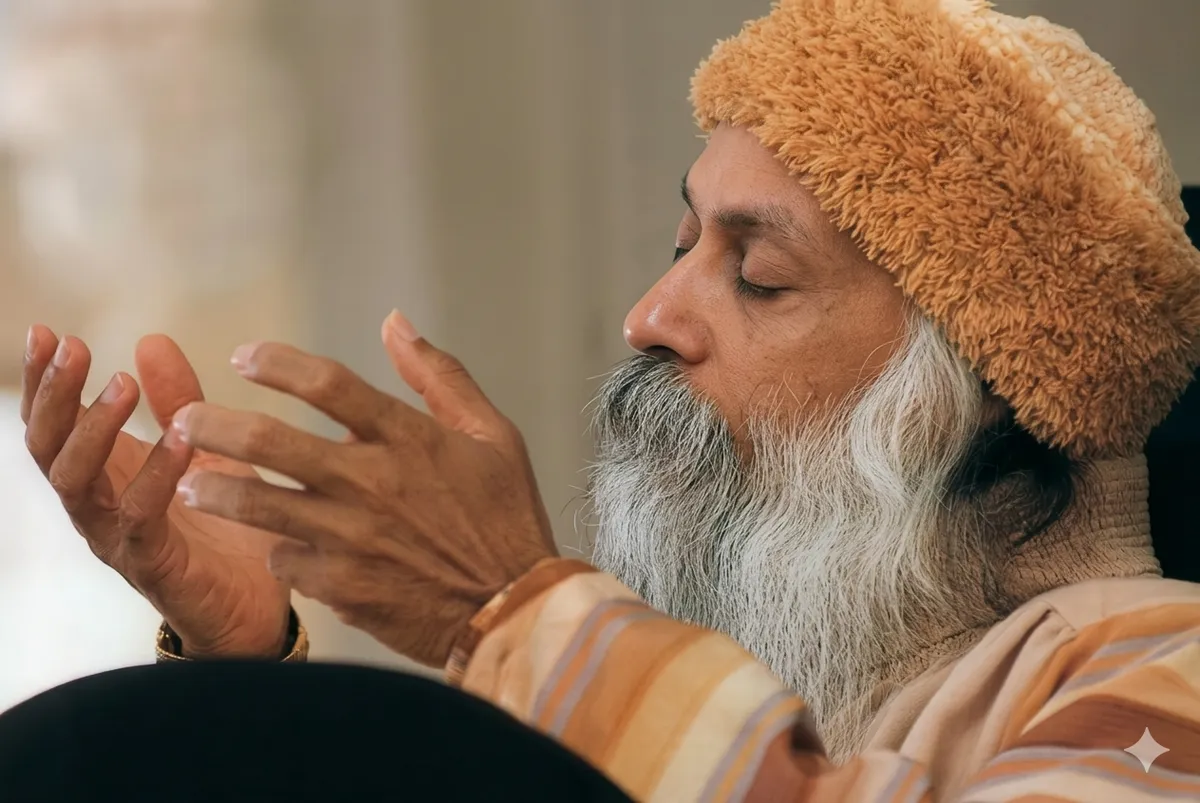
Like a seed losing its shell to become a flower, your body and ego can die, but the real you doesn’t—it blooms.
From the Discourses
Passages where Osho speaks to this question — each links to the complete discourse.
Osho, what is the essence of Gorakhnath’s teaching?
Very small, concise— Laugh, play, live in color. Do not keep company with lust and anger. Laugh, play, sing songs. Keep your heart-mind steady and firm. This is my teaching too: Laugh, play, live in color. Live in color! In delight, in merriment, in joy. So much has the Divine given—dance, hum, sing! A song of gratitude should rise from your heart; that is prayer. Laugh, play, live in color. Laugh. If you cannot laugh, understand that you can never be religious. Your so‑called sadhus and saints have forgotten how to laugh. They simply cannot; to laugh is a sin, a transgression. That’s why you can’t stay long with them. You go, quickly touch their feet, bow, and leave. If you stay a full day, you’ll see the difficulty—your own laughter will be snatched away. People become grave around sadhus and saints. They stiffen up—dry, solemn, ultra‑serious! Laughter will feel…
Osho, forget even talking about death—I am afraid of the very word. How can one get rid of death?
Kusum Rani! There is no getting rid of death. One will have to die! Death is the other side of the same coin as birth. Once you are born—once you have taken one side of the coin—how can you avoid the other? Death already happened in birth. It may take you seventy years to find out, that’s all; but the event has already occurred. The very day a child is born, cry then and there; death has arrived. Now, whether anything else happens in life or not, one thing is certain: there will be death. Life is wondrous! In it, nothing is certain except death. Everything else is uncertain—may or may not be; but death will surely be. However much you run and hide, no one can escape death, no one can outrun it. And the more you fear, the more you die. Death comes only once, but to the…
Osho! I am an internationally renowned man of letters, thinker, philosopher, scientist, and religious preceptor, and yet I seem to be living only death. If liberation from death is possible, then what is the way to befriend it and become one with it?
Before you fly from this cage, if only you realize “I am not the cage,” then there will be no need to enter another cage! You will dissolve into existence, become one. Then there will be neither birth nor death. Then your life is eternal. Then you become one with the eternal law. Esa dhammo sanantano! Buddha says: such is the eternal dharma. It makes no difference whether you are famous or unknown. What difference could that make? How many know you—what of it? Even if millions know you, what then? Do you know yourself or not—that is the question. And the strange thing is: why do people crave fame? Precisely so that others may know them. They do not know themselves, have never recognized themselves; there has never been any meeting with the soul; they have never even encountered themselves—no bridge to themselves—so they feel empty, and want to…
And the reason why we can't see it is that we always see others die. Naturally the body becomes dead: the bird, the invisible bird, flies. That was the real person, but we had never seen him; we had always believed him to be his body. So the cage is left there, dead, silent, because the bird is no more there -- no song, no fluttering, no noise, no movement. But the bird continues in another cage somewhere else, in another womb, in some other body, in some other form. And ultimately one becomes a non-body, a non-physical, invisible existence. Ultimately one becomes one with the cosmos. That's the last death, the ultimate death. When the death happens the body dies, but one is no more born into another body. The East has been searching for it.
A friend has asked: Osho, why should we think about death at all? We have life—let us live it. Be in what is present. Why allow the thought of death to come in between?
Just as there can be fear of sleep. Sleep is, in a way, a daily death. The day is life; the night is death. It is a piecemeal death. Every day we die a little, we sink within; in the morning we return fresh again. Then after seventy or eighty years the whole body gets tired—work, work, work—the body wears out. Then full death takes hold; the entire body changes. But we are very afraid of that. It is a deep sleep. Yet we are very afraid of it. Have you noticed that the body changes every morning too? It changes a little, which is why you don’t notice. It does not change completely; there is a partial transformation. When you go to sleep in the evening, your body is in one condition; when you wake in the morning, your body is in another. By morning the body has become…