
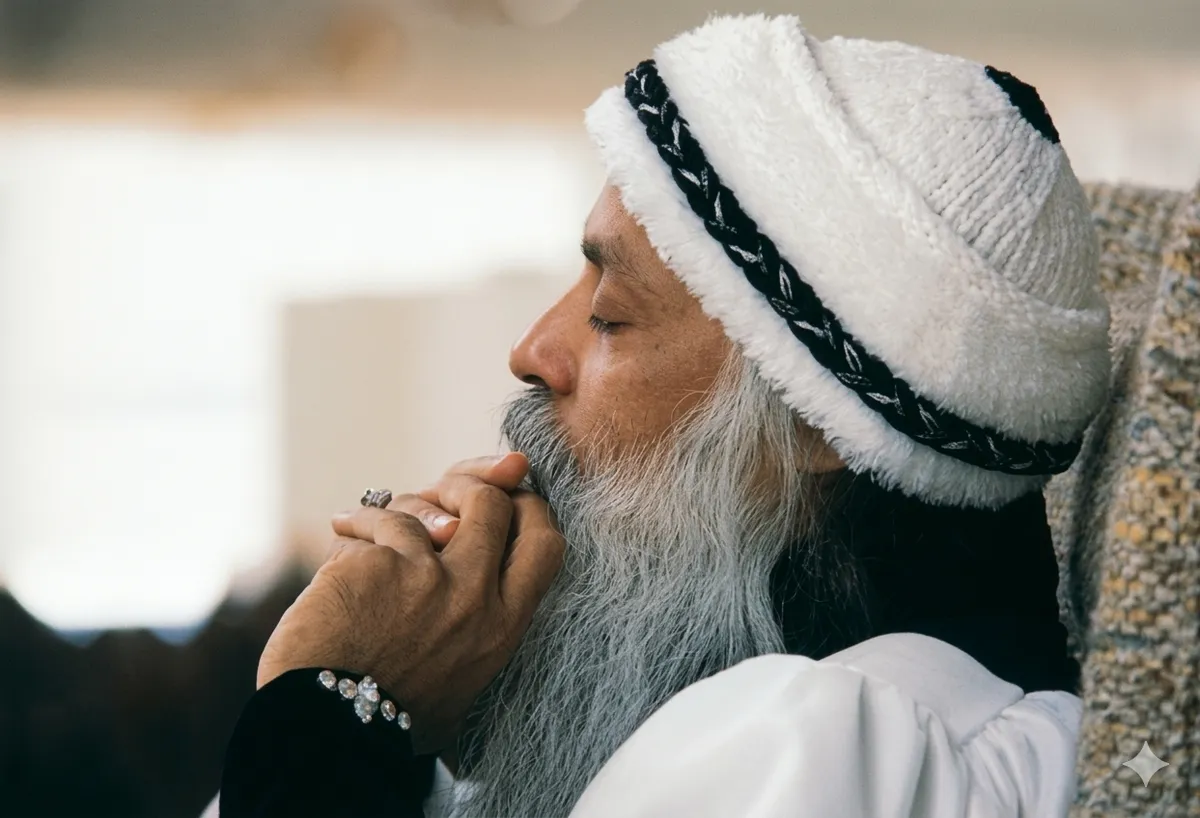
According to Osho, death is not an end but a change of form—the curtain falling in existence's play. As child becomes youth and seed becomes tree, life only transforms; nothing real is destroyed. Matter is indestructible, and so is consciousness. You were before and will be after; upon awakening, one remembers continuity across births—or rests in liberation beyond return.
Death is like going behind a curtain to change costumes—you’re still there, just in a new form or finally free of the stage.
From the Discourses
Passages where Osho speaks to this question — each links to the complete discourse.
Osho, what is the essence of Gorakhnath’s teaching?
Very small, concise— Laugh, play, live in color. Do not keep company with lust and anger. Laugh, play, sing songs. Keep your heart-mind steady and firm. This is my teaching too: Laugh, play, live in color. Live in color! In delight, in merriment, in joy. So much has the Divine given—dance, hum, sing! A song of gratitude should rise from your heart; that is prayer. Laugh, play, live in color. Laugh. If you cannot laugh, understand that you can never be religious. Your so‑called sadhus and saints have forgotten how to laugh. They simply cannot; to laugh is a sin, a transgression. That’s why you can’t stay long with them. You go, quickly touch their feet, bow, and leave. If you stay a full day, you’ll see the difficulty—your own laughter will be snatched away. People become grave around sadhus and saints. They stiffen up—dry, solemn, ultra‑serious! Laughter will feel…
Someone asked Osho's views on death and dying.
There is nothing as sure as death. Where there is life, there is bound to be death. He who bears not this fact in mind, wastes life, whereas he who knows this truth, obtains that which is immortal. I do not feel depressed at anybody's death, because there is no need to feel anything about it. However, it is a matter of sorrow, no doubt, if I see a life wasted. We have not to grieve after a dead body, but over a wasted life. You know, King Janak was called 'videh', i.e., without or beyond the body. Once, a young minister of his asked him, 'Your Excellency! How can you be considered without a body, when you do have a physical body? The king smiled but said nothing. After a few days, however, the king invited the minister for lunch. Such an invitation from the king himself was a…
Beloved Osho, you speak of reincarnation. I have not experienced it, and I don't want to believe in anything I don't experience. What to do?
Who is asking you to believe in reincarnation? And why are you concerned to do something about it? There must be some lingering belief. If you don't believe in reincarnation, that is the full stop. Why bother about what to do? Don't believe in reincarnation! Just live this incarnation, and you will come to experience that reincarnation is not theory, it is a reality. Just live this incarnation. Do you believe in this incarnation, or not? Reincarnation is either in the past or in the future, but you are here, alive. Life is throbbing in you. I know reincarnation is a truth. But I am not saying that you should believe it because I say so. Never believe anybody else's experience; that is a hindrance. I can only say to you, just live this incarnation. That will open doors and you will be able to see backwards, you will be…
Can you say something about death and the art of dying?
Indians are still hoping that with a little better technology, a little better government, a little more money, a little more production, things will all be perfectly okay. The Indian mind is hoping, it is very materialistic. The modern Indian is more materialistic than the people of any other country. The materialist countries are fed up with materialism. It has failed; they are disappointed and disillusioned. So let me tell you, my sannyasins are more Indian. They may be Germans, they may be Norwegians, they may be Dutch, they may be Italians, French, English, Americans, Russians, Czechs, Japanese, Chinese, but they are far more Indian. Journalists again and again come and ask, "Why don't we see more Indians here?" And I say, "They are all Indians! There are just a few foreigners -- just those few whom you think are Indians, just those few foreigners; otherwise they are all Indians."…
Osho, in other religions death is almost never spoken of and when it is mentioned the tones are grave and fearful. In your religion, death is talked about freely and happily is this significant?
They said, "He has fallen sick. He is very sorry that he has not come, but don't be worried: he has talked about you to every man of any importance in Bombay. But we were expecting that you would be very old because of the way he described you and said,'Nobody speaks like this man.' We were not thinking of just a young man, a thirty -- year old." At that meeting naturally, among those twenty, thirty thousand people nobody knew about me. Chitrabhanu spoke first and he talked about one of the most significant things about Mahavira, the only things that can be called a miracle in Mahavira's life. A snake, a cobra, bites him; Mahavira is standing naked in meditation and a cobra bites him. Instead of blood, milk comes out of the wounds on his feet. Jainas have always believed that -- there is no problem. When…