
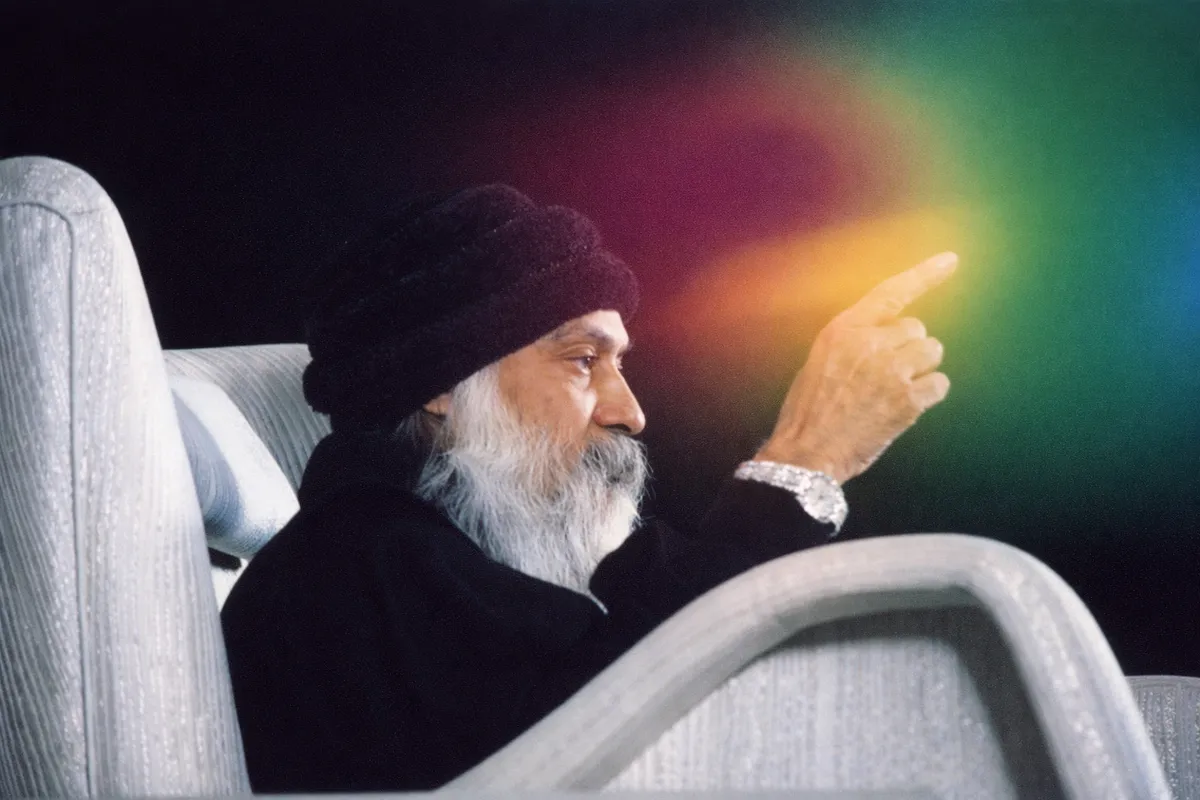
According to Osho, Eastern psychology centers on facing death directly: whatever is, must be looked into. Because life inexorably moves toward death, avoiding death means avoiding life. By consciously encountering death - especially through deep meditation, a voluntary inner 'death' - one discovers the witnessing essence beyond death and thereby transcends fear. Thus, understanding death becomes the key to understanding life and attaining inner freedom.
Don’t hide from death; if you look at it calmly—like in meditation—you find a quiet part of you that doesn’t die, and living gets easier.
From the Discourses
Passages where Osho speaks to this question — each links to the complete discourse.
Yesterday you said that the understanding of death is the basis of eastern psychology, and the understanding of sex is the basis of western psychology. Will you please say something more about it?
Death is the greatest thing that is going to happen in life; death is the climax. Death has to be understood, because death is the goal of life: all life is moving towards death. Not to understand death will really mean not to understand life. But we have been taught to avoid the fact of death; we don't talk about it, we don't think about it. The very idea gives shivers; a trembling arises in the being and we want to be occupied somewhere else. When somebody dies you feel a little embarrassed. It looks like this is not the thing to be done -- why should he die? Anybody's death brings you again and again to the awkward situation, and the awkward question arises in your being: 'One day, am I also going to die?' -- and that you want to avoid. The East has not avoided anything. That's…
People don't like to talk about death. It is not thought to be polite, mannerly, cultured, to talk about death, because it reminds everybody of his own death which is always there, hanging like a naked sword from a very thin thread: it can fall any moment! Just a little breeze is enough and it can fall on you. How can you enjoy life? How can you live totally when death is always following you like a shadow? It contaminates all your joys. It is a well-known fact, observed almost all over the world by all the researchers, that people are afraid of love for the simple reason that when they move into love-making a moment of deep orgasmic joy comes when they suddenly experience themselves as being close to death, melting, disappearing, and they become frightened, they become frozen.
Osho, you said the truth of life is death. Then what is the truth of death?
Buddha called this the state of suchness—accepting what is, as it is. No yes-and-no. No imposing your desire that it be like this or like that. As it is, let it be as it is. Kabir said: Just as it is—accept it as such. Because as long as you reject, you are fighting life—you are contending with God. You are trying to impose your will. You are not a seeker of truth; your ego is still thick. In accepting what is, as it is, the ego dissolves; there remains no place for it. The struggle is gone, the ego is gone. Ramana lay down. He consented: If death comes, it comes. What is in my hands? “Jih vidhi rākhe Rām, tih vidhi rahiye”—In whatever way Ram keeps you, remain that way. If death has come, it has come. This is how Ram wishes to take me—so be it. He was…
What is the relationship between meditation and the unlearning process?
In the East just the totally different thing has happened. We cannot conceive of Buddha going mad. That would be the most impossible thing in the world: Buddha going mad. Nietzsche goes mad because Nietzsche is a thinker, Buddha CANNOT go mad because he is a NO-thinker; he drops thinking, how can he go mad? One day the whole crowd is gone and he is sitting alone, nobody to even disturb, so much alone that he is not even one, because who is there to say that you are one? If somebody is there to say that you are one, the other is still present. Meditation is unlearning. Peel your onion. It is difficult, because you have become identified with the onion, you think these layers are YOU so to peel them is difficult, it is painful also, because it is not like just throwing your clothes, rather it is…
Osho, to remain awake to life, is the fear of death necessary?
I did not speak of fearing death, because what does fear of death even mean? It is essential to know that death is. The one who does not know this is the one who is afraid. To be afraid means we carry the notion that someday we will die—that what we presently take to be life will be snatched away. So the fear is that death might take away our life. That is what the fear is. But if you come to know that you are already dead, what is there to fear? If you come to see that every day you are dying, that much of you has already died, what is there to fear? As long as what you take to be life appears to you as life, the fear of death appears. And if this very thing begins to be seen as death, what fear of death…