
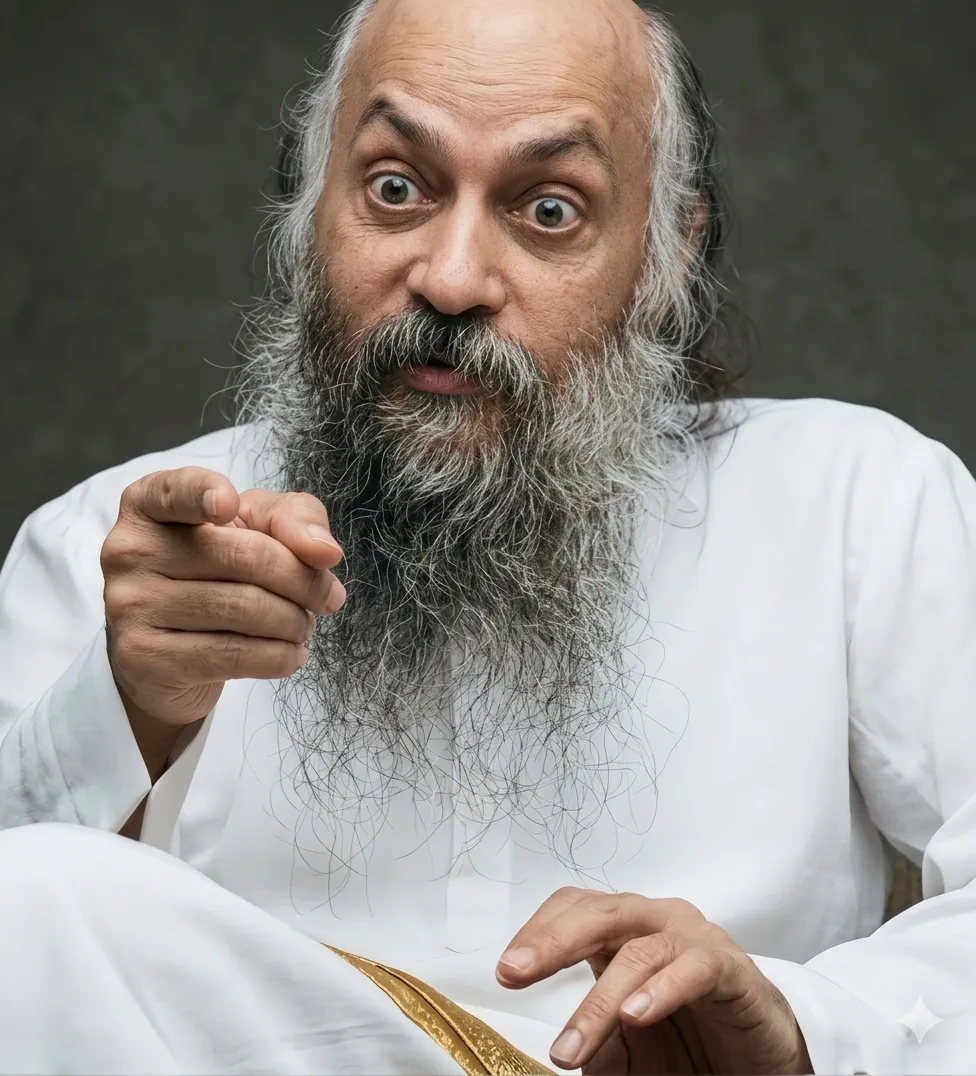
We black out at death because we’ve lived on autopilot; train awareness now to stay awake even while dying.
From the Discourses
Passages where Osho speaks to this question — each links to the complete discourse.
Beloved Osho, it is stated that man becomes unconscious at the time of death. Why is this so? Is it due to the terror of death or the process of death?
Ananda said, "But you are a little late. We have given our permission that the master can disappear into the whole, and he has already entered the first stage. So please forgive us, it is not our fault. Forty-two years you have postponed; now wait a few thousand years more. When another Buddha appears, another enlightened man, then don't be so foolish." But Buddha opened his eyes. He said, "Ananda, this will be a condemnation for me -- that a man had come thirsty, and I was still alive and I could not quench his thirst. I can delay death a little bit, but his question has to be answered; otherwise the poor fellow will feel guilty his whole life." A conscious man dies in a totally conscious way, step by step. And if he wants to return before he has taken the fourth step, he can come back. His…
One friend has asked: one can die fully conscious, but how can one be in full consciousness at birth?
Remember, the darker the night, the brighter the stars. The flash of lightning stands out like a silver strand, the darker the clouds are. Similarly, when, in its full form, death surrounds us from all sides, at that moment the very center of life manifests in all its glory -- never before that. Death surrounds us like darkness, and in the middle, that very center of life -- call it atman, the soul, shines in its full splendor; the surrounding darkness makes it luminous. But at that moment we become unconscious. At the very moment of death, which could otherwise become the moment to know our being, we become unconscious. Hence one will have to make preparations towards raising one's consciousness. Meditation is that preparation. Meditation is an experiment in how one attains to a gradual, voluntary death. It is an experiment in how one moves within and then leaves…
A friend has asked, Osho, one can die with awareness, but how can one be born with awareness?
Most fasters spend twenty-four hours repeating, “I am hungry; I have not eaten,” with their minds absorbed in planning tomorrow’s menu. Then the fast is wasted; it is merely a hunger-strike. That is the difference: a hunger-strike means not eating; upavasa means “dwelling nearer and nearer.” Nearer to whom? To oneself. Away from the body, closer to the self. Even the word upavasa carries no implication of starving; it means nearer-dwelling. Thus one could be in upavasa even while eating—if one knows the eating is at a distance and “I am elsewhere.” And one could not be in upavasa even while not eating—if one keeps thinking, “I am hungry; I’m dying of hunger.” Upavasa is a psychological knowing of one’s separateness from hunger. Other sufferings too can be invited voluntarily. A man can even lie on thorns, simply to see that the thorns do not pierce me; they pierce elsewhere,…
Is death also like that—does it happen in unconsciousness?
Absolutely. That is precisely why one never really experiences death. We have died many times, yet we did not experience it—because long before the actual moment of dying we had already fainted. Hence we never came to know the event of death. We have died many times, but almost as if under chloroform. And nature has made full arrangements. Nature has arranged it so that any situation beyond your capacity to endure immediately makes the body release such elements that you become unconscious. For example, if an overwhelming sorrow descends, one faints. The sorrow was so intense that, had one not fainted, one would have died. To save you from death there is a substitute: the body renders you unconscious. Then you are no longer aware of the pain. By the time you regain consciousness, time will already have healed much of the wound. And if the practice of meditation…
Osho, in the Dwarka camp you said that meditation and samadhi are a voluntary, conscious entry into the state of death, through which the illusion of death dissolves. Then the question arises: to whom does the illusion of death occur? Does it occur to the body or to consciousness? Since the body is only an instrument, it cannot have delusive awareness; and there is no reason for consciousness to be deluded. Then what is the cause and basis of this event of delusion?
They sent word. She came very annoyed. “It’s his same old habit,” she said. “He’s grown old but hasn’t dropped it. Even at death he will create mischief.” She came with a stick, banged it on the ground and said, “Stop this devilry! If you must die, die properly!” The man laughed, came down, and said, “I was only playing a little—wanted to see what they would do. Now I will die properly, conventionally.” Then he lay down and died. His sister left, saying, “Fine, now finish the rites. There is a right way for everything; do things properly.” Our illusion about death is a social delusion. It can be broken. There are methods and arrangements to break it. And even if no one else breaks it for you, anyone who has done a little meditation will break it himself at the time of death. No outside help is needed.…