
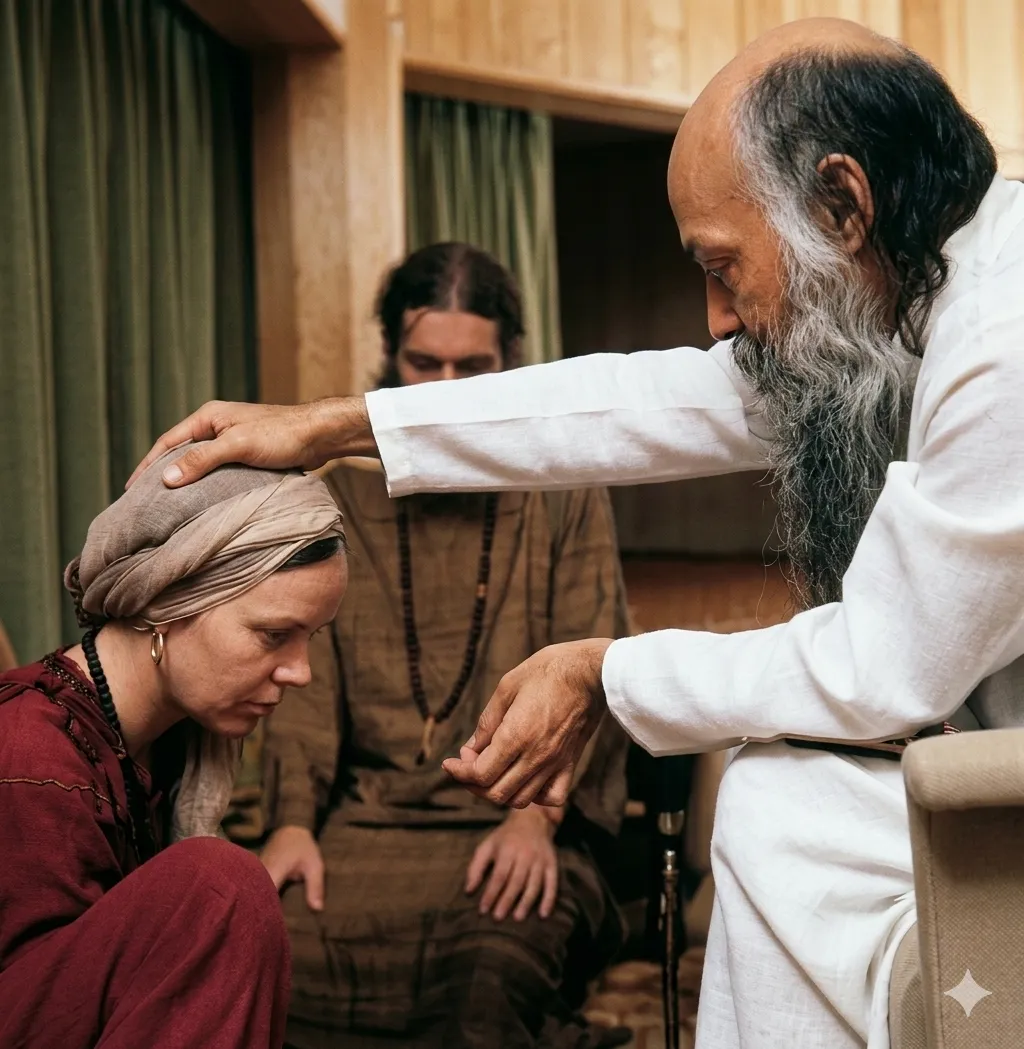
You feel sad because you’ve become one with the master and fear losing the guide and the warm space he fills in you—so the pain is about your own unfinished journey and its possible emptiness.
From the Discourses
Passages where Osho speaks to this question — each links to the complete discourse.
Osho, the moment I heard someone talk of shooting you the other day, I kept crying. I have never cried in my life even over anyone’s death! Now I tremble just hearing talk of your death. Why? Please explain.
I cradle upon my eyelids this delicate dream of someone’s. Why does someone say I am lost in the tangle of the dark, that in smoke-filled streets I have wept like lightning, hiding? I am pouring into every particle, O bee, a love like tears for someone’s. I cradle upon my eyelids this delicate dream of someone’s. On the dust the thorn’s soft kiss, in the sky the clouds’ invitation; today the ocean of cataclysm greets my trembling. A storm-messenger has brought, fragrant, someone’s breath as a gift. I cradle upon my eyelids this delicate dream of someone’s. The pupil has stolen the sky, the heart has hidden a lightning-realm; like body-color upon my limbs is the boundless shadow of the One. Upon my own body, O bee, how becoming is, I know not why, someone’s adornment. I cradle upon my eyelids this delicate dream of someone’s. For the first…
When we love a person he becomes part of our being. That's exactly what love is: becoming parts of each other, becoming members of each other. So when a person dies, a part of you dies with him. It is not simply a suicide of [him]; it is a partial death of [you] too. He has taken a part of you, the part that he has put inside you, that had become involved with you; he has taken that away. Now there is a blank, a hole; it hurts. So when you go back to the flat it hurts more because everything reminds you of it. If death is natural then one can accept it; because what could poor [man] have done? One can forgive a natural death, mm? because he would have simply died; what could he have done about it?
Osho, when you speak of your death I begin to tremble. Master, we cannot bear to hear it. We cannot live without you. Even the thought makes the heart shudder.
We had a friend—Ramlal Rana. In the machinery of his head, who knows what went wrong. He began to take himself to be a grain of wheat! Wherever he saw a rooster—he would be afraid: “This one will eat me”— and die a thousand deaths while still alive. Wherever he saw a sack, he grew nervous, skittish: “Someone will stuff me into it, tie it shut.” And if a flour mill came into view, Brother Rana would run for his life: “Here I’ll be ground to powder!” Well, some well-wishers, to set his brain right, filled out a form and had him admitted to the asylum. The doctor explained, “Dear Rana! You have two ears, two eyes, two legs, two hands, you walk, you speak— how can you be a grain of wheat?” But Rana wouldn’t agree— simply wouldn’t agree. He went on believing himself a grain of wheat. A…
Beloved Osho, I have been your sannyasin for a few months, after a long search for a master. Now I am afraid you might die, and I cannot fulfill the meaning of my life without your presence.
Prem Felix, you are still too concerned with your own ego. You are not worried about my death; you are worried about your enlightenment -- what will happen to your enlightenment. You are not aware that this is not love; this is not trust. You are trying to use me. And love never tries to use. You have not yet found the master; you have simply believed.... Because you find here so many people in such deep love and in such deep ecstasy, you have believed in them -- perhaps here is a master. But it is a perhaps. If you have really found your master, you will forget all about your enlightenment. In finding the master, you have already found the path. In finding the master, you have already found someone who is going to be with you, even after death. That is the meaning of being with a…
Osho! The story of the passing of Saint Rajjab, Sundaro, and Dadu has always thrilled me. But what I saw with my own eyes at the time of the death of my Master, and our beloved Dada, who was also my friend, thrilled me even more. It fills my eyes with sweet tears.
All who were immersed in me there felt it. Nikalank was there, Shailendra was there, Amit was there, Swabhav was there, Sohan was there, Usha was there. Sheela used to come every day. Lakshmi came every day. My mother was there. They all felt something exceptional had happened, something that cannot be bound in language, hard to comprehend—yet something happened; something crossed beyond! But this was felt only by those close to me. The nurses were there, the doctors were there, the hospital staff was there; they felt nothing. The next day when I spoke here, Dr. Sardesai gathered all the staff and doctors and played my tape. His affection for me has slowly begun—hesitantly, timidly. Naturally, near a man like me there is nervousness: there is a wife, children, responsibilities. And they see those who come to me go mad, drown. He has seen his friend Ajit Saraswati drown.…