
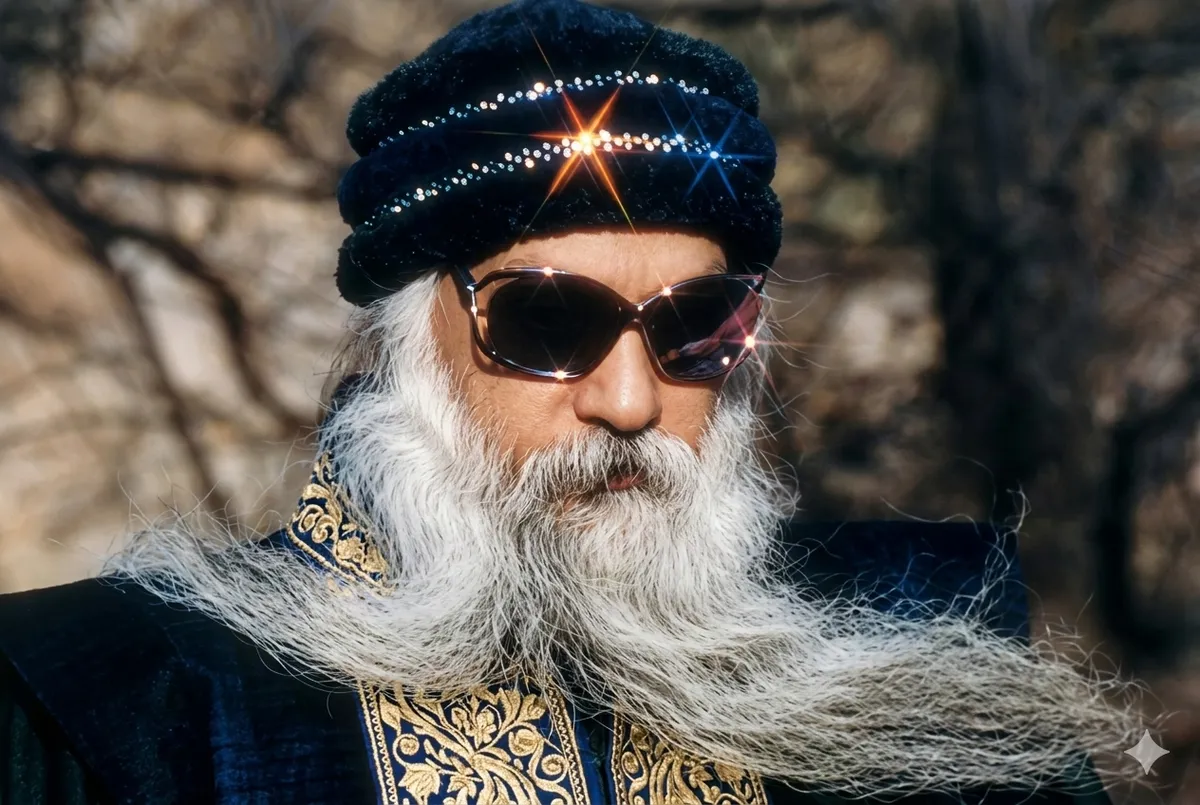
According to Osho, dharma is truth: the state of non-relationship, resting unwaveringly in your own nature as the thought-free witnessing consciousness. Truth is not what you understand, but the knower within who sees. Even attachment to a master must fall; a true satguru is only a doorway. When ignorance and understanding, world and renunciation drop, what remains—the witness—is dharma, God, liberation, your innermost nature.
Dharma means being the quiet watcher inside you, free from all attachments—even to ideas or teachers.
From the Discourses
Passages where Osho speaks to this question — each links to the complete discourse.
It is asked again: “Is dharma the truth?”
Dharma is truth. Dharma means: a state of non-relationship. Dharma means: to be steady in one’s own nature; to be immersed in oneself. Nothing remains outside. No kind of connection with the outside remains. Not even the relationship with the master remains. The true master is the one who brings you to the place where you are freed even from the master. Such a master is called a satguru. The one who entangles you in himself is called a false guru—who says, “Don’t go beyond me. This is your halt; the destination has arrived. No further.” The one who holds you stuck in himself is a false guru. The one who lets you go beyond himself, who becomes a ladder, a doorway—so you climb and pass through—he alone is the satguru. And remember: a feeling of gratitude arises only toward the satguru. Toward a false guru, anger will arise—if not…
Osho, have you completely attained dharma? Are you a true master? Are you capable of bringing God to me?
In a town of madmen, a sensible person has arrived! Questions raised out of cleverness have no value. Below it is signed, “a seeker of truth.” There is neither curiosity nor search here; the mind must be stuffed with beliefs. A true seeker does not even know that God is. A seeker does not even know that dharma is. A seeker does not even know that there is a master. A seeker does not so much ask questions; a seeker declares his thirst. Questions arise in two ways: one as thirst—then their quality is different. And the other out of information, from an intellect filled with junk; from that, questions arise. The first question: “Have you completely attained dharma?” Do you even know what dharma is? Do you know what “completely” means? In the realm of dharma, does anyone who “attains” remain? Each word needs to be understood, because it…
Dharma, religion, is not a social phenomenon, it is purely and simply the most personal transformation. It has nothing to do with others; it is concerned with one's own self alone. It isn't concerned with what a man does with others but what he does with himself. Dharma is concerned with how you behave with yourself in your total isolation and loneliness. What are you in your total isolation? That is what you must know -- who you are. Only the knowledge of your being will lead you to religion. There is no other way to lead someone to religion. No temple, no mosque, no church can take me to the place where I am. You don't have to climb any outside stairs to get there. All temples are outside. All temples are part of samsara, of the world, and you cannot reach the self through their doors.
Osho, you have titled this series of talks “Sahaj Yoga.” Do “sahaj” and “yoga” not seem mutually opposed?
Anand Maitreya! They don’t just seem opposed, they are opposed. But no ultimate truth of life can manifest without contradiction. Life is made of opposites—darkness and light, day and night, woman and man, negative electricity and positive electricity, birth and death. The very structure of life is woven of opposites. Hence the opposites are not only opposed; they are complementary to each other. If you have labored hard all day, you will be able to sleep deeply. Labor and rest are opposites, yet only the one who has worked can rest deeply—and the one who has not worked cannot. So the opposites are not only opposed, they complete each other. And only the one who has rested deeply at night can rise in the morning and engage in work again. One who has not rested through the night will not be able to work in the morning. Look closely at…
And the fifth thing they said was, “Now Osho is speaking properly; he isn’t like before—he has improved a little!”
Absolutely wrong! I am getting worse. The question of improving does not arise. The more I experience all these fools, the sharper I keep my edge. Their necks have to be cut. I am driving the blade in deeper. My blow will grow deeper every day. Let no one remain in this mistake. And yet they go on explaining this to my disciples. Now this is most amusing: on the one hand they call me “Bhagwan Rajneesh,” and on the other they say I am improving! Is there anything left to improve in a Bhagwan? Does it mean that even after being God something still remains to be improved? Only “worsening” remains; there is nothing left to improve. And once you are a Bhagwan, even the fear of worsening is gone. Now, even if you send me to hell, it makes no difference. I will celebrate there too. There you…