
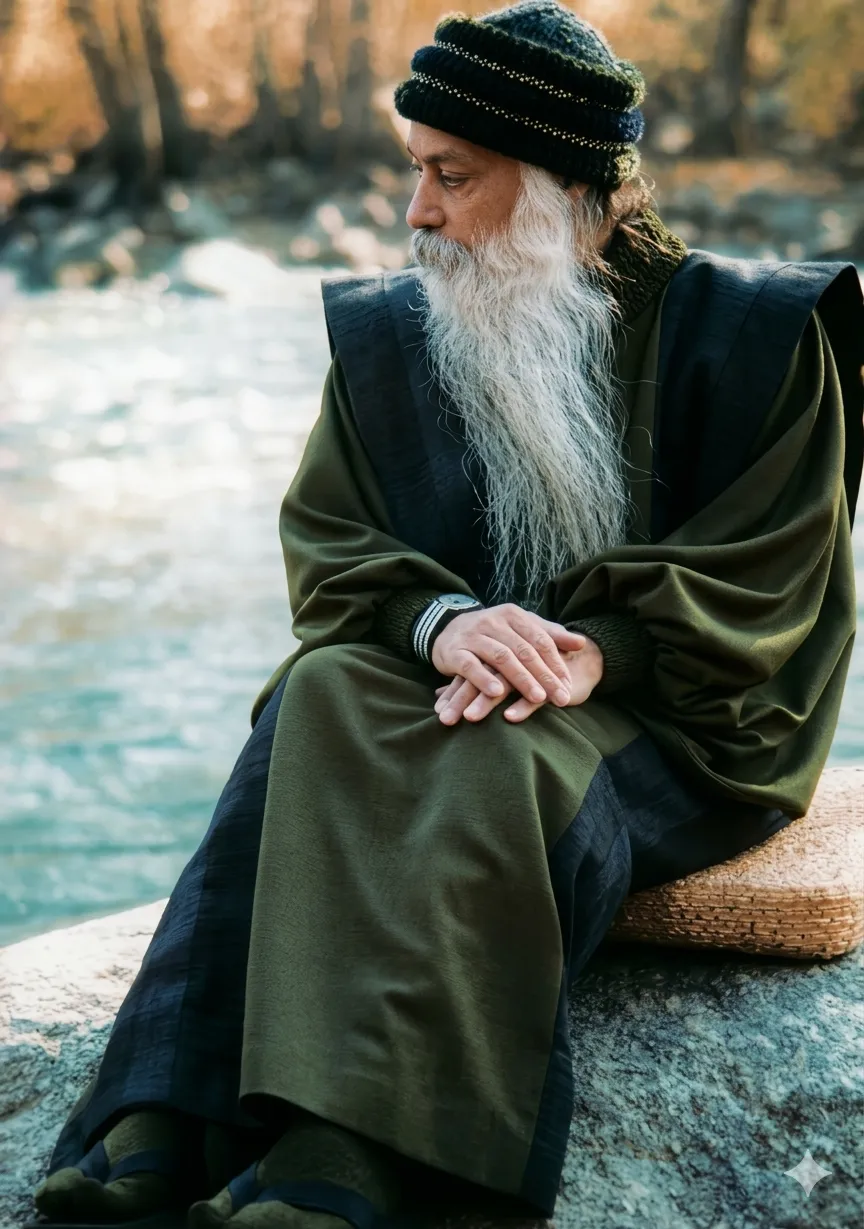
Death isn’t a forever nap—it’s like unplugging from the body; if you still want things you’re born again, and if you’re done wanting you wake up into everything.
From the Discourses
Passages where Osho speaks to this question — each links to the complete discourse.
Beloved master, when I am dead, am I really dead? I want to be really convinced that death is eternal sleep.
It is not a conviction, it is not a belief -- it creates trust. And once trust is created the journey has started. I know, Ram, you need great help. I have looked into your eyes -- just once you have been here and just once I have looked into your eyes -- they look very sad. You must be carrying great anguish inside yourself. On the outside you are a successful man, the topmost criminal advocate in this country. On the outside you are successful in every way -- a member of the parliament, president of the lawyers association of India -- but deep down I have seen, just a passing glimpse, that you are sitting on a volcano. I have seen great anguish in your eyes, great tears just waiting to flow from your eyes. You are not in any way blissful. I can make you blissful --…
Osho, what is the essence of Gorakhnath’s teaching?
Very small, concise— Laugh, play, live in color. Do not keep company with lust and anger. Laugh, play, sing songs. Keep your heart-mind steady and firm. This is my teaching too: Laugh, play, live in color. Live in color! In delight, in merriment, in joy. So much has the Divine given—dance, hum, sing! A song of gratitude should rise from your heart; that is prayer. Laugh, play, live in color. Laugh. If you cannot laugh, understand that you can never be religious. Your so‑called sadhus and saints have forgotten how to laugh. They simply cannot; to laugh is a sin, a transgression. That’s why you can’t stay long with them. You go, quickly touch their feet, bow, and leave. If you stay a full day, you’ll see the difficulty—your own laughter will be snatched away. People become grave around sadhus and saints. They stiffen up—dry, solemn, ultra‑serious! Laughter will feel…
Osho, in the Dwarka camp you said that meditation and samadhi are a voluntary, conscious entry into the state of death, through which the illusion of death dissolves. Then the question arises: to whom does the illusion of death occur? Does it occur to the body or to consciousness? Since the body is only an instrument, it cannot have delusive awareness; and there is no reason for consciousness to be deluded. Then what is the cause and basis of this event of delusion?
They sent word. She came very annoyed. “It’s his same old habit,” she said. “He’s grown old but hasn’t dropped it. Even at death he will create mischief.” She came with a stick, banged it on the ground and said, “Stop this devilry! If you must die, die properly!” The man laughed, came down, and said, “I was only playing a little—wanted to see what they would do. Now I will die properly, conventionally.” Then he lay down and died. His sister left, saying, “Fine, now finish the rites. There is a right way for everything; do things properly.” Our illusion about death is a social delusion. It can be broken. There are methods and arrangements to break it. And even if no one else breaks it for you, anyone who has done a little meditation will break it himself at the time of death. No outside help is needed.…
A friend has asked: according to what you have said, one can triumph over death through meditation or sadhana. But then, doesn't the same state exist when we are in sleep? And if it does, then why can't death be conquered through sleep?
Every year, millions of dollars are being spent on tranquilizers in America. Ten big laboratories are conducting research on thousands of people who are being paid to undergo nights of rather uncomfortable, painful sleep. All kinds of electrodes and thousands of wires are attached to people's bodies, and they are examined from all angles to find out what is happening inside them. One incredible discovery these experiments have revealed is that man dreams almost the whole night. Waking up, some people said they didn't dream, while some said they did. But in fact, all of them dreamt. The only difference was that those with better memories remembered dreaming, while those with weaker memories could not recall dreaming. It was found, however, that a completely healthy person was able to slip into a deep, dreamless sleep for ten minutes. Dreams can be scanned through machines. Nerves in the brain remain active…
Osho, in that timeless interval you have described what happens to the soul. But what is the soul’s disembodied form? Is it still or does it wander? How does it recognize other familiar souls? And is there any possibility of dialogue in that state?
Ask: in a dream are you still or moving? It is hard to say. Waking, you find you lay still in bed; yet within the dream there was great movement. Strictly speaking, even movement in dreams is not real. If you understand precisely, in dreams you are not a participant but only a witness. You can see yourself dying in a dream; you can see your own corpse. Even when you see yourself walking, what you see walking is only the dream; you remain the seer. Properly understood, in dream you are only the witness. Hence religion devised a maxim: one who comes to see the world as dream-like attains the supreme realization. Philosophies calling the world maya or dream arose for this reason: if we can see the world as a dream, we become the witness. In dreams there is never a participant; there is always a witness. You…