
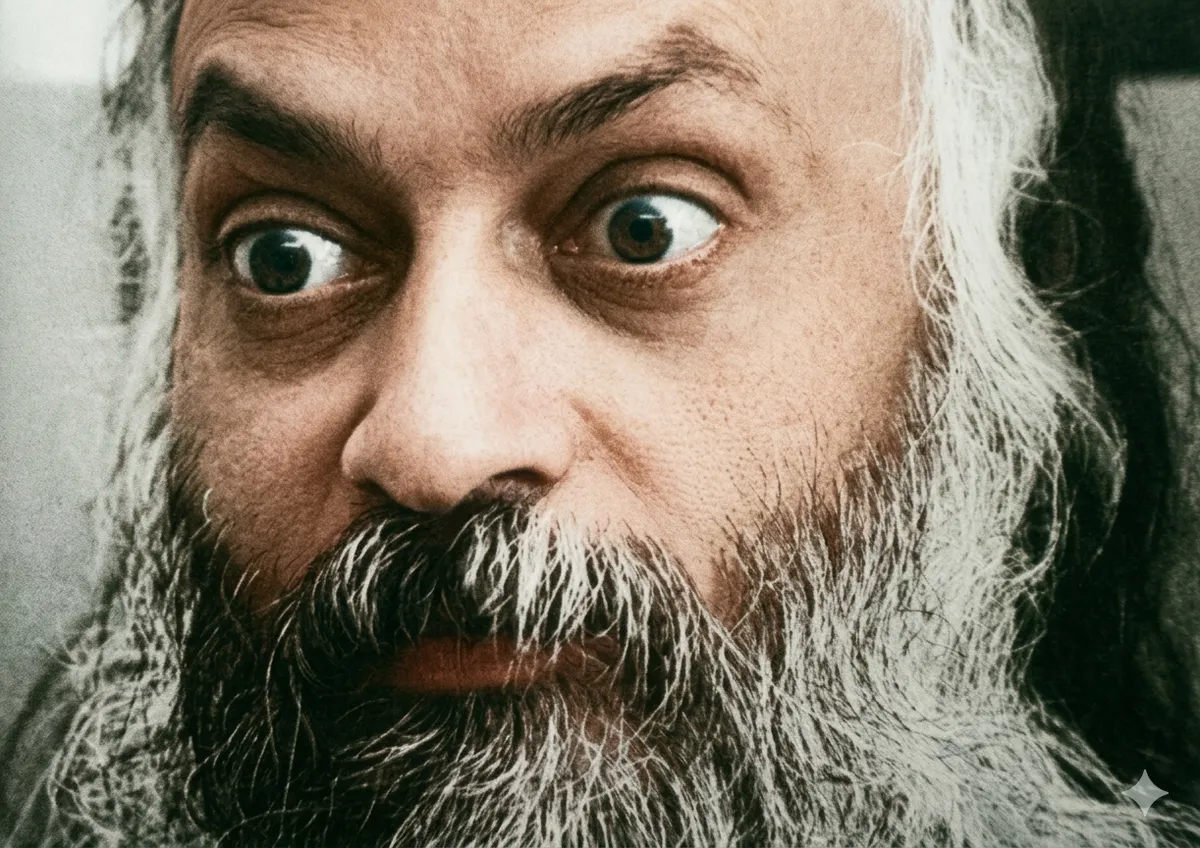
Stop trying to push thoughts away; just watch them calmly, and you’ll realize you were never truly trapped.
From the Discourses
Passages where Osho speaks to this question — each links to the complete discourse.
Beloved Osho, we hear what you say, but we in the west keep the information in our heads. How can we get out of our heads? What methods can we use, and can will-power help us?
No. Will-power will not help you. Will-power is not a power at all, because will depends on the ego -- a very tiny phenomenon, it cannot create much power. When you are will-less, then you are powerful -- because then you are one with the whole. Deep down, will-power is a sort of impotency. To hide the fact that we are impotent, we create will. We create the opposite to deceive ourselves and others. Persons who feel they are foolish try to show that they are wise. They are constantly aware that they are foolish, so they do everything to look wise. Persons who are ugly or feel they are ugly always try to beautify themselves -- even a painted beauty, just a face, a mask. People who are weak always try to look strong. The opposite is created; that is the only way to hide the reality within. A…
Osho, is there any practical process for being in the realm of existence beyond thoughts, in the void?
The way to thin them out is non-cooperation. Right now we are their makers—that is, we are the ones maintaining them. When we sit idle, some thought or other is running, because without our cooperation they cannot run. Withdraw your cooperation from whatever thoughts are running, and do nothing else; regard just this as samayik, as meditation. If all thoughts dissolve, you will feel no ego and no person within. You will know only being—only being will be known, in which the distinction “I am an individual” or “I am the whole” will not be felt. Only pure being will remain—pure existence. In truth, because of the thoughts accumulated upon that pure existence, we appear to be a person. This sense that I am “A,” you are “B,” you are “C”—the A, B, C we have pasted on—is our thought-power. We commonly say, “I will become liberated”—this is not quite…
Osho said that there was no need to try to still the mind, to stop the thoughts. He said that just as the traffic goes by and one remains on the sidewalk, unaffected, just a watcher, so one should simply witness the thoughts as they went by. We are not our thoughts, and recognising that we are the witness is enough. The very acceptance of the thoughts makes one more relaxed. The relaxation helps to create a distance, to separate oneself. To evaluate a thought as good or bad means that you are attached to your thoughts -- so one should not put labels on them.] ... put yourself aside, sit under a tree, and just watch the traffic. Soon, one day, the traffic disappears and the road is empty. Suddenly there is an interval and in that interval is meditation. But that interval cannot be created or cultivated.
How do we reach the state of blessedness when the mind is empty of chatter, defenses, plans and games, and god is?
IF YOU ASK HOW, YOU ASK A WRONG QUESTION. The how brings the chatter in; the how, the technique, brings the future in. The how brings the methodology and the mind in. So it is not a question of HOW DO WE REACH THE STATE OF BLESSEDNESS WHEN THE MIND IS EMPTY OF CHATTER DEFENSES, PLANS AND GAMES, AND GOD IS? It is not a question of how, it is not a question of technology at all. Meditation is not a technique. Once you ask how, you bring ALL that you want to drop. How means it cannot happen right now; the how will need time -- tomorrow, the day after tomorrow, this life or after this life. Because the Hindus created so many techniques for meditation, they had to suppose many lives; it was a necessary corollary. One life was not enough to do Patanjali's Yoga. Many more lives…
A friend has asked: Osho, you say “drop thoughts”—how do we drop them? How will a thought drop? This morning you said, “Drop thoughts and become thoughtless,” but how do we drop thoughts?
A man crashes into precisely what he wants to avoid. He is surrounded by precisely what he tries to flee. Ask celibates: they see nothing but women. It cannot be otherwise. Even if God were to appear, he would appear to them in the form of a woman—no other form is possible. The poor celibate’s misery is that he fights sex and is surrounded by sex. That is why rishis and munis have expressed such anger toward women. For whom is this anger? For the women who besiege them within, not for real women. What have real women to do with it? They say, “Woman is the gate to hell; avoid women.” Whom are they telling you to avoid? The inner woman who surrounds them. And why does she surround? Because they run from women; therefore the woman surrounds. Whatever you run from will encircle you. Whatever you try to…