
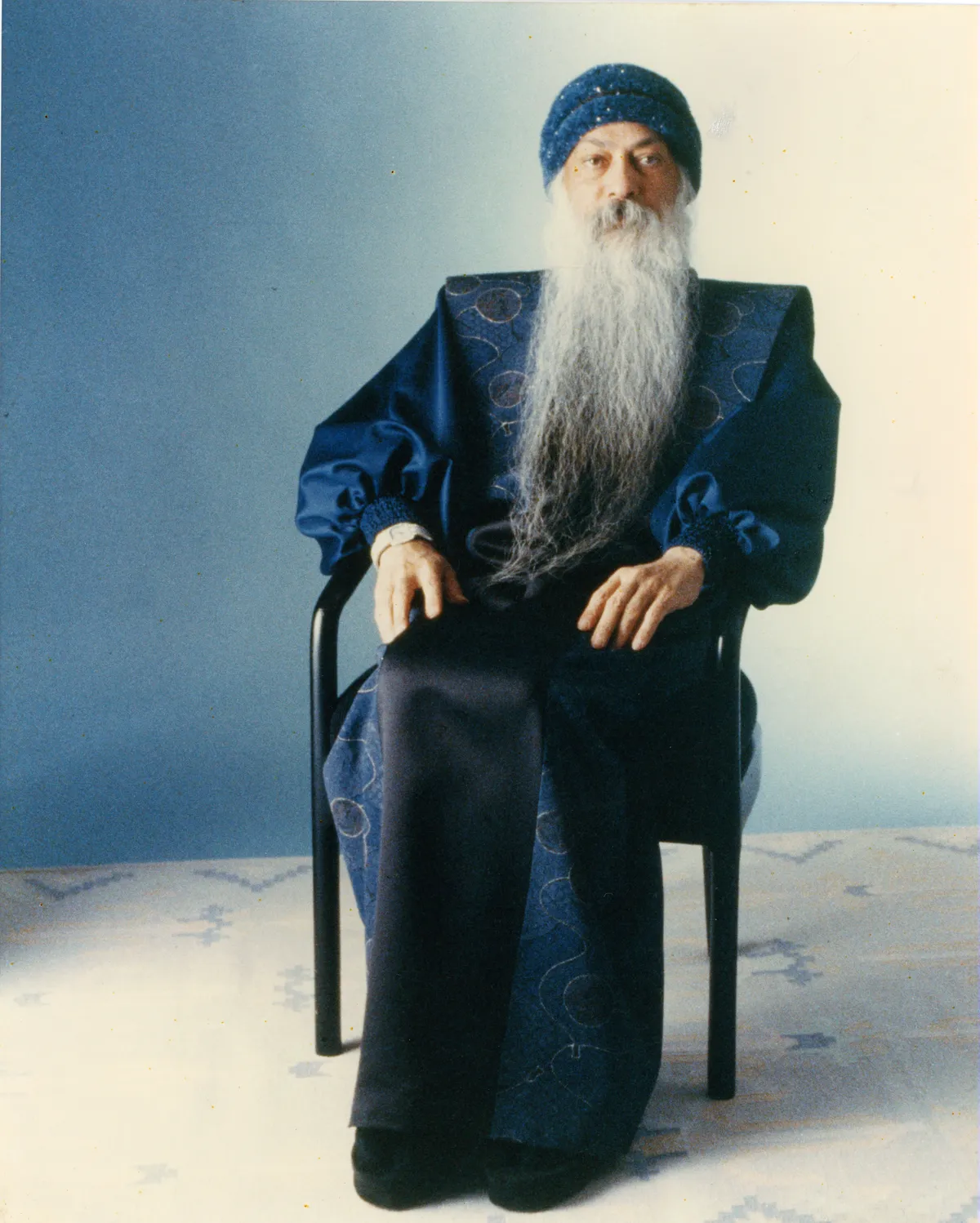
Keep checking in with yourself all day by asking “Am I here?” and answering “Yes,” so you stay awake inside whatever you’re doing.
From the Discourses
Passages where Osho speaks to this question — each links to the complete discourse.
Osho, you say that if there is awareness, then how are the two to be brought into harmony?
That is precisely the practice of active meditation: awareness. Awareness is the very means of going into emptiness in relation to all actions, to the movements of the mind as well. For example, if you lie there for half an hour—what will you do? In that half hour, whatever thoughts are moving in your mind, you are to be simply aware of them. Simply a witness—what else will you do? Just become a witness. Keep silently watching; let them move. But obstacles arise in our seeing. We become absorbed. We fail to remain a witness. We don’t even notice when we have become one with those very thoughts. That sense of awareness fades; a kind of stupor, a moorchha, comes in. A thought comes, a memory arises, and we stop being the watcher. We become part of that thought and of its flow. That is moorchha. And the opposite is…
The monk zuigan used to start every day by saying out loud to himself, "master, are you there?" and he would answer, "yes sir, I am." then he would say, "better sober up." and he would reply, "yes sir, I'll do that." then he would say, "look out now, don't let them fool you." and he would answer, "oh no sir, I won't, I won't."
In America, the whole market depends on how you can befool the customer, how you can create an idea in the minds of others. Now, a two-car garage is a must if you want to be happy; in America, a two-car garage is a must. Nobody asks why. If you are not happy with one car, how can you be happy with two cars? If there is fifty percent happiness with one car, how can you be happy with two cars? With one car you are unhappy; with two cars you will be doubly unhappy, that's all. The mathematics is simple. But there is advertisement, propaganda; the whole society exists by manipulating others. Happiness is something like a commodity in the market -- you go and purchase it, it has to be purchased. How can happiness be purchased? Happiness is not a commodity, it is not a thing; it is…
Mahavira has called apramad—vigilance, awareness, continuous wakefulness—the basis of practice. A friend asks: how can we bring this awareness into our conduct while doing our tasks—in the office, in the shop, while working? If attention remains on awareness, how will the work get done? While engaged in work, what is the place of awareness, and can this itself be a sadhana?
Take attention also as delight. Do not make it a restlessness. Let it not become a burden on your head that “I must work attentively.” Do not load it with strain and effort; let it grow lightly, support it. Whenever the remembrance arises, do it consciously. If you forget, do not worry. When remembrance returns, begin again to do it consciously. If you decide, “Now I will do my work consciously,” you will not be able to do it today itself; it may take years. To keep awareness even for a moment is difficult. You will decide to walk consciously; you will not be able to take even two steps before awareness has gone elsewhere and the feet have started walking elsewhere. Do not be anxious about that; do not repent. Heedlessness is the habit of countless lives; there is no reason to be distressed. We ourselves have cultivated unawareness—whom…
While breathing, a support… The mind has the habit that it needs some kind of support. If there is no support at all, the mind will die. In that very death you will experience samadhi. When the mind has completely died, becomes utterly empty, then you will discover the self. So the mind wants food to keep itself alive. It demands a support—let there be some support. If you keep chanting Ram-Ram, the mind is very pleased; there is no problem. If you keep singing bhajans, the mind has no difficulty.
He said, “Even if life has been spent in scriptures, those lines are utterly useless. The lines should be these: There is no mirror of the human mind at all—where will the dust gather? Whoever knows this truth knows dharma.” He said, “There is no mirror of the human mind—where will the dust gather? Whoever knows this truth knows dharma.” And the master accepted him, and that rice-pounder became the head of the monastery thereafter. With the gradual practice of meditation it will become evident to you: there is no mind. The mind was an illusion. That dust upon it was a second illusion. There is no mind. And when you come to know that there is no mind, you will be filled with a transcendent experience. Only that experience leads a person into religion. And that experience becomes possible by awakening in your actions. So for these three days…
Osho, “By continual practice the dull-witted become wise. As the rope goes to and fro, it carves marks in the stone.” Does one also need some practice to attain the divine? Please clarify.
Some people, when they have to think, start scratching their heads. Hold their hand and don’t let them scratch, and they’re in trouble—they can’t think. “Let go of my hand, or my thinking is ruined!” It’s a mechanical habit. Someone must light a cigarette to think; as the smoke begins, thinking becomes easier. Snatch the cigarette and he’s disoriented—“What do I do now?” Another person must ring the temple bell every morning, wave the plate of offerings. Keep him from entering the temple for a day and he is upset all day. You think there is a difference between scratching the head, ringing the bell, smoking a cigarette? There is none. Dr. Hari Singh Gaur had a habit—he told me this story himself—that whenever he argued a deep point before the Privy Council, he would twirl the button of his coat. If his fingers found that button, his brain worked…