
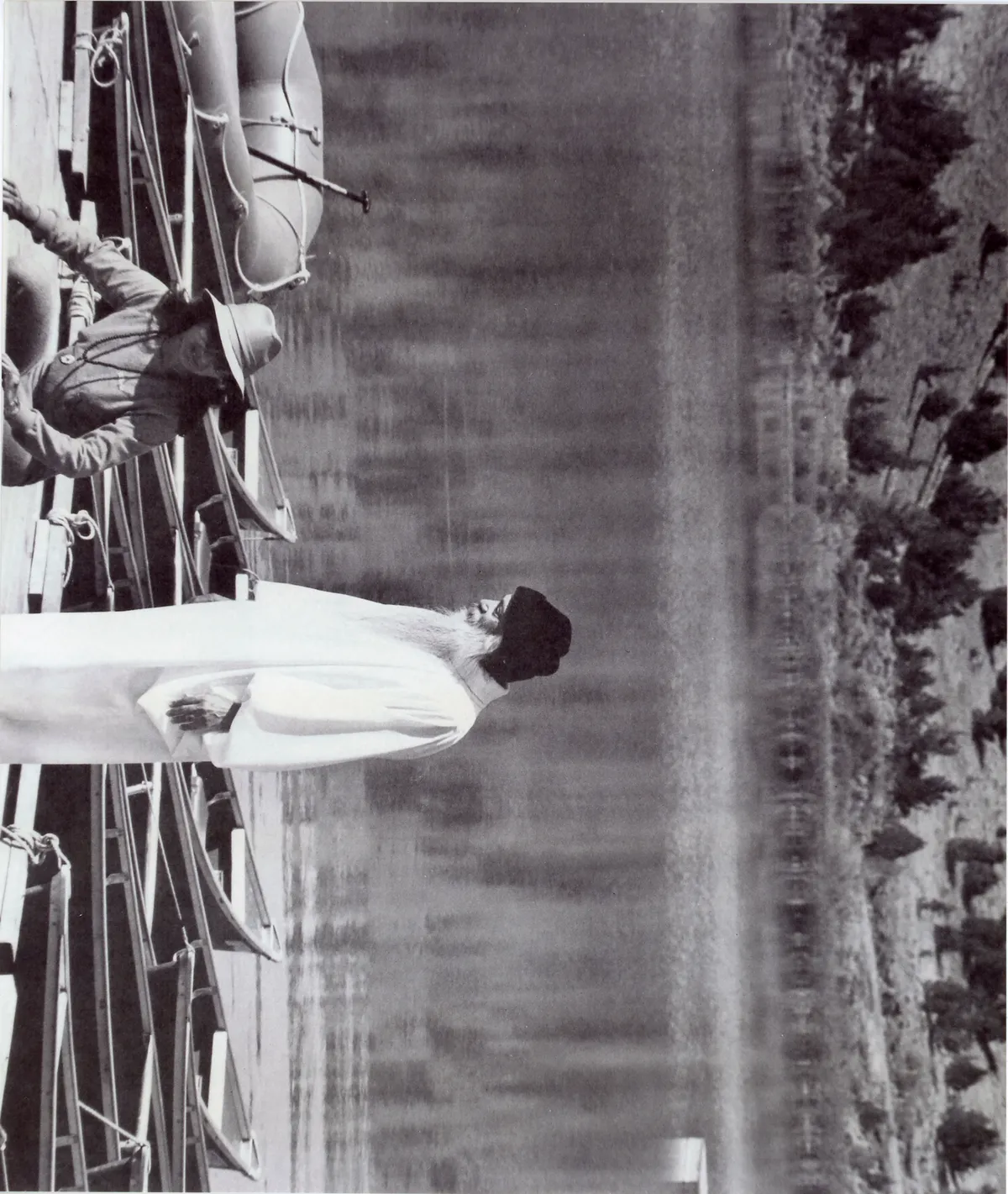
Do one thing at a time with your whole attention, treating every small task as important.
From the Discourses
Passages where Osho speaks to this question — each links to the complete discourse.
Osho, you say that if there is awareness, then how are the two to be brought into harmony?
That is precisely the practice of active meditation: awareness. Awareness is the very means of going into emptiness in relation to all actions, to the movements of the mind as well. For example, if you lie there for half an hour—what will you do? In that half hour, whatever thoughts are moving in your mind, you are to be simply aware of them. Simply a witness—what else will you do? Just become a witness. Keep silently watching; let them move. But obstacles arise in our seeing. We become absorbed. We fail to remain a witness. We don’t even notice when we have become one with those very thoughts. That sense of awareness fades; a kind of stupor, a moorchha, comes in. A thought comes, a memory arises, and we stop being the watcher. We become part of that thought and of its flow. That is moorchha. And the opposite is…
Mahavira has called apramad—vigilance, awareness, continuous wakefulness—the basis of practice. A friend asks: how can we bring this awareness into our conduct while doing our tasks—in the office, in the shop, while working? If attention remains on awareness, how will the work get done? While engaged in work, what is the place of awareness, and can this itself be a sadhana?
Take attention also as delight. Do not make it a restlessness. Let it not become a burden on your head that “I must work attentively.” Do not load it with strain and effort; let it grow lightly, support it. Whenever the remembrance arises, do it consciously. If you forget, do not worry. When remembrance returns, begin again to do it consciously. If you decide, “Now I will do my work consciously,” you will not be able to do it today itself; it may take years. To keep awareness even for a moment is difficult. You will decide to walk consciously; you will not be able to take even two steps before awareness has gone elsewhere and the feet have started walking elsewhere. Do not be anxious about that; do not repent. Heedlessness is the habit of countless lives; there is no reason to be distressed. We ourselves have cultivated unawareness—whom…
Osho, when we sit in meditation we feel bliss. But later, when we return to work and daily dealings, we forget. The mind gets caught again in activity. By what way can the experience of bliss remain constant?
The essential point is this—the essential point is this: that which comes for a little while in meditation and then is lost is not joy, first of all. It is only the absence of misery. One must understand the difference. It is not bliss. In fact, for an hour you simply forget the web of your life’s suffering—your occupations, anxieties, shop, market, relationships—because your energy is moving in a different direction. From this forgetting the illusion arises that bliss is being attained. Bliss is not being attained; only the usual suffering is, for the time being, not being felt. Hence the misunderstanding. That is not the bliss of meditation. It is only that, because the mind moves in another direction, it forgets the directions in which it is ordinarily entangled. The day the bliss of meditation happens, you will not say that it has gone. It does not go; the…
While breathing, a support… The mind has the habit that it needs some kind of support. If there is no support at all, the mind will die. In that very death you will experience samadhi. When the mind has completely died, becomes utterly empty, then you will discover the self. So the mind wants food to keep itself alive. It demands a support—let there be some support. If you keep chanting Ram-Ram, the mind is very pleased; there is no problem. If you keep singing bhajans, the mind has no difficulty.
He said, “Even if life has been spent in scriptures, those lines are utterly useless. The lines should be these: There is no mirror of the human mind at all—where will the dust gather? Whoever knows this truth knows dharma.” He said, “There is no mirror of the human mind—where will the dust gather? Whoever knows this truth knows dharma.” And the master accepted him, and that rice-pounder became the head of the monastery thereafter. With the gradual practice of meditation it will become evident to you: there is no mind. The mind was an illusion. That dust upon it was a second illusion. There is no mind. And when you come to know that there is no mind, you will be filled with a transcendent experience. Only that experience leads a person into religion. And that experience becomes possible by awakening in your actions. So for these three days…
A: Hm mm. To be meditation means an effort to be aware. To be aware of the whole process of life, but in the beginning one can chose some object like breathing. It is a very natural object to be aware: The ingoing and the outgoing of the breath. Be aware constantly: the breath has gone out, it has come in; and the rhythm and the process and the in and out going phenomena, be aware of it. The moment you will be aware, you feel a certain change, a certain chemical change within your mind. Because when you become aware of the breathing process, mind becomes silent. The silence is automatically created. Because your total mind is engaged in seeing, in witnessing the breathing. And the rhythmic circle of breath creates an inner music. That inner music too leads you to more and more silent and sweeter moments within.