
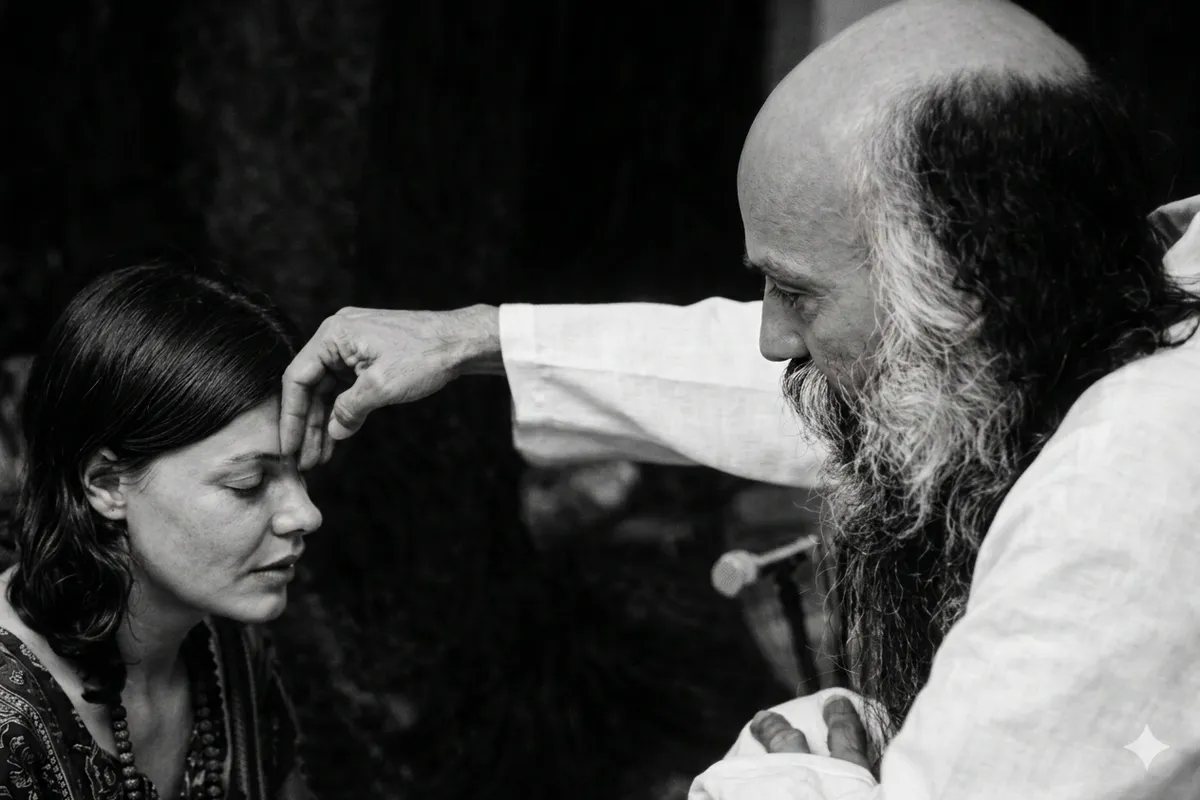
People who depend on old beliefs and roles fear losing comfort and power, so they label new spiritual voices as dangerous.
From the Discourses
Passages where Osho speaks to this question — each links to the complete discourse.
Osho! Basically, you are a herald of religion—of the original, essential religion. You yourself seem to be religion. But the surprising thing is that right now your strongest opposition comes from the religious establishment itself! The recent statements by two Shankaracharyas are fresh examples. Would you kindly shed some light on this?
The death of his father shook Shankaracharya utterly. But the mother, already in grief, would be left alone if Shankara took sannyas. She refused. The story says: Shankara went to bathe in the river, and a crocodile caught his leg. A crowd gathered on the ghat; the mother came running. Shankara said, “The crocodile says it will let go if you allow me to take sannyas.” What could the mother do? With tears she said, “All right, then become a sannyasin—at least live. If you live, even as a sannyasin, I will see you some day.” And the story says the crocodile let go. That is just a story; crocodiles were not that wise then, nor now! If man is not so wise, what of crocodiles! I spoke of Mulla—he did marry. Fourteen-year-old girl, eighty-year-old groom. The next day friends asked, “How was the wedding night?” “Don’t ask—great joy! Only…
Question: , WHY ARE PEOPLE SO MUCH AGAINST YOU? Sudheer, they are not so much against me as they are afraid of me. Out of fear they are against, but the root cause is fear. And why are they afraid? -- because they don't understand. It is misunderstanding. It always happens, it is bound to happen; it is nothing new. I say one thing, they understand something else because their minds are prejudiced. They have been brought up in certain traditions and I am breaking all traditions! They have been brought up to think in certain ways, and my whole effort here is to take you beyond thinking. People are conventional, conformist, traditional. And to me religion is rebellion -- rebellion against all conventions, against all conformities, against all traditions. Religion is never a tradition, can never be a tradition. Science can be a tradition but religion never.
Osho, the twenty-one-day ritual you have hinted at—was that practice or elemental realization in any way traditional? Because from your mode of expression it continually seems that you surely represent some teacher’s or Tirthankara’s method. Within this I also want to dare to ask: do you want to add a link to some established spiritual lineage, or, like Buddha, are you attempting to cut a new path through the mountains?
Nor is the issue one of tolerance. It is a matter of sky-like spaciousness, not tolerance. Not mere forbearance. Not that a Hindu “puts up with” a Muslim or a Christian “puts up with” a Jain. Forbearance already holds violence within it. I do not say the Quran and the Gita say the same thing. The Quran says something quite different; it has its own individual voice—that is its greatness. If it only repeated what the Gita says, it would be worth two pennies. The Bible says something else again, which neither the Gita nor the Quran says. Each has its own voice. Mahavira does not say what Buddha says; they say very different things. And yet from these differing statements one ultimately arrives at the same place. My emphasis is on the oneness of the destination, not on the oneness of the paths. My emphasis is that in the…
Why are your teachings not accepted as religion or religious by the society?
THEY ARE NOT RELIGIOUS OR RELIGION in the ordinary sense of the term. They are far more... they are far deeper and higher. The so-called society has no vision; it consists of blind people. It has always been happening. When Buddha appeared, they didn't believe that his teachings were religious. When Jesus appeared, they crucified him. When Mansoor declared, "I am God," they killed him. Mohammedans thought Mansoor was one of the greatest irreligious persons who has ever been on the earth -- to declare oneself God? This is KUFR; this is irreligion, this is anti-religion. Whenever it happens that something of the pure truth is expressed, is sung, the society starts becoming uneasy about it. It is natural, because the society has a very pseudo kind of religion -- comfortable, convenient, consolatory. It has false temples to worship in, false gods to worship, false priests to follow. And it…
Osho, does the ritual of twenty-one days which you indicated you were doing in your previous birth belong to any particular tradition of meditation and self-experience? Because from your speeches, it appears that you are definitely representing the methods of some great teacher or teerthanker. In view of this, may I also dare to ask whether you wish to connect a spiritual link to some traditional chain, or like buddha are you attempting to cut a new path on some mountain?
The overall perspective which I have before me is this: that I would like to help every person to move according to his capacity, his stage of evolution, his culture -- according to what has already been assimilated in his blood. Then it will be much easier for him to achieve. Therefore, I have neither any religion of my own, nor any path of my own, because now one exclusive path or religion will not work for the future, and a religious sect means a path. Nowadays, such a religion is required which doesn't insist on a particular path, which can become the crossroads for all the paths, which can say that all paths belong to it and which can ask everyone to follow the path of his liking. Such a religion would emphasize that you will reach the same place from wherever you walk, that all roads lead to…