
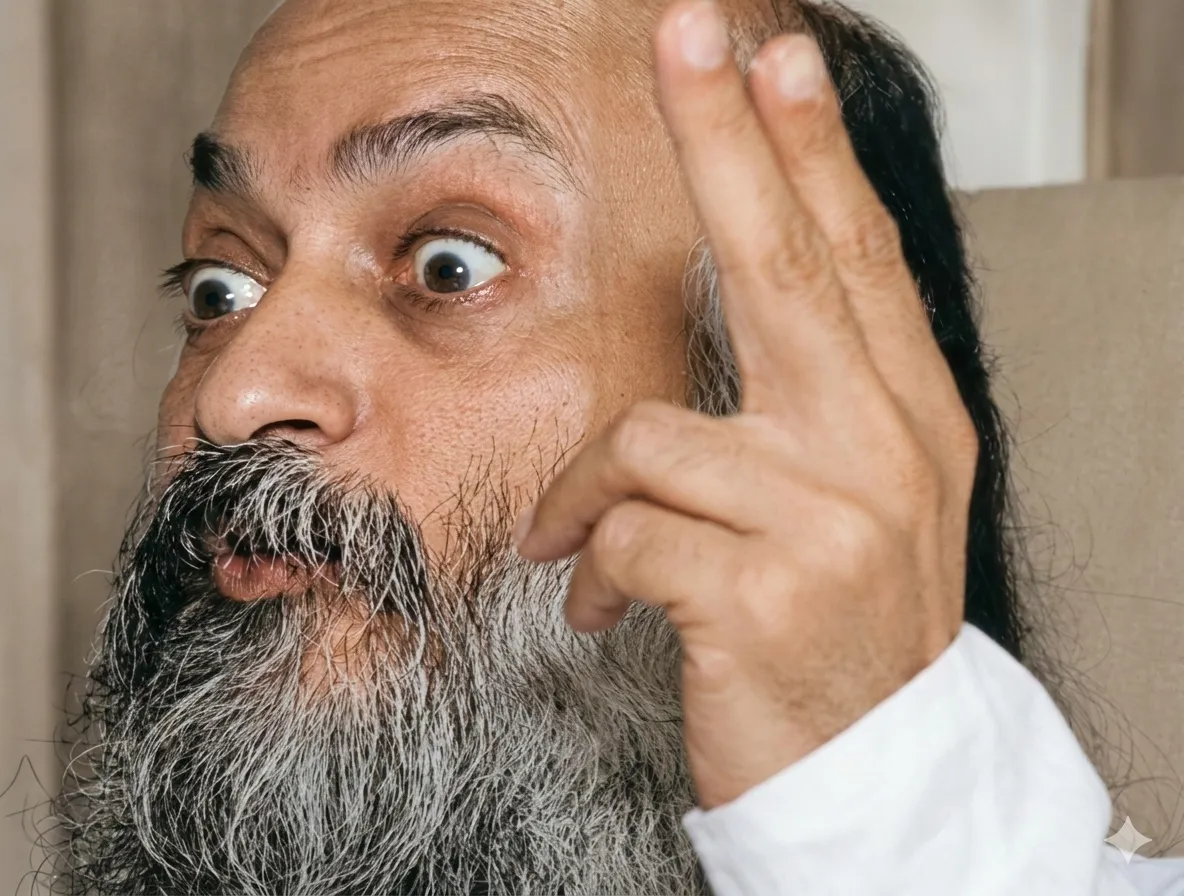
No figure recurs in Osho's discourses as constantly as Gautam Buddha. He devoted entire multi-volume series to the Dhammapada and to Buddhist sutras, took Buddha's dying words — 'be a light unto yourself' — as the summary of his own message, and simultaneously fought the religion built in Buddha's name. For Osho, Buddha is not a founder to be followed but a proof of what every human being can become.
The passages below show the Buddha Osho kept pointing at: the seeker whose effort failed and whose let-go succeeded, the master who refused all authority including his own. Each links to the full discourse.
From the Discourses
Passages where Osho speaks on buddha — each links to the complete discourse.
Osho, is it absolutely inevitable that a buddha will always be misunderstood?
YES, IT IS ABSOLUTELY INEVITABLE. It can't be otherwise. A Buddha is bound to be misunderstood. If a Buddha is not misunderstood then he is not a Buddha at all. Why is it so? -- because the Buddha lives in a state which is beyond mind, and we live IN minds. To translate something from the beyond to the mind is the most impossible thing in the world. It can t be done, although every Buddha has tried to do it. That too is inevitable; no Buddha can avoid it. The Buddha HAS to say the unsayable, he has to express the inexpressible, he has to define the indefinable. He has to do this absurd act, because the moment he reaches beyond the mind great compassion arises. He can see people stumbling in the dark, he can see people suffering unnecessarily -- creating their own nightmares, creating their own hell…
Question: BELOVED OSHO, DOES A BUDDHA EVER GET BORED? ... Their question is relevant -- but you can get bored only if you are there. So I sometimes tell them, "The room may be getting bored with me -- the same person. I am not bored. There is no one who can get bored. And life is so rich, even in an empty room. And every moment the room is changing, it is not the same. Nothing can be the same -- even the emptiness goes on changing, it has its own moods. A buddha has no ego, you cannot bore him. He exists like an emptiness, as if he is not. If you penetrate him you will not find anyone there. The house is vacant, no one lives there really. You can move in a buddha but you will never meet him.
What motivates a buddha?
The question is absurd, because a Buddha becomes a Buddha only when all motivation has left, when all desires have disappeared. A Buddha becomes a Buddha only because he now has nothing to do, nothing to desire, nowhere to go, no achievement. The achieving mind disappears -- then one becomes a Buddha. So if you ask, "What motivates a Buddha?" you are asking an absurd question. Nothing can motivate him; that's why he is a Buddha. Siddhartha Gautama became enlightened. The story goes that a Brahmin was passing by. He had never seen such a beautiful person. Something unearthly was surrounding Buddha sitting under his tree; he was luminous, a tremendous peace. The Brahmin could not go. He was in a hurry, he had to reach somewhere; but the silence of Buddha pulled him. He forgot where he was going, he forgot his motivation. Being close to this man who…
What is the difference between waiting for godot and waiting for god?
It is as if the sun has risen in the morning and you are sitting in your room with closed doors and windows, in darkness. Open the doors, you become available to the sun. The sun was already available -- just the meeting happens. You cannot wait for God. All waiting is for Godot. Godot means the one who never comes, who CANNOT come, whose arrival is impossible. And the only impossible thing is that which has already happened -- how can it happen again? You are alive, and you are waiting for life, Now, this is ridiculous. The real man of religion does not think in terms of God. He thinks in terms of life or, even better, of living -- because life can again become an abstract idea. Living, moment-to-moment living. In that very living, one knows what God is, because one knows who one is. Your idea…
Read 8 more passages on buddha
Does a buddha also need something as a complementary? Who is complementary to a buddha?
Buddha or Buddhahood is not any polarity. It is not opposite to anything. It is beyond the duality. Night is against day. Life is against death. Love is against hate. Buddhahood is not against anything. It is to transcend the duality. When you are neither day nor night, you are a Buddha. When you are neither life nor death, you are a Buddha. When you are neither this nor that, NETI NETI, you are a Buddha. Buddhahood simply means transcendence of duality. So Buddhahood is all and nothing. There is nothing as polar opposite to, and there is no complementary to it. Remember this: you would like to become a Buddha because you would like to be happy. But then you misunderstand. Buddhahood is beyond happiness and unhappiness. That was the insistence in yesterday's talk: it is beyond agony, and beyond ecstasy also. So the man who has really attained…
Beloved Osho, what is the difference between the emptiness of the child before the formation of the ego and the awakened childlikeness of a buddha?
Whether you are for it or against it doesn't matter -- your concern shows where your ego is hanging. And I will include the capitalist in it also: his whole concern is how to gather money, hoard money -- because money has power over matter. You can purchase any material thing through money. You cannot purchase anything spiritual, you cannot purchase anything that has any intrinsic value; you can purchase only things. If you want to purchase love, you cannot purchase; but you can purchase sex. Sex is the material part of love. Through money, matter can be purchased, possessed. Now you will be surprised: I include the communist and the capitalist both in the same category, and they are enemies, just as I include Charvaka and Mahatma Gandhi in the same category, and they are enemies. They are enemies, but their concern is the same. The capitalist is trying…
Osho, if an enlightened person cannot lose his buddhahood, how does a baby born as a buddha lose his?
Innocence plus consciousness is equal to Buddhahood. Innocence minus consciousness is equal to childhoodness. And how one can be conscious? The only way -- and let me emphasize -- the ONLY way is to lose it and gain it again. You ask me, Hajo: IF AN ENLIGHTENED PERSON CANNOT LOSE HIS BUDDHAHOOD, HOW DOES A BABY BORN AS A BUDDHA LOSE HIS? The enlightened person has lost it and found it. The baby has not lost it, and has not yet found it; he is born with it, oblivious of it. Hence you will see in the eyes of small children something of the saints, something of the same beauty; but also a deep ignorance. The innocence is there but full of ignorance. The saint is innocent but full of awareness, knowing. His innocence is not mixed with ignorance; it is wisdom. And the children are bound to lose their…
Question: OSHO, WHAT IS BOREDOM? ARE YOU NEVER BORED WITH LIFE? ... I said, "Simple, just open the show tomorrow. Declare that the show will be on and that it will be the first show. When the curtain opens, Janaka, the father of Sita, will declare, 'Yesterday, through the mistake of my servants, the real bow of Shiva was left In the palace. The bow that got broken was just a bow which children play with. Today, the real bow is here and the show starts. The manager said, "That good -- that will do. So the show started next day. People were laughing t because again it was a bamboo bow and if somebody wanted to break it, he could. But that Ravana was taken out, there was somebody else playing the role.; The story continued, and the people fell asleep and snored.
Beloved master, why are you being continuously misunderstood and misinterpreted by people?
Rajesh, it is absolutely inevitable, it is unavoidable. It has to be so. It is part of the destiny of those who speak the truth. They are bound to be misunderstood, misinterpreted. If they were not misunderstood, not misinterpreted, that would be a miracle. It has not happened up to now and there is no hope that it is ever going to happen. Buddhas have always been misunderstood for the simple reason that they speak from a totally different vision which is not available to the masses. They speak from a totally different experience. Their experience is such that it cannot be expressed through words, yet they try to express it through words -- they try to do the impossible. Saying it through words creates trouble. They use words in their own way, they give the words their own color, but when those words reach YOU they have lost all…
What exactly is boredom? If I don't do something, even something needless, a panic arises, a huge fear. What is it that causes this frenzy of movement? Why am I so uncomfortable with this feeling? The frustration of boredom increases when I think that what I would do is equally a meaningless frenzy. I feel caught.
ABHA, BOREDOM IS ONE OF THE MOST IMPORTANT THINGS IN HUMAN LIFE. Only man is capable of boredom; no other animal is capable of being bored. Boredom exists only when mind starts coming closer and closer to enlightenment. Boredom is just the polar opposite of enlightenment. Animals cannot become enlightened, hence they cannot become bored either. Boredom simply shows that you are becoming aware of the futility of life, its constant repetitive wheel. You have done all those things before -- nothing happens. You have been into all those trips before -- nothing comes out of it. Boredom is the first indication that a great understanding is arising in you about the futility, meaninglessness, of life and its ways. Now, you can respond to boredom in two ways. one is what is ordinarily done: escape from it, avoid it, don't look eye to eye into it, don't encounter it. Keep…
Why is there so much misunderstanding in the world?
Now the same sentence takes a new meaning, just the contrary to the first. The meaning is that man is free. That man can be whatsoever he chooses to be. That man is a kind of god. That nobody decides for man, man has to decide for himself. That man's decision has to come from his own soul. What he is going to write on the tabula rasa is his own writing, there will be his own signature. Man has individuality. No mango tree has any individuality. No peacock has any individuality -- all peacocks are alike, and all mango trees. But man has uniqueness, individuality. There is great hope. Now see? The meaning has turned just to the opposite polarity. I have come across a third interpretation too. For others it means: Everything is permissible to man. And with that they abandon all restraint, they become licentious. They say,…
If you become sated with any thing, you will become bored. In this world there is nothing—nothing—which, upon obtaining, will not bore you. Yes, taste remains only so long as it is not obtained. So long as it is far, while the hand is stretched and that thing has not come into it—only then can you be full of juice. As soon as it is gotten, boredom arises. In this world, all things, if tasted daily, provoke anxiety. I have heard: the emperor of Mulla Nasruddin’s land, to enjoy his jokes and wit, kept him near. On the first day the emperor sat to dine and seated Nasruddin with him. A certain vegetable pleased the emperor very much. Nasruddin said: Of course you like it; this is not a vegetable—it is nectar. He praised its qualities so glowingly that the emperor ordered the cook to make that vegetable daily.
अगर आपकी किसी चीज से तृप्ति हो जाए, तो आप ऊब जाएंगे। इस जगत में ऐसी कोई भी चीज नहीं है, कोई भी चीज नहीं है, जिसको पाकर आप ऊब न जाएंगे। हां, तभी तक रस रह सकता है, जब तक वह मिले न। जब तक दूर रहे, जब तक पाने के लिए हाथ फैला हो और हाथ में आ न गई हो कोई चीज, तभी तक आप रसपूर्ण हो सकते हैं। मिलते ही ऊब पैदा हो जाती है। इस जगत में सभी चीजें ऐसी हैं कि रोज-रोज उनका स्वाद लिया जाए, तो घबड़ाहट हो जाती है। सुना है मैंने, मुल्ला नसरुद्दीन को उसके देश के सम्राट ने उसकी बातें, उसके व्यंग्य का मजा लेने के लिए अपने पास रख लिया था। पहले ही दिन सम्राट भोजन के लिए बैठा, तो नसरुद्दीन को भी साथ बिठाया था। कोई सब्जी सम्राट को बहुत पसंद आई। तो नसरुद्दीन ने कहा, आएगी ही पसंद, यह सब्जी नहीं, अमृत है। और उसने उसके गुणों की ऐसी महिमा बखान की कि सम्राट ने अपने रसोइए को कहा कि रोज यह सब्जी तो बनाना ही।
Understanding Osho's Reading of Buddha
The threads that run through his discourses on buddha.
Enlightenment Came When Effort Dropped
Against twenty-five centuries of Buddhist scholarship, Osho insisted that Buddha's six years of austerity did not produce his enlightenment — abandoning the search did.
Buddhist scholars for twenty-five centuries have thought that he achieved this state because of those six years of arduous effort. I differ from them absolutely. And they have not been able to prove to me... and they think that I am crazy because they think that if it were true, then in twenty-five centuries people would have seen it. But I say that he attained enlightenment because he dropped the desire to attain it.The Golden Future, Chapter 11, Question 1 →
Be a Light Unto Yourself
Osho returns constantly to Buddha's final words — and here he sharpens them: Buddha said be, not become.
THESE WERE THE LAST WORDS of Gautam the Buddha, his parting message to his disciples: "Be a light unto yourself." But when he says, "Be a light unto yourself," he does not mean become a light unto yourself. There is a great difference between being and becoming. Becoming is a process, being is a discovery.Walking in Zen, Sitting in Zen, Chapter 13, Question 1 →
Blowing Out the Lamp
In the Es Dhammo Sanantano series Osho unpacks nirvana literally — the blowing out of the ego's flame, and a choice between two ways of living that lies in every person's hands.
This is what Buddha has said—blow out the lamp of ego. The blowing out of the lamp is called Nirvana. As you are extinguished here—on the other side, from all sides, Paramatma, Truth—whatever name you give—enters within. So there is one way of living—the way you live. There is another—the way of the Buddhas. The choice is in your hands.Es Dhammo Sanantano, Chapter 15, Para 3 →
The Message of All the Buddhas
Asked for his own essential message, Osho gave Buddha's — Appa Deepo Bhava — and defined a master's work as kindling thirst, never handing over truth.
The same as has always been the message of all the buddhas: Appa Deepo Bhava! Be your own lamp! Be your own helmsman! Do not lean on another’s shoulder. Only if you eat yourself will your hunger be satisfied. Only if you drink yourself will your thirst be quenched. Only when you know truth yourself—and only then—will the veena of contentment sound within you. The truth I have known is of no use to you. I cannot give you truth. I can only kindle within you the longing to realize it.Ami Jharat Bigsat Kanwal, Chapter 6, Question 5 →
Questions Osho Answered on Buddha
35 questions in the library — the most sought-after:
A Buddha sees what words can’t show; we don’t, so we mix up his message—but he still tries to help us open our eyes.
A Buddha has no matching opposite because being a Buddha means going beyond all either-or choices.
A child is pure because they don’t know yet; a Buddha is pure again after fully living and understanding, so the purity is wise and never lost.
When you let go of the past and ego and stay fresh right now, boredom can’t catch you because everything feels new.
A Buddha isn’t trying to get anything—he’s just fully awake, and whatever happens flows naturally without a reason.
Osho says surviving poison made him clean and open so Buddha’s spirit could help him keep Buddha’s unfinished work alive.
A Buddha doesn’t do caring as a task; he naturally radiates care to everyone, and you feel it more when you’re open instead of wanting to be special.
He praises saints to inspire you, then knocks them off the pedestal so you stop worshiping them and start finding the same light in yourself.
Frequently Asked
He regarded Buddha as a peak of human consciousness — among the figures he quoted most. But his devotion was unsentimental: he attacked Buddhism wherever it turned Buddha into ritual and doctrine, insisting that a Buddha can only be lived, not worshipped.
On the essentials — awareness, no-self, 'be a light unto yourself' — completely; he called his own message the same as all the buddhas'. He departed from the tradition on life-affirmation: where Buddhist renunciation withdrew from the world, Osho wanted Buddha's silence married to Zorba's celebration.
The largest are the twelve-volume Dhammapada series in English and Es Dhammo Sanantano in Hindi, both commentaries on Buddha's verses. Buddha also pervades his Zen series — Zen being, in Osho's telling, Buddha's living stream — and appears throughout his discourses.