
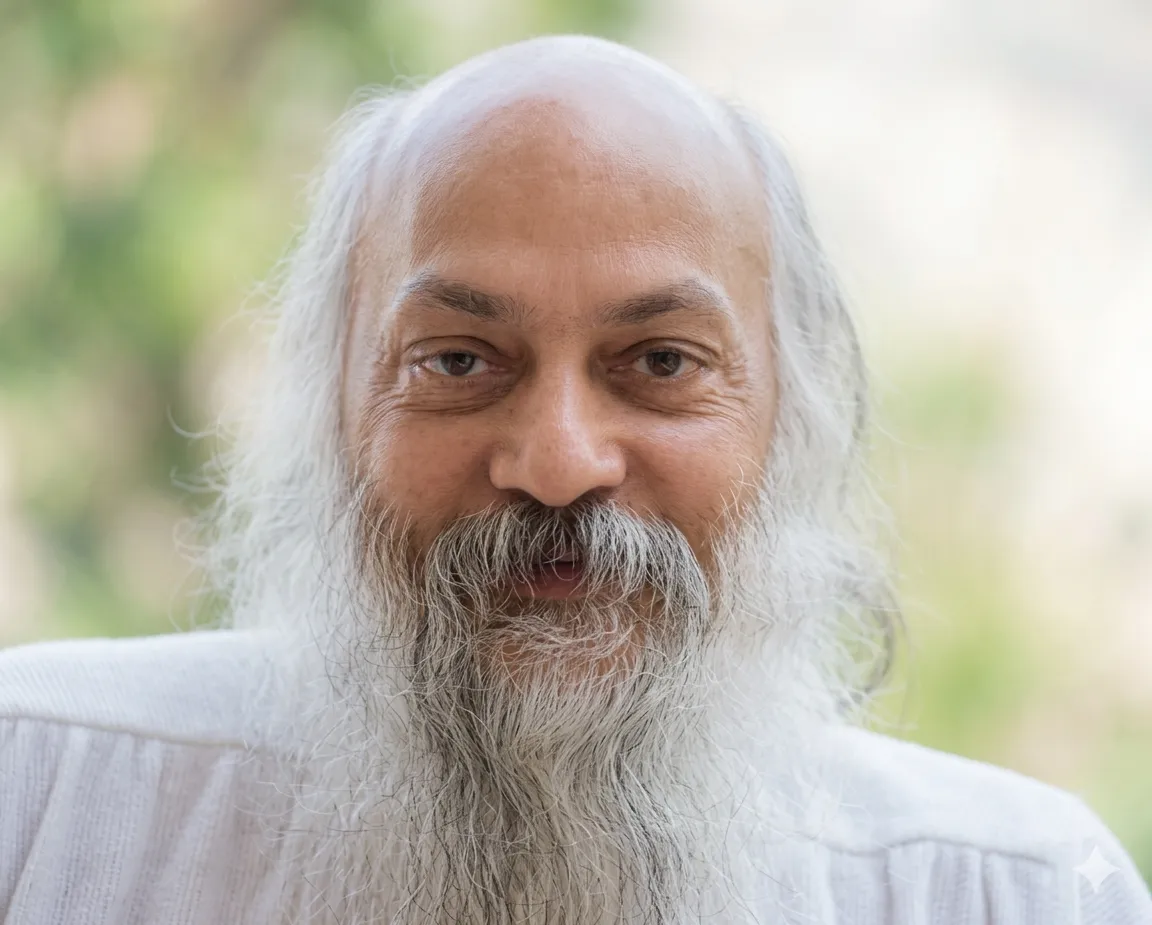
According to Osho, religion is not an outer creed, code, or sect but the inner flowering of consciousness—the kindling of awareness, the dawn of meditation and samadhi. It is an inner revolution that dissolves borrowed identities and rule-bound dependence. Awakening is right; sleep is wrong. Live from within, trust your being, and keep external rules only for practical harmony.
Religion means waking up inside and living from your own aware heart, not from outside rules or labels.
From the Discourses
Passages where Osho speaks to this question — each links to the complete discourse.
Osho, what is the definition of God?
Words are very small. If you say God is light, then what of darkness? The scriptures have said that God is light. Suppose we accept this as a definition—then what about darkness? Where will darkness go? Darkness is too; in fact it is far more than light. Light sometimes is and sometimes is not; darkness is always, eternal. Where will you place darkness? If you say God is light, darkness is left out. If you say God is darkness, then light is left out. If you say God is both darkness and light, a contradiction arises: they cannot be together. Try to have both darkness and light in the same room. If you bring in light, darkness disappears; if you preserve darkness, you cannot have light. Then how can both be together? That becomes an impossibility. So you cannot say “both” either. Then the fourth device is to say: it…
Beloved Osho, what is religion?
In anger one day the archbishop took a motorboat and went to those three people who were sitting under a tree. He looked at them and he could not believe it: what kind of saints are these? In the very beginning he introduced himself and declared, "I am the archbishop." The three saints all touched his feet. Now he felt relaxed, "These are fools... and things are not yet gone so far that they cannot be controlled." He asked them, "Are you saints?" They looked at each other, and they said, "We have never heard the word. We are uneducated, uncultured. Don't talk Greek to us; just simply say what you mean." "My God," said the archbishop, "you don't know what a saint means? Do you know the Christian prayer?" Again they looked at each other, and nudged each other as if to say, "You tell him." The archbishop now…
Osho, what is the definition of God?
Words are very small. If you say God is light, then what of darkness? The scriptures have said that God is light. Suppose we accept this as a definition—then what about darkness? Where will darkness go? Darkness is too; in fact it is far more than light. Light sometimes is and sometimes is not; darkness is always, eternal. Where will you place darkness? If you say God is light, darkness is left out. If you say God is darkness, then light is left out. If you say God is both darkness and light, a contradiction arises: they cannot be together. Try to have both darkness and light in the same room. If you bring in light, darkness disappears; if you preserve darkness, you cannot have light. Then how can both be together? That becomes an impossibility. So you cannot say “both” either. Then the fourth device is to say: it…
Beloved Osho, what is religion? What is your opinion on organized religion?
I condemn the organized religions in the same way I condemn the politicians -- they are nothing but politics. So when I said to you that religious people should be respected, honored -- the politicians should go to them for advice -- I was not talking about organized religions; I was talking only about religious individuals. And a religious individual is neither Hindu nor Christian nor Mohammedan. How can he be? -- God himself is not Hindu, not Mohammedan, not Christian. And the man who knows something of the divine becomes colored with his divinity, becomes fragrant with godliness. In the ancient East these religious people were our highest flowers, and even kings and emperors used to go to them to touch their feet and to be blessed -- to ask their advice on problems which they were unable to solve. If we want the world to remain alive, we…
Osho, please understand one thing: in any country, if the society happens to be spiritualist, then those who don’t get a chance in it are pulled toward materialism; and in other countries, those who are materialists—when they don’t get a chance—are pulled the other way. So it is the chance-less who have erected the opposite cult. What do you say about this?
And remember, this small path that takes us from sleep into awakening is religion in the fundamental sense—this small path! Neither temples, nor rituals, nor sacrifices have anything to do with it. All this is meaningless. These are the devices of sleeping people. Temples, prayers, fire rituals, chanting mantras, repeating “Ram, Ram”—these are the creations of the sleeping. A sleeping man also manufactures a kind of religion—and then it becomes the cause of quarrels: Hindu, Muslim, Christian. These are differences of ritual, not of religion. One sleeping man builds one kind of temple—he doesn’t know what a temple is; he is building it himself. Ten other sleeping men build a mosque; ten more build a church. Then the three fight: ours is the true temple; whoever does not come to our temple will go to hell. Sleeping men also coin doctrines, create systems. They try to explain. But the explanations…