
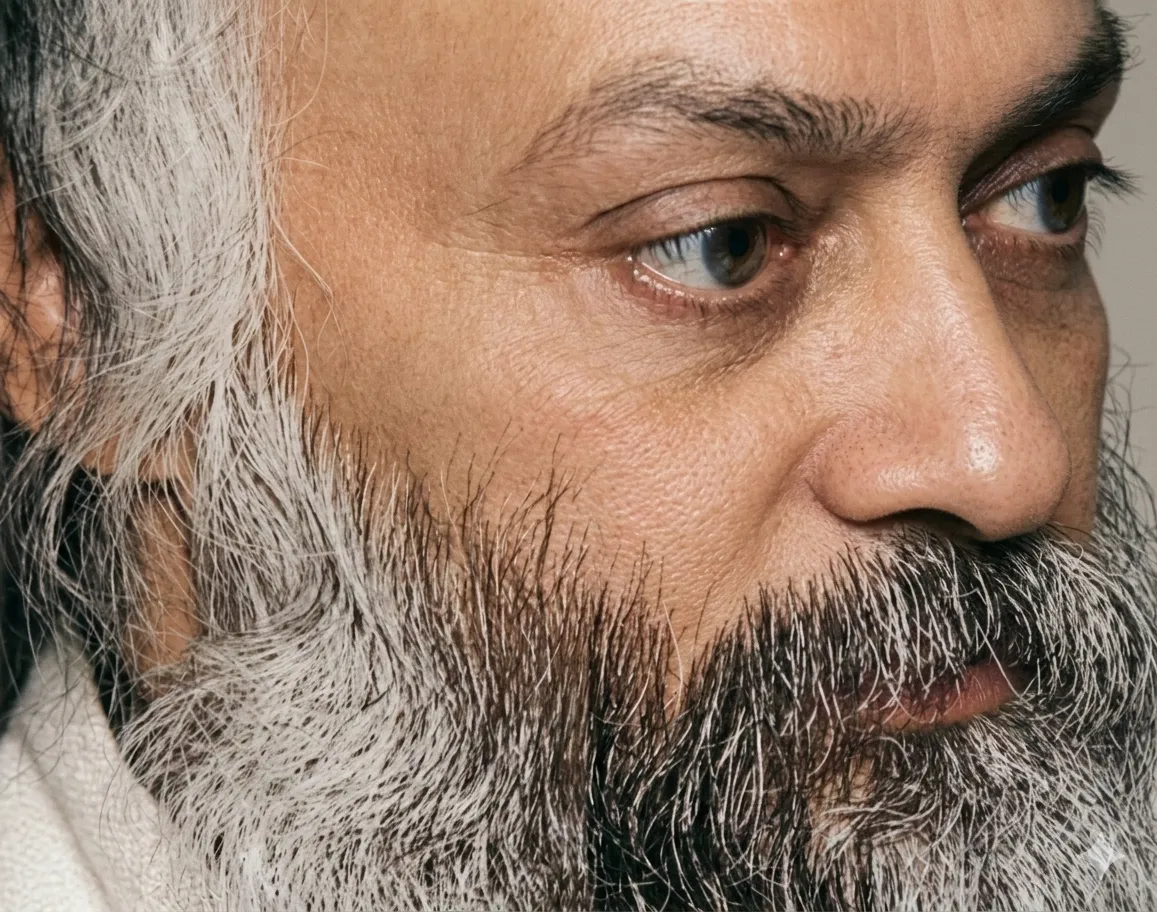
According to Osho, emotions have no legitimate role in authentic religion; true religion transcends emotions, sentiments and thoughts—the whole mind—into silent awareness. Emotional appeals create mass-followed pseudo-religions that exploit people, turning repressed sexuality into devotional fantasies (lover–beloved gods). Real spirituality frees rather than enslaves, seeking awakening (as in Zen) beyond emotional intoxication and projection.
Real religion isn’t about big feelings; it’s about quiet, clear awareness, while emotional religion just plays with your feelings and turns your unmet desires into holy daydreams.
From the Discourses
Passages where Osho speaks to this question — each links to the complete discourse.
Question: Maneesha's question: OUR BELOVED MASTER IN HIS BOOK, PERENNIAL PHILOSOPHY, ALDOUS HUXLEY WRITES: "RELIGIONS THAT MAKE NO APPEAL TO EMOTIONS HAVE VERY FEW ADHERENTS." LOOKING AT HOW MANY CHRISTIANS THERE ARE IN THE WORLD AS COMPARED WITH THOSE DRAWN TO ZEN, IT WOULD SEEM TRUE. ARE PEOPLE ATTACHED TO THE IDEA OF A GOD BECAUSE IT EXCITES THE EMOTIONS? THAT MAY INCLUDE FEAR AS WELL AS LOVE, BUT AT LEAST ONE FEELS SOMETHING, AND IS FOR THE TIME BEING TAKEN OUT OF ONESELF. No. Maneesha, Aldous Huxley is a great thinker, but he is not an awakened buddha. What he is saying is logically true, but not existentially true. Religions that make no appeal to emotions have very few adherents, but those are the only religions there are. The religions that attract people and appeal to their emotions are not religions but mock religions, pseudo-religions, fake.
The so-called religions are all rooted in a sad attitude. Their approach towards life is very serious. they don't take it as fun, they don't take it as a cosmic joke; they are very serious about it -- and that seriousness becomes a cancer in the soul. Life becomes a burden because for centuries these so-called religions have been teaching people how to renounce life, not how to live it. They have not taught the art of loving; their whole concern is how to commit slow suicide. and your so-called saints are nothing but suicidal people. to me they are all pathological, ill, they are not healthy and whole. They are lopsided; their vision is not clear. And they are not really religious. A really religious person will say yes to life joyously, dancingly. His whole being will be a celebration.
Osho, what is the definition of God?
Words are very small. If you say God is light, then what of darkness? The scriptures have said that God is light. Suppose we accept this as a definition—then what about darkness? Where will darkness go? Darkness is too; in fact it is far more than light. Light sometimes is and sometimes is not; darkness is always, eternal. Where will you place darkness? If you say God is light, darkness is left out. If you say God is darkness, then light is left out. If you say God is both darkness and light, a contradiction arises: they cannot be together. Try to have both darkness and light in the same room. If you bring in light, darkness disappears; if you preserve darkness, you cannot have light. Then how can both be together? That becomes an impossibility. So you cannot say “both” either. Then the fourth device is to say: it…
Osho, what is the definition of God?
Words are very small. If you say God is light, then what of darkness? The scriptures have said that God is light. Suppose we accept this as a definition—then what about darkness? Where will darkness go? Darkness is too; in fact it is far more than light. Light sometimes is and sometimes is not; darkness is always, eternal. Where will you place darkness? If you say God is light, darkness is left out. If you say God is darkness, then light is left out. If you say God is both darkness and light, a contradiction arises: they cannot be together. Try to have both darkness and light in the same room. If you bring in light, darkness disappears; if you preserve darkness, you cannot have light. Then how can both be together? That becomes an impossibility. So you cannot say “both” either. Then the fourth device is to say: it…
Beloved Osho, what is religion?
In anger one day the archbishop took a motorboat and went to those three people who were sitting under a tree. He looked at them and he could not believe it: what kind of saints are these? In the very beginning he introduced himself and declared, "I am the archbishop." The three saints all touched his feet. Now he felt relaxed, "These are fools... and things are not yet gone so far that they cannot be controlled." He asked them, "Are you saints?" They looked at each other, and they said, "We have never heard the word. We are uneducated, uncultured. Don't talk Greek to us; just simply say what you mean." "My God," said the archbishop, "you don't know what a saint means? Do you know the Christian prayer?" Again they looked at each other, and nudged each other as if to say, "You tell him." The archbishop now…