
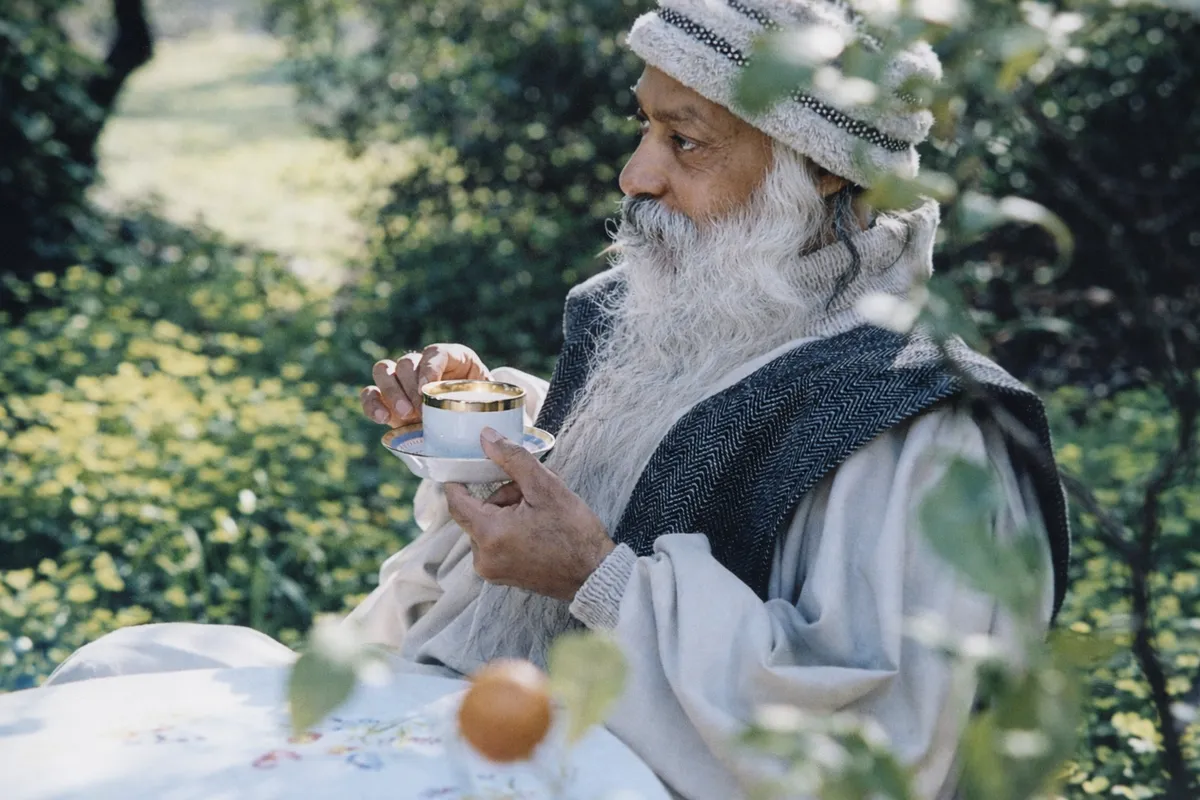
Osho spoke of Jesus with a strange double edge: tenderness for the man, contempt for the institution. He gave whole discourse series to Jesus' sayings — 'Come Follow To You', 'I Say Unto You' — while insisting that the Christian church represents the same priestly establishment that crucified him. His Jesus is an uneducated Aramaic-speaking rebel who spoke of the kingdom of God from a state of awakening the church later domesticated.
These four passages show the main lines of that reading, each anchored in the full discourse it comes from.
From the Discourses
Passages where Osho speaks on jesus — each links to the complete discourse.
Question: OSHO, DID JESUS REALLY CALL BACK LAZARUS FROM DEATH? The function of the master is precisely that: to call the disciples to the real life -- ordinarily they are dead. Ordinarily you only appear to be alive; don't be deceived by the appearance. You function like a robot, efficiently, but it is not life. You have not tasted life yet. Life has the taste of eternity, not of time. Time is death. In Sanskrit we have one word for both, for time and death -- kal. It is very significant. It must have been because of the mystics' experience. time is death. To live in time is not to live at all; to go beyond time is the beginning of life. That is the meaning of the parable; it is a metaphor. Lazarus represents all the disciples, Jesus represents all the Masters.
Did jesus father any children?
Shiva... again? I don't think so, because he would not go into that tedium. But there is a man... Just the other day I was reading about him, he lives in Srinagar, Kashmir, his name is Sahib Zadda Basarat Salim. He claims that he is the direct descendant of Jesus Christ. He has in his possession even today, a complete genealogical table which traces his direct ancestry from Jesus Christ. People go for non-essential things. Now this genealogy must be fictitious. It is true that Jesus lived in Kashmir for many years, but there is not any possibility of him fathering children, because once a Master starts creating disciples, they are his children. And then giving birth to children will simply be a conflict. It will create problems, it will not help anybody. And the Master is no more interested in his physical persis-tence through children, his whole interest has…
Beloved Osho, jesus says, "come follow me." you're against this statement. What would you like to say about it?
And why are the followers with him? They are seeing his contented, authoritative statements, his determined effort, unwavering. Now, when Jesus says, "I am the only begotten son of God," with authority, naturally the poor people.... Who were the people who followed him? Have you ever thought about it? The twelve apostles -- who were these people? All uneducated: fishermen, farmers, woodcutters, carpenters. Only Judas was a little educated; so he betrayed him. All the others were absolutely uneducated, poor people in search of somebody who could hold their hand and could give them a certain strength that they were lacking in themselves. The followers feel it is a mutual conspiracy. Perhaps both are unaware: the leader is unaware that he needs followers to feel comfortable with his own idea, with his own fiction, and the follower is unaware of why he is following this man. He is following because…
Questioner: why did jesus claim?
Jesus did not. He did not claim that he was the messiah. His claims were quite different. In fact, his claims don't come in the form of statements; he claimed through his being. People recognized that he was the messiah. As I mentioned earlier, john the Baptist, a rare sage, had declared that the messiah was coming and he was his messenger. He also said that the day the messiah would arrive he, the messenger, would depart from the world. He lived on the banks of the River Jordan and initiated people in the water of that river. Thousands of people were initiated by him. Jesus too, had his initiation from John the Baptist. When Jesus was standing in water up to his neck, John initiated him and then said, "Now, you should begin your work and I go." The news of this event in the River Jordan spread like…
Read 8 more passages on jesus
Osho, what do you think? Is jesus coming back to earth again as he had promised or not?
A new arrival knocked on heaven's door. Jesus was on duty and opened the door. "Who are you?" he asked. "Adolf Hitler," came the reply. "Adolf Hitler! You cannot come here. You are a megalomaniac bent on world domination. Get away!" "But I want to mend my ways!" "No way! Get out!" "Ah, if you will let me in, I will give you something." "Well," said Jesus, weakening a little, "what is it?" Hitler, in dress uniform, pulled off his special Iron Cross and showed it to Jesus. "Well," he asked, "can I come in?" "You just wait here. I'll go and ask my dad." Jesus found God in his study. "Dad, there's a newcomer at the gate who wants to come in." "Who is he?" "Adolf Hitler." "Adolf Hitler! That megalomaniac bent on world domination? He can't come in here!" "But he has something very special to give me."…
Osho, do you believe in the second coming of christ?
And who do you think I am? Christ is not a person, Christ is a state of consciousness. There have been Christs before Jesus, there have been Christs after Jesus. Jesus is only one of the Christs. Buddha is a Christ, Mahavir is a Christ, Lu-tsu is a Christ, Zarathustra is a Christ. Christ simply means the ultimate state of consciousness; it is equivalent to Buddha. Buddha is not the name of any person, it is a happening. So is Christ -- it is not Jesus' name! His name was Jesus. One day Jesus disappeared and the Christ-consciousness descended IN him. He was no more the ego, he became the vehicle of the whole. He could say, "I and my Father in heaven are one." This is Christ-consciousness; it has nothing to do with Jesus. If you are waiting for Jesus' second coming, then you are waiting in vain; but…
Osho, my christian parents used to talk about god's promise to man and that when jesus left this earth he promised his disciples he would return to take them to the kingdom of god. Are you this promise come true? Are you jesus christ?
WHY SHOULD I BE JESUS CHRIST? One is enough! I am myself. I am just my being. I am neither Jesus Christ, nor Gautam Buddha, nor Vardhaman Mahavira. Why should I be? How can I be? I am not a carbon copy of anybody else; have my original face. But such questions arise. You love Jesus Christ and now you have fallen in love with me -- it is YOUR PROBLEM! Now you would like to bridge your two loves somehow; there must be a conflict inside: what to do now? Now you are in love with me and you have loved Jesus Christ; deep down the mind will say, "Are you betraying Jesus? Falling in love with this man?" And you don't want to betray Jesus -- and now you cannot betray me either! So the conflict. You would like an assurance that I am Jesus Christ so your…
Osho, in Krishna’s time there was the great war of the Mahabharata, and Krishna held a central place in it. He could have stopped the war if he had wanted to—but he did not. A vast devastation followed, and much of the responsibility for that devastation seems to fall on Krishna. Can Krishna be blamed for that war?
This race resembles the one that began some three centuries ago when ships from Europe rushed toward Asia—Portuguese, Spanish, English, French, German. Then, expansion and development demanded possession of Asian lands. Now that has become meaningless. Asians think their independence movements freed them; that is only half true. The other half is that there is no longer any point in holding Asian territory. That era is over. Now the struggle is to possess other ground—celestial ground. Eyes and energies have turned there. Life is an adventure of power. Those who embrace lifelessness are gradually destroyed. We are such a people—being destroyed. All the more reason why Krishna’s message is meaningful—not only for us. I would say the West too stands at a point where it may have to fight one more decisive war—surely not on earth. Even if rivals on earth must fight one another, they will likely do it…
ओशो, कृष्ण के समय में बहुत बड़ा महाभारत का युद्ध हुआ था और कृष्ण उसमें बड़े प्रमुख स्थान में थे। और वे चाहते तो महाभारत का युद्ध रोक सकते थे। लेकिन वैसा नहीं हुआ। और एक बड़ा भारी विध्वंस हुआ। और उस विध्वंस की बहुत बड़ी जिम्मेवारी कृष्ण पर जाती है। तो क्या कृष्ण पर यह लांछन लग सकता है युद्ध का?
यह दौड़ अब वैसी ही है जैसे एक दिन दौड़ आज से कोई तीन सौ साल पहले यूरोप से एशिया की तरफ लग गई थी और सारे जहाज एशिया की तरफ भागे जा रहे थे--पुर्तगीज भी और स्पेनिश भी और अंग्रेज भी, और सब, फ्रेंच भी और जर्मन भी, सब भागे जा रहे थे। तीन सौ साल पहले जैसे एशिया की जमीन पर कब्जा करना जरूरी हो गया था विस्तारवादी के लिए, विकास के लिए। अब वह बेमानी हो गया, अब कोई मतलब नहीं है। एशिया के लोग समझ रहे हैं कि हमारी स्वतंत्रता की लड़ाई ने हमको आजाद किया है। इसमें आधी ही सचाई है। आधी सचाई तो दूसरी है, और वह यह है कि अब एशिया की जमीन पर कब्जा करने का कोई मतलब नहीं रह गया है, अब वह बात खतम हो गई है। वह दौर खतम हो गया है। अब तो कहीं लड़ाई और दूसरी जमीन पर कब्जा करने की है। अब वहां दृष्टि और जगह चली गई है, अब वहां दौड़ है। कल चांद-तारों पर और दूर तक दौड़ हो जाएगी। शक्ति का एक अभियान है जीवन। उस अभियान में जो मुर्दानगी को पकड़ लेते हैं, वे धीरे-धीरे नष्ट हो जाते हैं। हम ऐसी ही नष्ट हो गई कौम हैं। …
Beloved master, buddha told his disciples that he would come back to this earth. Twenty-five centuries have passed, but he has not yet come back. It seems his disciples are still expecting him. Will you do the same thing to us?
All your so-called religious leaders have been promising -- after your death, after two hundred or two thousand years they will be coming back. And none of them has shown up. It is enough proof that those people were lying. But you go on waiting for them. You are simply wasting your time, your life. I cannot do that. I cannot promise you anything. I trust in the moment, in the present. For me there is no tomorrow. For me there is no future. And I want you to understand that existence is always now and here. If you want to live it authentically, intensely, then be now and here. Use this moment to its totality. Squeeze the whole juice out of it. Don't wait for the next moment, because who knows about the next moment. And you are waiting for centuries, for thousands of years. This is simply wasting…
What does christ really mean when he says, "come follow me"
Exactly what he says: "Come follow me." TO FOLLOW JESUS A DEEP TRUST, SURRENDER AND LOVE IS NEEDED BUT TODAY A DEEP SKEPTICISM IS PREVALENT ALL OVER THE WORLD. WHAT IS THE WAY? This is from Swami Yoga Chinmaya. Think about yourself. Is deep skepticism within you? That's the question to be asked. A deep skepticism is prevalent all over the world: who are you to be worried about the whole world? This is a way to escape the real problem. Skepticism is deep within, the worm of doubt is there in your heart, but you project it; you see it on the whole world's screen. "The world is skeptical -- what is the way out?" Now you are transferring the problem. Look within yourself. If there is doubt, then find it out. Then something can be done. The world won't listen to you, and there is no need, because…
Osho, Mahavira’s prior-life state was a state of moksha, and you say that from moksha there is no return. Then how did he return? Please clarify.
In a rush he kissed the maid and said to the wife, “Take care of the children!” The wife protested. He said, “Then let me correct it,” kissed the wife and told the maid, “Take care of the children.” “Sometimes I slip,” he said. So do we all—we keep remembering: this is my father, my wife, my son. If we forget, others remind us: “I am your father.” We must remember our roles; the more dutifully one plays, the more “conscientious” he is. I do not say, “Do not play.” Life is for playing—and it is delightful. Only do not forget one thing—even if you forget everything else—do not forget that it is a play, and that inwardly there is a point in you that forever stands outside. Swami Ram went to America. He had a strange habit; people were puzzled—he always spoke in the third person. He would say,…
प्रश्न: ओशो, महावीर के पूर्व-जन्म की स्थिति मोक्ष की स्थिति थी और आपका कहना है कि मोक्ष से लौटना नहीं होता, तो फिर उनका लौटना कृपया स्पष्ट करें।
एक फ्रेंच चित्रकार अमरीका जा रहा था। उसके भुलक्कड़ होने की बड़ी कहानियां थीं। उसकी पत्नी और उसकी नौकरानी, उसको दोनों विदा देने एअरपोर्ट आई हैं। उसने जल्दी में नौकरानी को चूम लिया है और पत्नी को कहा, खुश रहना, बच्चों का खयाल रखना! और वह जाकर...वे दोनों घबड़ा गई हैं, क्योंकि वह, उसकी पत्नी ने कहा, यह क्या करते हैं? आप खयाल नहीं करते, वह नौकरानी है! उसको आप चूमते हैं और मुझे नौकरानी बनाते हैं? मैं आपकी पत्नी! उसने कहा, चलो बदले देता हूं! उसने कहा कि चलो, बदले देता हूं! पत्नी को चूम लिया है, नौकरानी को कहा, बच्चों का खयाल रखना। उसने कहा, कभी-कभी चूक जाता हूं, खयाल नहीं रख पाता। कभी-कभी चूक जाता हूं, खयाल नहीं रख पाता। हम खयाल रख पाते हैं, कुछ लोग चूक जाते हैं। खयाल क्या रख रहे हैं हम चौबीस घंटे? यह मेरा पिता है, यह मेरी पत्नी है, यह मेरा बेटा है, इसका हमें खयाल रखना पड़ता है चौबीस घंटे! …
Beloved Osho, are you a messiah?
I know poor people, utterly poor, who have nothing; it is so difficult for them to even manage one meal a day. Sometimes they have to just drink water and sleep -- water to fill their empty belly so they can feel that something is there. But they are in a certain way satisfied, they have accepted it as their fate, they don't think that things can be better than this. You can provoke them. You can put the fire in their minds very easily -- just give them hope. But then sooner or later they are going to hold you by your neck: "Where are the hopes?" And that was the situation after forty years when Moses left them. The excuse was, "I'm going to find the people who have got lost somewhere." He never came back -- he died in India. I have been to his grave. You…
Understanding Osho's Reading of Jesus
The threads that run through his discourses on jesus.
The Church Cannot Be Trusted About Christ
Asked about Jesus' sacrifice for the world's sins, Osho began where he always began: whatever a church says about its founder is bound to be wrong.
THE FIRST THING TO BE UNDERSTOOD about a man like Jesus is that whatsoever the church that is bound to grow around such a man says about him, it is bound to be wrong. What the Christian church says about Christ cannot be true. In fact the Christian priest does not represent Christ at all. He is the same old rabbi in new garments, the same old rabbi who was responsible for Jesus murder. The Pope is not a different kind of person. It makes no difference whether it is a Jewish establishment or a Christian establishment or a Hindu establishment; all establishments function in the same way. Jesus is a rebel, just as Buddha is or Lao Tzu is.Be Still and Know, Chapter 2, Question 3 →
Born a Jew, Died a Jew
Osho liked to remind Christians of an inconvenient history — the man they worship never heard the word 'Christian' and never spoke the word 'Christ'.
He was never known as Christ in his own times because the word 'Christ' is a Greek word. Hebrew has no word like 'Christ' or 'Christian'. And Jesus was absolutely uneducated, he had no knowledge even of Hebrew. He spoke a small local dialect -- Aramaic. He was born a Jew, he lived as a Jew, he died as a Jew.The Last Testament Vol 6, Chapter 5, Para 69 →
Why Crucifixion Was Inevitable
For Osho the cross was not an accident of politics but the predictable response of a threatened past to a man carrying a new future.
Nobody is crucified anywhere unless the masses feel that the very ground on which they are standing is in danger. Jesus must have created so much of a stir that the people became afraid that if this man lived he would destroy the whole past. And in a way the people were right. The man was trying to destroy the whole past; he was trying to bring a new man into the world.The Miracle, Chapter 22, Para 31 →
Did Jesus Die at Thirty-Three?
Osho repeated an Eastern tradition that scandalizes both believers and historians: the crucifixion was survived, and Jesus lived out his enlightenment far from Jerusalem.
Many things may have to be considered: one, Jesus died for Christianity at the age of thirty-three. Remember, for christianity, because actually he did not die -- he lived to be one hundred and twelve. But that is another story, not related with Christianity at all. and he died a fully Enlightened One like Buddha, Mahavir and Krishna. So this is the first thing to be understood. Christianity has only this much to say, that he was seen resurrected after his crucifixion.The Ultimate Alchemy Vol 2, Chapter 9, Question 2 →
Questions Osho Answered on Jesus
14 questions in the library — the most sought-after:
No—Osho says Jesus’ real “children” were his disciples, because he lived to share spirit, not to start a family line.
Osho says Jesus won’t literally come back; enlightened ones don’t return, so stop waiting and learn from living wise people and your own inner awareness.
Don’t copy any leader—even holy ones—because you’ll stop using your own eyes; listen, share, but walk your own path.
No—it's a teaching story: a master wakes people who are 'asleep' inside so they can truly live beyond the clock.
He didn’t brag about being special; his life showed it, and when people asked, he honestly said he was the long-awaited one who existed before Abraham.
It means Mary’s heart and mind were very pure and innocent, not that sex didn’t happen.
If you stop loving suffering and start loving life, Jesus appears as living joy, not as a story of pain and death.
He jokes that Jesus wrote, “Please don’t throw a stone, Mom,” to remind us not to judge others because nobody is perfect.
Frequently Asked
Deeply — he counted Jesus among the enlightened ones and spoke several loving discourse series on his sayings. His attack was reserved for Christianity: the priesthood, the guilt, the worship of suffering. He often said Jesus was never a Christian at all, but a Jew.
That it was the establishment's inevitable answer to a man dismantling its past — and, provocatively, that it failed. Following traditions he cited from the East, Osho held that Jesus survived the cross and lived to old age in Kashmir.
As awakened equals with opposite flavors: Buddha the silent, cultured prince; Jesus the fiery, uneducated carpenter's son. Osho noted that Jesus' Jewish idiom — God as father, kingdom of heaven — was shaped by the audience he spoke to.