
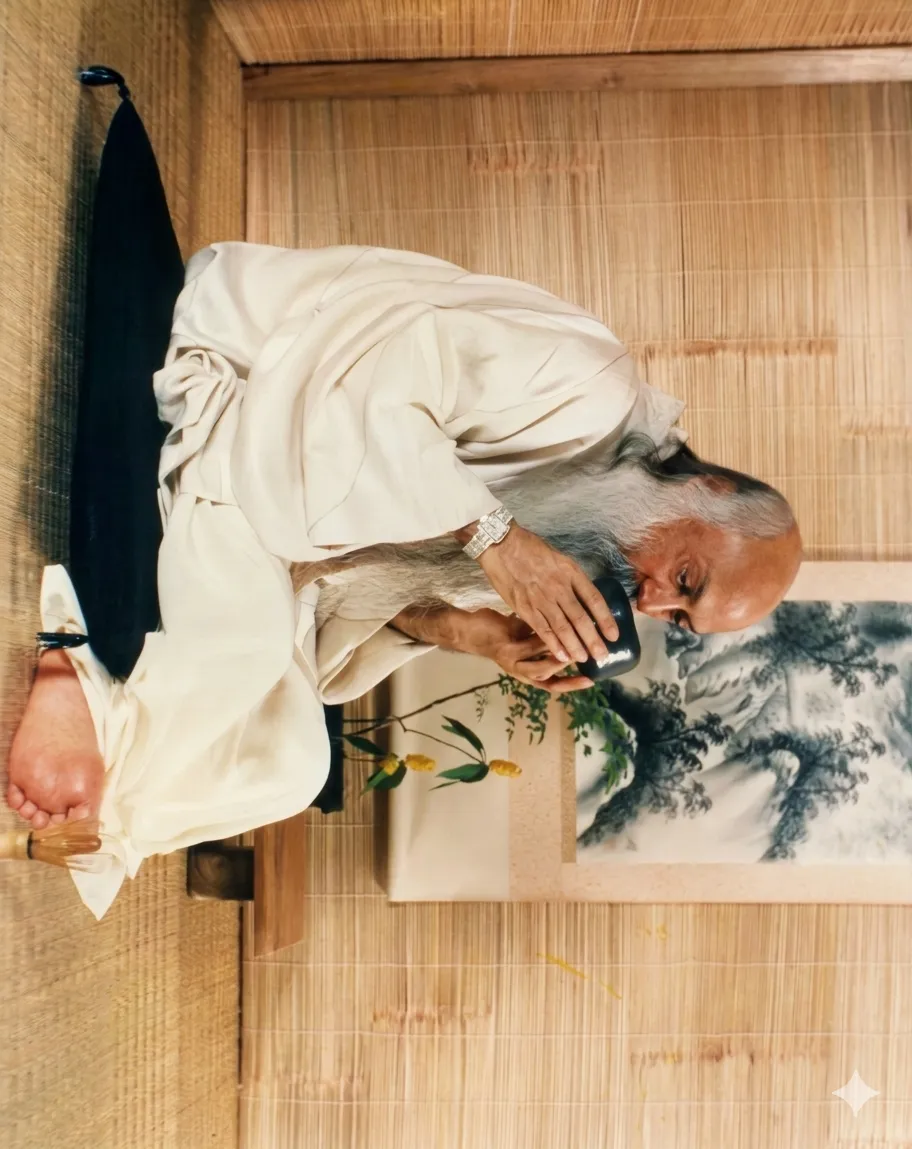
According to Osho, saints and mystics retreat to unnoisy, uncrowded places because, until realization ripens, they are seekers who need protective conditions to grow inner strength. Noise and crowds can pull a fragile consciousness back. Solitude crystallizes a center; then one returns, untouched by disturbance. For siddhas, place is irrelevant—their silence travels with them—but for beginners, temporary seclusion is skillful.
They go somewhere quiet to get strong inside; once truly strong, noise can’t bother them and they can live anywhere.
From the Discourses
Passages where Osho speaks to this question — each links to the complete discourse.
You said that noise and disturbances are not outside in the world, but are because of your own minds and ego. But why do the saints and mystics always live in unnoisy, uncrowded places?
Because they are still not saints and mystics. They are still endeavoring, still working. They are seekers, not SIDDHAS. They have not reached. Noise will disturb them, the crowd will disturb them. The crowd will pull them back to its own level. They are still weak, they need protection. They are still not confident. They cannot move into temptation. They have to protect themselves in the lonely solitude where they can grow and become strong. When they are strong there will be no problem. Mahavir moved into the wilderness. For twelve years he was alone, silent, not talking, not moving in villages or cities. Then he became enlightened. Then he came back to the world. Buddha was in total silence for six years. Then he came back to the world. Jesus or Mohammed, or anyone -- when they are growing they need protected conditions. When they have grown, then there…
Samadhi is the ultimate state of being, the ultimate flowering of consciousness. Man lives in the mind, animals live below the mind. Samadhi is the state above the mind where thinking disappears, and with the thinking, all wavering of consciousness disappears also. Thinking is like ripples in a lake, and because of the ripples, the reflection cannot be true; the moon is reflected but the ripples distort it. God is reflected in everybody, we mirror him, but our mind is so full of thoughts, waverings, clouds, that whatsoever we come to see is no more the same; it is not that which is. The mind has imposed its own thoughts upon it, it has interpreted it, and all interpretation is a distortion. Reality needs no interpretation; it needs only reflection. There is no point in interpreting, the interpreter goes on missing the point.
Osho, why do saints leave family and society and go to the forest in search of the Divine? Please explain.
And where else should they go? There is no other place. It is society and family that have distorted you; you must be free of them. Whether someone literally leaves society, or leaves it mentally, one way or the other one has to be free of society. The forms may differ. Charandas left the world; Kabir remained in the world. Do not think Kabir did not renounce. Kabir too renounced—he renounced while living in the world. The world has to be left. One must be free of the limits of the world. If you can be free from within—be so; nothing is more auspicious. But if you find that inner freedom alone is not possible, then outer freedom will also be needed; if that seems necessary, then that too is necessary. But free you must be. These layers of darkness on your mind have been laid by society. When you…
Osho, why does pratikraman—the return home—feel uneasy, difficult, almost impossible to us?
Hence whenever a living Master appears, those who uphold old scriptures become his opponents, because because of him people begin to set scriptures aside. When scriptures are set aside, the pandits are set aside, the whole business is set aside. It becomes hard. The pandits become enemies. Then when this Master dies, the same pandits who were his enemies gather at the cremation ground—to offer homage. They then make scriptures out of him. Their enmity was with the living, not with scripture. So they themselves make the scriptures. It is amusing: Mahavira was a Kshatriya, but all his ganadharas were Brahmins! Strange—what is this? The moment Mahavira died, the Brahmins rushed in: “Good opportunity—now we can make scriptures again.” At once they set up scriptures. Jainism got constructed. Now if once again someone brings living religion, the scholars, the pandits, the worshipers of scripture, are in trouble again; their business…
And once you have caught hold of a single note, then there is no problem. Then you can search for the very source through it. A single ray of light can lead you to the very sun from where it comes. Jesus heard it, Buddha heard it, and anyone who has ever heard it has been no more part of the earth, has become part of the sky, has been no more part of time, has become eternal. And unless one becomes that, one suffers. Suffering is because we are missing our own treasure. Suffering is because we have not been able to see our own kingdom. [To a sannyasin who has been living in a cave in the mountains] That always happens: if you live in the mountains too long then you become habituated to the mountains and the silence. These are just habits of the mind.