
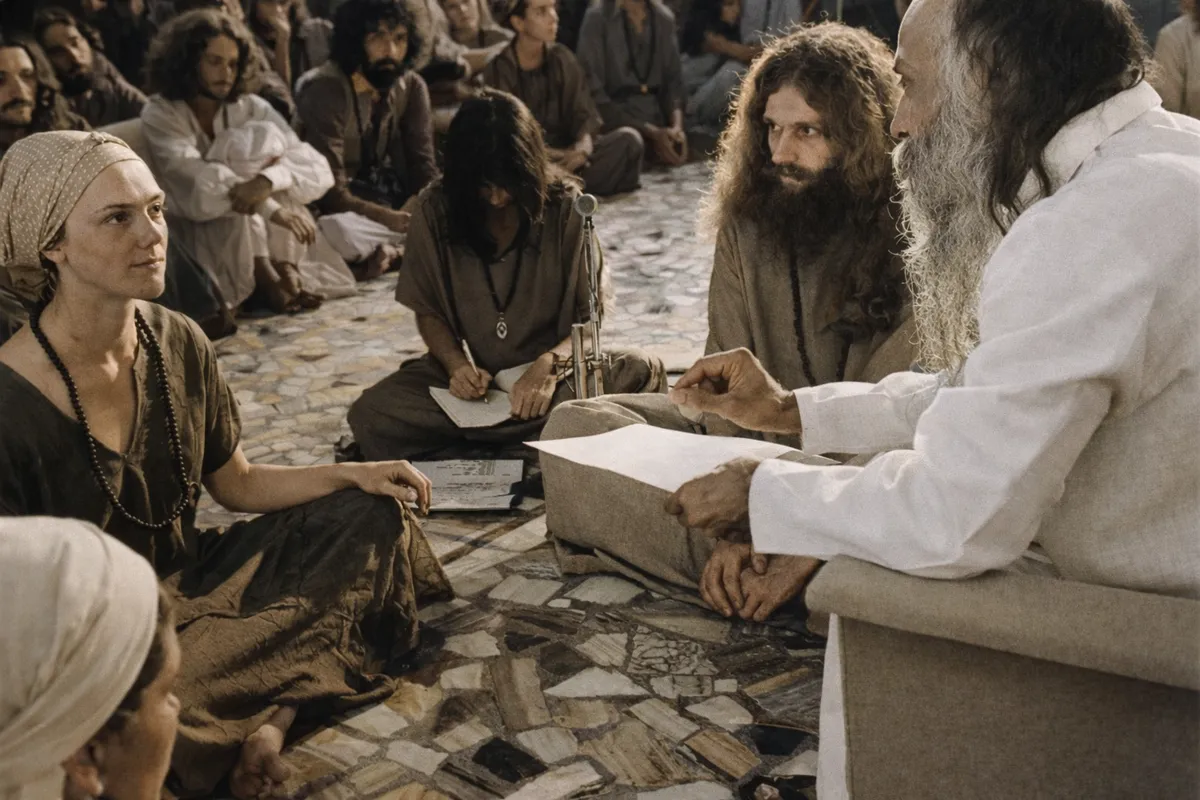
According to Osho, ego is a misinterpretation of life’s flow: you believe “I am doing” what is, in truth, simply happening. Like the woodpecker claiming the lightning’s power, the mind translates happenings into doings and invents a doer. Recognize there is no doer or do-ee—only happenings—and the ego dissolves. Practice by inwardly replacing “I’m doing” with “It is happening” to return to humility and effortless presence.
Ego is when you take credit for what life is already doing by itself—like thinking you broke the tree when lightning did it.
From the Discourses
Passages where Osho speaks to this question — each links to the complete discourse.
Question: WHAT IS THIS EGO? An ancient story: A young woodpecker, who felt exceedingly vigorous one morning, looked around the forest and decided to start the day by pecking a huge oak. He had just gotten off to a good start when a bolt of lightning split the tree from top to bottom. The bird hustled out from under the debris, looked up at what was left of the tree, and murmured with a shudder, "My! I did not even know my own strength." This is what ego is. It is a misinterpretation -- what is already happening, you think you are doing it. Just a translation from happening to doing is the creation of the ego. Watch, and whenever you feel that you are doing something translate it to "It is happening." Read "It is happening" and the ego will disappear. All is happening, nothing is being done.
Osho, what is the fundamental anguish of human life?
There is only one anguish: that a human being cannot become what he was born to be. There is only one anguish: that the seed remains a seed and does not bloom like a flower; that it cannot scatter its fragrance to the infinite winds; cannot converse with the moon and stars; cannot offer its colors to the sky; cannot be expressed. If the poem within the poet cannot be revealed—anguish. If the painter cannot paint—anguish. If the dancer cannot dance—if chains lie on his feet—anguish. Anguish means only this: that what we are meant to be—our innate nature and destiny—does not come to fruition, and we are forced to be something else. Then anguish is born. Then melancholy gathers over life. And all those countless people you see burdened with sorrow, living in a kind of hell—the reason is only this: each has come carrying the seed of becoming…
Osho, please summarise what the ego is.
An egotistical lover met a girl in a drugstore and asked her 'How would you like to sleep with me tonight, baby?' The giri, insulted and angry, used her knowledge of judo and swung him out of the door. Jolted and jilted, the egotistical lover returned. 'But baby,' he said, 'You haven't answered my question!' That's what ego is -- the greatest stupidity. You can't see it because you are it. You can always see it in others, you cannot see it in yourself. A Jew suddenly became very rich and he wanted to show it off to everybody. So he and his wife went to the costliest restaurant dressed in the costliest dresses. The wife was wearing diamonds and emeralds and all that money could purchase -- and they had really become very rich. She was looking very ugly with all those diamonds and emeralds because she had no…
What is the ego?
The MacGregor of Scotland were all big, husky, country men. They knew the wilds of their own surroundings, but had little use for the finer aspects of civilization. When a problem arose with respect to their land rights, the head of the clan -- known as The MacGregor -- sent to the university in Edinburgh for an attorney. The city lawyer was pale and slight next to the clansmen, but he had the expertise they needed, so he was generously thanked and invited to share the MacGregor' gargantuan dinner. Entering the huge dining hall, the lawyer was pointed to one end of the table overflowing with food. The lawyer, not wanting to usurp the master's place at the head of the table, said, "Oh, sir, I could not sit in the chair of The MacGregor himself." "You may sit," The MacGregor assured him, "since it is he himself who invites…
Yesterday Dhabbu-ji was saying, Osho, I finished my worship and then saw my little niece, a while later, sitting on the same seat with eyes closed, hands folded, swaying and singing: “Do bechaare, bina sahaare, phirte maare-maare!” (Two poor fellows, without support, roam around hounded!)
Dhabbu-ji told me this, and I burst out laughing. I asked, “Ninu, what’s this?” She said, “Please be quiet, I’m doing puja, Uncle!” Dhabbu-ji said, “Puja? But that’s a film song, not a hymn!” She quickly shot back, “In puja you and Grandma also sing ‘Om Jai Jagdish Hare’—that’s a song from the pictures too.” What difference does it make what you’re singing? Whether it’s a bhajan or a film song—within your sleep, all is equal. Even if you dream of heaven, it makes no difference. Even if gods appear in your dream, nothing changes. When you wake up, you’ll find all dreams were false. Some people are lost in worldly dreams; others are lost in dreams of renunciation. And these renouncers you’ve kept calling “great souls.” Their sleep is just like yours—no real difference at all. Even their dreams are like yours, because a dream is a dream; what…