
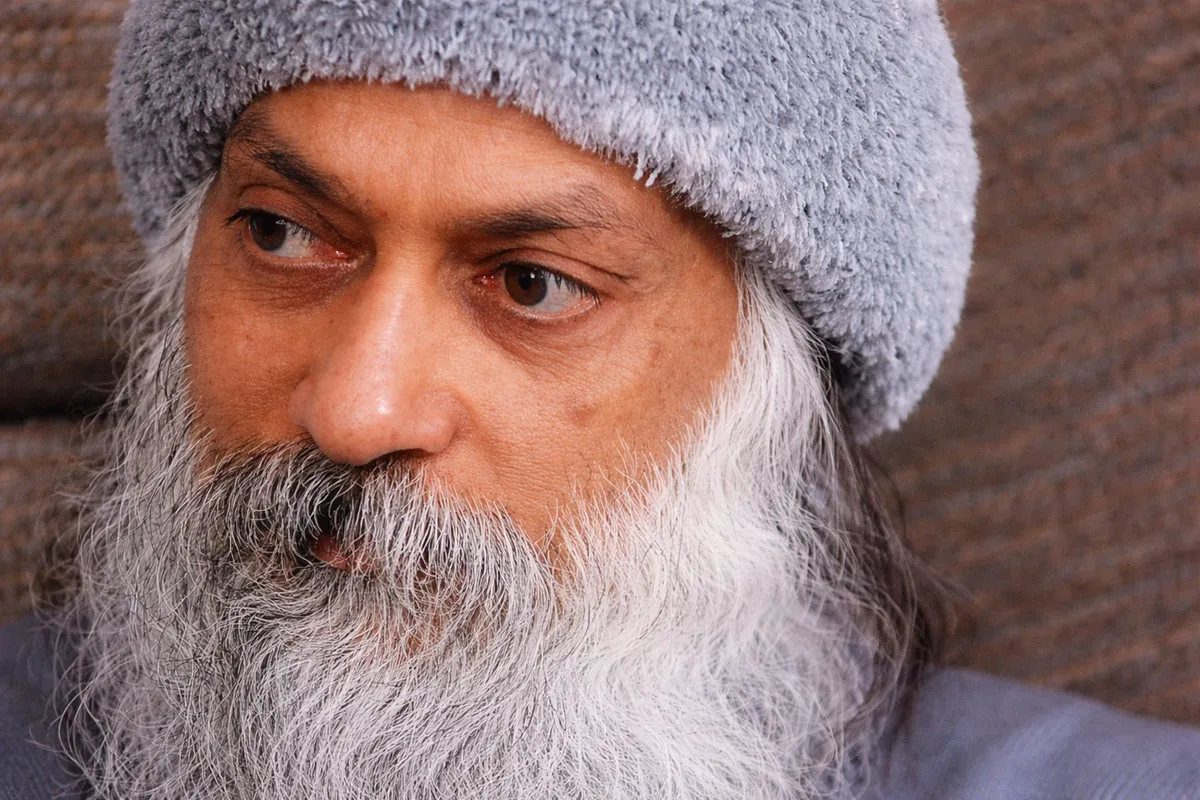
They looked down on him because his people attacked him, India seemed weak, and he wouldn’t flatter their religion—he just told hard truths.
From the Discourses
Passages where Osho speaks to this question — each links to the complete discourse.
Osho, you say that religion blossoms only in the East, and that people from Western lands come to India out of a religious quest. Why then did those very countries not welcome you? Why did they treat you with such contempt?
They saw me as an enemy because I did not go after the West’s poor, orphans, or beggars—and there is no shortage of beggars there; in America alone there are thirty million beggars. Those who are busy turning other beggars in the world into Christians do nothing for their own beggars, because they are already Christians. The people I influenced were professors, writers, poets, painters, sculptors, scientists, architects—gifted people. And this was alarming: if the gifted people of the country are being influenced by me, it is a sign of great danger. Because these are the people who set the path for others. Seeing them, others walk those paths. Their footprints will lead others along the same ways. And I did not tell anyone to leave his religion. I did not tell anyone to accept a new religion. I only said: Try to understand—what is religion and what is irreligion.…
Osho, India is a land whose very life-breath is religion. One proof is that even the most insignificant gurus here do not keep their number of disciples below a hundred thousand. But it is surprising that a guru as radiant as the sun, like you, has so few Indian disciples. Kindly shed some light on this.
Ramanand Agnihotri! No country has religion as its life-breath! Not India, not China, not Japan, not Iran, not Pakistan—no country. Countries cannot be religion-breathed. Countries are political units; what could they possibly have to do with being religion-breathed! Do countries have any prana—any life-breath at all? If there is no life-breath, how will there be religion-breath? Individuals are religious, not countries. Not castes, not communities, not organizations—only individuals. That is the dignity of the individual. Did it never occur to you that first there must be life-breath? At the very least, there should be life—religious or irreligious—but life. Do countries have any life-breath? These are political fictions, political tricks. Just a while back, before 1947, Pakistan was India; now it is not. What will you say? Is Pakistan now religion-breathed or not? Before 1947 it was; now? Now it is not. Bangladesh earlier was religion-breathed because it was part of…
Osho, someone once told me Poona is the Oxford of India—a city of culture and a representative of the country’s elite. But here, almost every night, well-dressed people ride scooters or cars around Koregaon Park and mercilessly beat sannyasins—especially sannyasinis—with sticks. And now, as if sticks were not enough, they’ve started using iron chains. Osho, what kind of people are these?
In the West you can bathe naked at the seashore—no problem. No man will pounce on you. Here the situation is the reverse. If your arm is showing, it means you lack character; you are attackable. If you were wrapped in a sari, you would be certified as a lady of a “good family.” Here people are weighed by their clothes. So Western visitors naturally face difficulties. They continue to behave as they learned from childhood. There is nothing wrong in that behavior. Among decent people, bathing naked at river or sea should be no issue. Nakedness is natural. Yes, wear clothes in office and market—but there should be some place where one can move free. Here there is none. Mulla Nasruddin went to his doctor. The doctor had hired a newly trained Western girl as an assistant. Mulla kept staring. Inside he said, “You’ve hired such a beautiful girl…
Osho, I wish you would say something about the eastern indifference to what you are doing, and the western attraction.
You can see it happen everywhere. Rabindranath Tagore got the Nobel Prize. Before he got the Nobel Prize his book was already published for years -- the book on which he got the Nobel Prize, GITANJALI -- but nobody has praised it. Once he got the Nobel Prize, the whole India was praising him, and he could see. He refused the invitation of Calcutta Corporation. They wanted to honor him. He said, "I won't come. I refuse this honor, because the book has been published for many years in the original, and you have never honored me." In fact, no note was taken of his book, and it is one of the greatest books ever written. On the contrary, people were criticizing it, criticizing it because it was not according to the old pattern of Indian poetry. It has something original, and the Indian mind cannot understand anything original; it…
Osho! In the morning discourse on May 22 a young man threw a knife and tried to kill you, but failed. What’s surprising is that no newspaper criticized the incident, and no “high-ranking” person made any statement about it! Nor did any paper or magazine print praise for the loving way ashram residents treated that man. Why are intellectuals and ordinary people all so full of indifference? Osho, your main ashram stands in such a dead country—where even a branch would seem pointless.
Israel cannot accept me. Christians cannot. Communists cannot. Wherever I live there will be trouble. I did not decide to live in India by accident; it is the most feasible place. So don’t worry, Kailash Goswami, “In such a dead country is it right for you to live?” Where there are corpses, there most is the need for someone to awaken the dead. Where there is illness, there a physician is needed. Where there is disease, there must be treatment. And yes, this country is dead—long dead. Yet great potential lies hidden here. The country that gave birth to Buddha, Krishna, Mahavira, Kabir, Nanak, Farid—that country has fire hidden under ash. The ash is five thousand years old. If we can remove it, the embers can glow again. And remember, we haven’t used our genius for five thousand years. That can be a benefit—like land left fallow for years accumulates…