
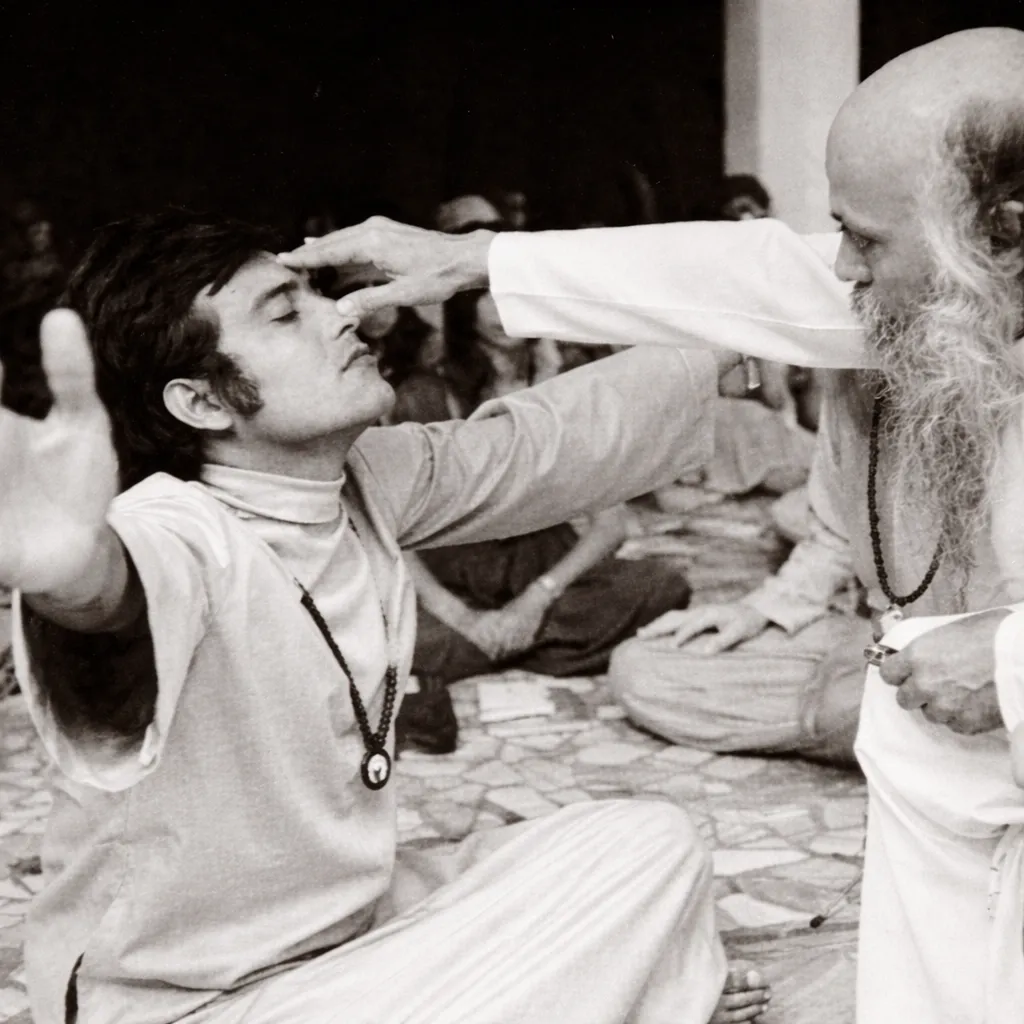
According to Osho, both statements are true. At the level of personality and what we call life, death is the greatest undeniable fact. Yet at the level of your innermost being, there is no death; it is only an absence, like darkness is the absence of light—a shadow without its own substance. Holding both reveals the whole truth.
Death is real for your body and ego, but the deepest you doesn’t die—like darkness is just where light isn’t.
From the Discourses
Passages where Osho speaks to this question — each links to the complete discourse.
A friend has asked: you mentioned once that there is no other truth greater than death. You have also said somewhere that there is nothing like death. Which of the two statements is true?
The judge was puzzled. How could both be telling the truth? Obviously, one of them was lying. The murderer began to laugh. The judge asked what was so funny. The man said, "Let me tell you that both of them are right. The house was incomplete; the roof had not yet been laid -- the stars could be seen above. The murder took place under the open sky, but close to the door, close to the wall which bears the bloodstains. The house was almost ready; the walls had been raised, only the roofing was not yet done. So both are right." Life is so complicated that even the things we find contradictory in it turn out to be right. Life is highly complex. Life is not the way we think it is -- it contains many contradictions; it is very vast. In one sense, death is the greatest truth…
A friend has asked: I have sometimes said there is no truth greater than death; and I have also said there is no such thing as death. Between these two, which one, they ask, is true?
Both statements are true. When I said there is no truth greater than death, I was drawing attention to this life that we call life, to this personality that I call “I.” In this personality and in this life, the event of dying is a very great truth. This personality will die; this life, which we call life, will also die. Death will happen. You will die, I will die. And what I am calling life will be wiped out, destroyed, will fall to dust. So when I say there is no truth greater than death, I want to remind you that I, you, all of us will die. And when I say death is absolutely unreal, I want to remind you that within the “I” there is someone else who will not die; within you there is someone else who will not die. And other than what you take…
Osho, you said the truth of life is death. Then what is the truth of death?
Buddha called this the state of suchness—accepting what is, as it is. No yes-and-no. No imposing your desire that it be like this or like that. As it is, let it be as it is. Kabir said: Just as it is—accept it as such. Because as long as you reject, you are fighting life—you are contending with God. You are trying to impose your will. You are not a seeker of truth; your ego is still thick. In accepting what is, as it is, the ego dissolves; there remains no place for it. The struggle is gone, the ego is gone. Ramana lay down. He consented: If death comes, it comes. What is in my hands? “Jih vidhi rākhe Rām, tih vidhi rahiye”—In whatever way Ram keeps you, remain that way. If death has come, it has come. This is how Ram wishes to take me—so be it. He was…
Osho, what is the essence of Gorakhnath’s teaching?
Very small, concise— Laugh, play, live in color. Do not keep company with lust and anger. Laugh, play, sing songs. Keep your heart-mind steady and firm. This is my teaching too: Laugh, play, live in color. Live in color! In delight, in merriment, in joy. So much has the Divine given—dance, hum, sing! A song of gratitude should rise from your heart; that is prayer. Laugh, play, live in color. Laugh. If you cannot laugh, understand that you can never be religious. Your so‑called sadhus and saints have forgotten how to laugh. They simply cannot; to laugh is a sin, a transgression. That’s why you can’t stay long with them. You go, quickly touch their feet, bow, and leave. If you stay a full day, you’ll see the difficulty—your own laughter will be snatched away. People become grave around sadhus and saints. They stiffen up—dry, solemn, ultra‑serious! Laughter will feel…
Man doesn't even know what life is. And if we can't know what life is, then there is no possibility of our knowing death either. As long as life itself remains unfamiliar, as long as it remains an enigma, there is no way one can be familiar with death, no way one can ever know what death is. The truth is, death seems to occur because we have no idea of what life is. For those who know life, death is an impossible word. It is something which has never occurred, never occurs, can never occur. There are certain words which are absolutely false; they contain not even an iota of truth. The word death is one of them. It is a totally false word. No event like death occurs anywhere. But we see people dying every day. Every day, death seems to be happening all around us.