
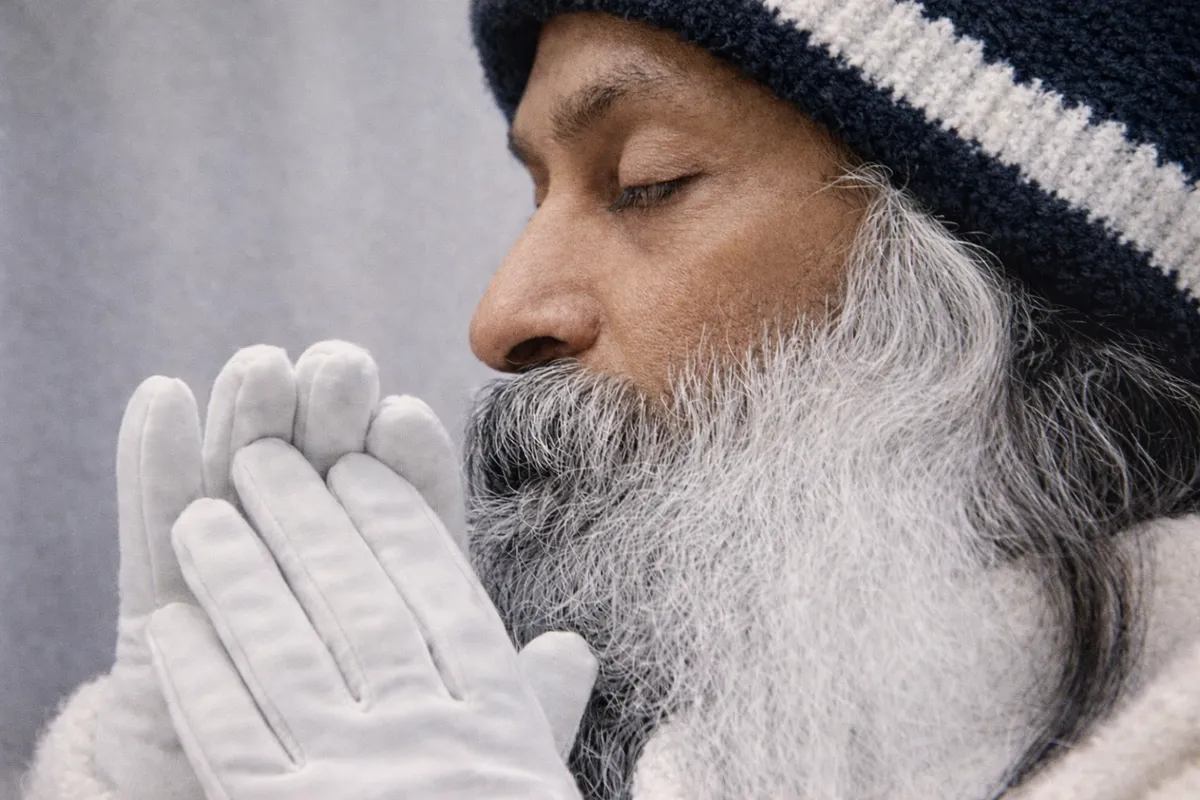
Stop pretending; choose one prayer or meditation and do it with your whole heart, as if nothing else exists.
From the Discourses
Passages where Osho speaks to this question — each links to the complete discourse.
Osho, you always emphasize experience. I have done everything—worship and rituals, yoga and meditation, vows and fasting! And for some years I even lived like an old-style sadhu. Yet nothing came of all that. What should I do now?
You have done nothing. Do you even know what fasting is? Fasting—upavas—means to dwell near, to sit close to the Divine. It does not mean starving. Yes, it often happens that sitting close to Him you forget food; you forget to eat. In real fasting, food is not in the focus—God is; and God is so much in focus that you forget the body. Then food does not come to mind: that is fasting. When you fast, the exact opposite happens. What you do should not be called upavas; that is why we have another word—anashan, a hunger strike. You go on a hunger strike: “Today I will not eat.” But have you seen what a man does when he decides to fast? “Tomorrow I mustn’t eat”—so tonight he stuffs himself. He makes up for tomorrow today. Is that fasting? And what will you do tomorrow all day? You will…
One needs experience of one's own. Only trust your own experience, then you are on the right track. In trusting your own experience you will come closer and closer to truth. And when the trust in oneself becomes absolute, unwavering, God is revealed. God cannot be manufactured by the mind; it has to be lived and experienced through the heart. It is a love phenomenon, not a logical conclusion. OSHO (TO PRAGITO): You are ready for many things! Just don't hold back! All that is needed her is flowing with the energy that is available; nonresistance is all that is needed. Our mind naturally resists. The mind is a great no-sayer. It is very afraid to say yes because yes means its death. It lives through no, no is its nourishment.
Osho, I am worn out from practicing religion—vows, fasts, yama and niyama—I’ve tried them all and found nothing. What should I do now? I have come to your refuge to ask this.
So sometimes fasting is useful. But fasting is not a way of life. Otherwise you are choosing slow suicide; you begin enjoying torturing yourself; you turn perverse and violent toward yourself. Such fasting is abuse—self-abuse—and no one can protect you from it. And your mute body already suffers so much at your hands. Do not imagine this abuse will bring you religion. Yes, the body will dry and wither—but do not fall into the delusion that the lotus of the soul blooms because the body withers. There is no necessary connection. So all that you did—yamas and niyamas, vows and fasts—each has its own value in its own place. But when you take them as synonyms for religion, Dayanand, you go astray. They are not synonyms. Religion has only one synonym—meditation. Mahavira used an exact word for it: samayik. The Jains call the soul “samay”—the timeless time. Samayik means: abiding…
Osho, yesterday you said that jealousy is included in respect. I have immense respect for you, but the jealousy inherent in it keeps poisoning it, and I feel guilt and pain. Does reverence transcend this poison-laced respect?
It needs a little explaining—it's a delicate point. Whenever you respect someone, you do so because you see in that person something you do not have. You respect because you glimpse in the other something you would also like to possess. A beggar respects an emperor because he, too, longs to be an emperor. So on the one hand he respects, and inside he also envies. Because he is not yet an emperor but wants to be. You have attained what he wants to attain. He respects you as skillful, successful: “I stand far back in the line; you have gone ahead to where I should have been.” So you are powerful, clever, intelligent, strong—he respects you. But inside a fire of jealousy also burns—if he gets the chance, he would like to be in your place and push you aside. And if the beggar gets that chance, he will…
Osho, tell us of some lure that would set us moving toward God—some temptation that would engage our mind in God-realization.
Difficult today, difficult tomorrow; the day after, not so difficult—if you persist and don’t jump up, “Oh, a bad thought—get rid of it!” The witness has nothing to do with good or bad. Thorns have the same worth as flowers. We label; the witness does not. Soon, an amazing thing begins: now and then a gap appears—an interval. A thought comes, then the next does not; a space remains. In that empty space, the first glimpses begin. In that emptiness, even you are not—there is only emptiness. That is the door. Keep at it, and thoughts lessen; spaces grow. It’s like a road where a person passes, then for an hour no one—emptiness. A thought appears on the screen, then none for a long while; the screen is blank. From that blankness, your first contacts with God begin—because in that moment you are present. Thought can take you to past…