
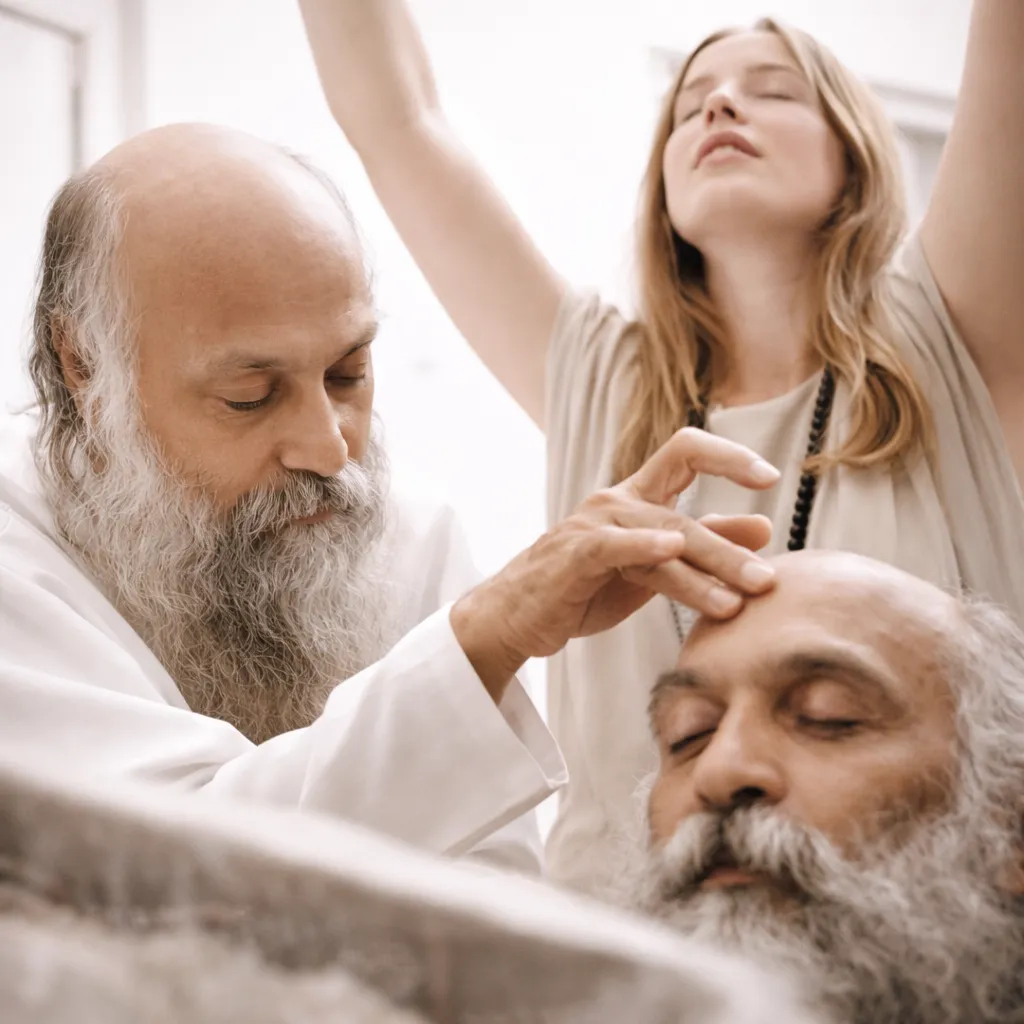
According to Osho, the only difference between experiencing and indulging is awareness. The act is the same—eating, lovemaking, listening—but without conscious witnessing it becomes mechanical indulgence; with full presence it is luminous experiencing. He refuses to label acts themselves; the pivot is your alertness. Awareness brings proportion, joy, and sufficiency; unconsciousness breeds excess, habit, and ugliness.
When you’re fully present, you truly experience; when you’re on autopilot, you just indulge.
From the Discourses
Passages where Osho speaks to this question — each links to the complete discourse.
Osho, what is the difference between surrender and blind imitation?
So be careful: the freedom you allow yourself, allow the other too. You have no right to judge another as blindly credulous or as a surrendered being. Drop that concern. You cannot judge anyway—how will you enter another’s heart? How will you know? Think only about yourself. See within whether, up to now, you have lived by blind belief or by surrender. Decide only there; leave worrying about others. Otherwise, all your judgments will be wrong. Jesus said: Judge not; do not set yourself up as a judge in relation to another. To the friend who has asked: if you are asking for yourself, good. Drop worrying about others. Look within and see: whatever I have been clinging to till now—have I ever staked my life to hold it? Have I meditated for it? Have I loved for it? Or am I just clutching what culture, society, civilization handed me?…
Osho, is the experience of the Divine different for each person?
Think of it like this: you go home from this garden, and your children say, “Tell us—what was the garden like?” A painter might tell you by making a painting: “It was like this.” A poet will write a poem—of the trees, of the winds passing through them, of the sun filtering between their leaves. Now a poem and a painting differ greatly. Or perhaps someone is a musician; he will not even write a poem—he will lift his vina. Why write? The winds passed through the trees and there was sound and resonance—he will reproduce that resonance on the vina. The colors in the trees he will translate into tones. The sun and shade he will pour into music. He will play the garden on his vina. Another will write a poem; another will render it on paper. The three expressions will differ. And if you look only at…
Question: what is the difference between awareness and witnessing?
Witnessing comes as a consequence of consciousness. You cannot practice witnessing; you can only practice consciousness. Witnessing comes as a consequence, as a shadow, as a result, as a byproduct. The more you become conscious, the more you go into witnessing, the more you come to be a witness. So consciousness is a method to achieve witnessing. And the second step is that witnessing will become a method to achieve awareness. So these are the three steps: consciousness, witnessing, awareness. But where we exist is the lowest rank: that is, in unconscious activity. Unconscious activity is the state of our minds. Through consciousness you can achieve witnessing, and through witnessing you can achieve awareness, and through awareness you can achieve "no achievement." Through awareness you can achieve all that is already achieved. After awareness there is nothing; awareness is the end. Awareness is the end of spiritual progress; unawareness is…
Are there different levels of hedonism? I suspect 'eat, drink and be merry' means different things to different people.
Because the first hedonist lives in the body, there are people who are against the first hedonist and they think they are spiritual. They are not. That's a logical fallacy. Because the first goes on living in the body, there are people who Logically think 'We have to go against the body, then only can we enter into the second realm of our being, then only can we attain to happiness, to heaven, to bliss. Because the first is missing -- and the first is missing because he is too much obsessed with the body -- the second, this so-called spiritualist, becomes obsessed AGAINST the body. This is not a real spiritualist. The real spiritualist is a hedonist. Let me repeat it: He is not against the body, he is for the soul. So now there are three kinds of people: the ordinary hedonist who lives in the body, the…
Osho, what is the difference between surrender and blind imitation?
So be careful: the freedom you allow yourself, allow the other too. You have no right to judge another as blindly credulous or as a surrendered being. Drop that concern. You cannot judge anyway—how will you enter another’s heart? How will you know? Think only about yourself. See within whether, up to now, you have lived by blind belief or by surrender. Decide only there; leave worrying about others. Otherwise, all your judgments will be wrong. Jesus said: Judge not; do not set yourself up as a judge in relation to another. To the friend who has asked: if you are asking for yourself, good. Drop worrying about others. Look within and see: whatever I have been clinging to till now—have I ever staked my life to hold it? Have I meditated for it? Have I loved for it? Or am I just clutching what culture, society, civilization handed me?…