
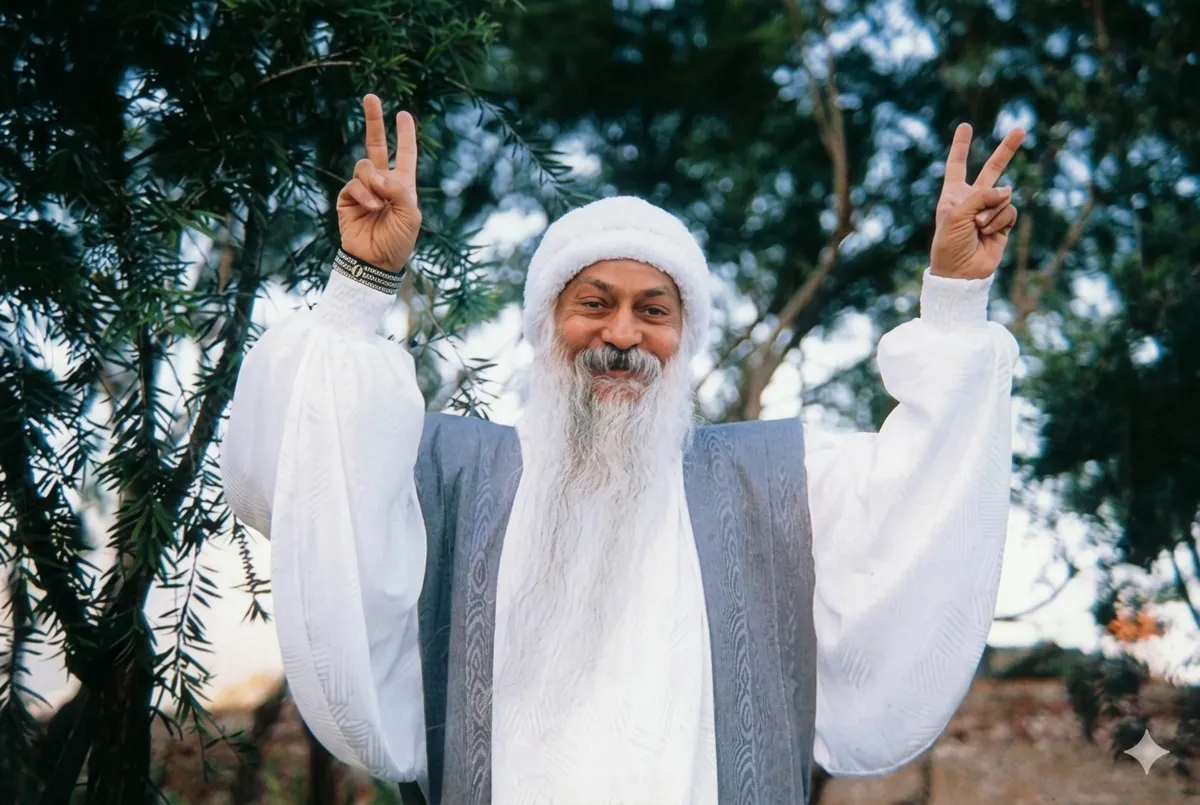
Listening deeply makes you feel joyfully “drunk” on love inside, so the small self fades and you feel part of everything.
From the Discourses
Passages where Osho speaks to this question — each links to the complete discourse.
Question: Fourth question: Osho, for an hour to an hour and a half after the daily discourse, a kind of intoxication descends. In that time, far from talking, I don’t even feel like looking at anyone. A strange smile spreads on my face. Sometimes tears come, and then I want to be alone. If anyone disturbs me at that time, I feel irritable. Please say something. It’s going well. This is exactly how it should be. This is no temple; this is a tavern. If the intoxication doesn’t come here, then nothing has happened. If you don’t get blissfully drunk here, you’ve missed. There is no preaching on scriptures going on here; here wine is being poured. Here it’s the work of drunkards. The weak have no passage here. Here, drink me. And drown here so deeply that you lose all your senses.
Osho, the other day while listening to your discourse, a strange kind of vibration arose in the heart and along the auditory nerves; since then even ordinary sounds set off odd ripples and waves of bliss. Please tell me: is there something in the voice of enlightened ones that produces a special effect? Also, in your presence there is a particular, delightful fragrance; at times it is felt in the ashram and sometimes during meditation as well. In this regard, please say whether certain moments in time have their own special fragrance too.
I speak with the same purpose with which a musician plays the vina. He does not play to explain anything. Remember me as a vina player. My speaking is my vina. What I am saying to you—less am I speaking, more am I singing. If you understand its purpose, that is enough: listening to this instrument—as one sometimes, listening to a vina, falls into a trance—one begins to sway; something within begins to vibrate; something like a stone inside begins to melt and flow. For a moment a window, an opening, is there—sky is glimpsed. Like a flash of lightning—the darkness is gone—even if only for a moment; but then you know that light is, and you also know there is a path. It was revealed for a moment in the lightning’s flare, but revealed it was. Now no one can tell you there is no path; no one can…
Osho, when I read your discourses I am filled with wonder. But when I listen to them, only sound keeps reverberating. In the end, only emptiness remains, and a soft, delicate bliss. Is this your taste, Osho?
Certainly. I am not saying anything to convince your intellect. My effort here is not to placate your mind. Sometimes I speak on devotion—then the effort is that your heart be stirred. Sometimes I speak on knowledge—then the effort is that you transcend both heart and intellect and become a witness. But I never speak for the intellect. The intellect is like an itch: the more you scratch… While scratching it feels pleasant; afterward a great soreness comes. I am not speaking for your intellect, not for your head. Either I speak for the heart, or I speak for that which is beyond both—beyond heart and intellect. Either for the witness, or for your feeling. Either for your love, or for the awakening of truth within you. And the greatest benefit will be for those who listen by putting the intellect aside. Heard through the intellect, nothing much is heard.…
Osho, you sit in the tavern and, every morning and evening, you pour brimming goblet after goblet of wine. I do get intoxicated by your wine, but I don’t lose consciousness. What should I do?
That is why even a Sufi like Omar Khayyam has been misunderstood. Whatever notion you have about Omar Khayyam is wrong. The wine he spoke of is not the wine sold in taverns. The beloved he praised is not flesh-and-bone. He called the Beloved—God. And he called wine—devotion. Fitzgerald, who first translated Omar Khayyam into English, because of whom Omar became world-famous, did not understand him. Fitzgerald thought wine meant wine. He was a Western man. He took two plus two to be four. He took “wine” as wine and “beloved” as beloved. The subtle intention of the Sufis fell into a great misunderstanding. On the basis of Fitzgerald’s version the whole world translated him, and the mistake spread everywhere. Today taverns are named “Omar Khayyam.” Nothing could be more foolish. Temples should bear Omar Khayyam’s name—not taverns. Because the tavern he spoke of is of another kind. There is…
Question: Second question, Osho, This is the longing of the wine-lovers: O cupbearer, today pour such wine that all the drunkards in the tavern turn into worshippers at prayer. It is not so that nothing is gained; but what is gained is within. You cannot show it to others, cannot display it. It is difficult to express. If you say, “I feel light within,” people will glance around anxiously to see if anyone else heard, lest they be seen with you. If you say, “Waves of joy rise within me,” the other will doubt your sanity—for his experience, and everyone’s, is waves of sorrow. If you say, “Within me it is full moon,” his experience is new moon. Why would he believe you? You will say, “There is great elation, great ecstasy—fountains of laughter are springing up.” People will say, “Either you are deluded or you want to delude us.