
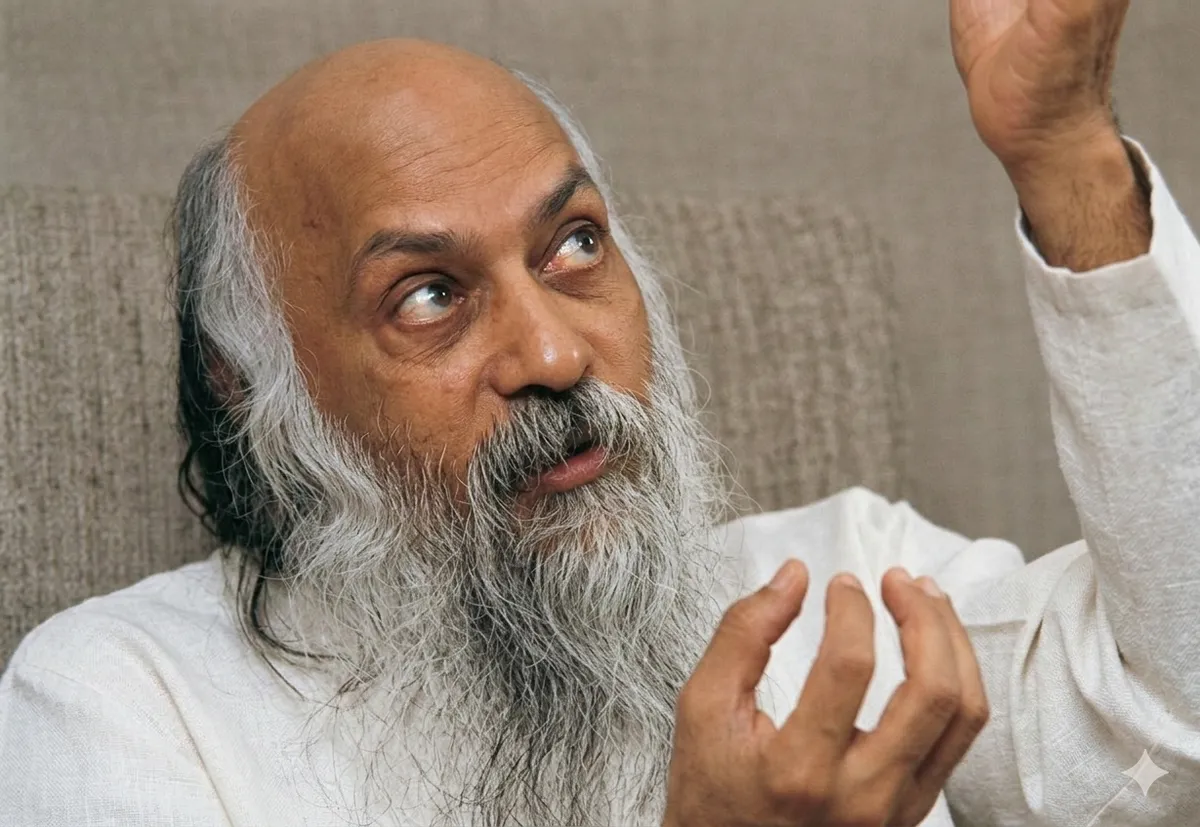
A memory is you thinking about what happened before, which makes you separate from it, while the original moment had no separation—you were just in it.
From the Discourses
Passages where Osho speaks to this question — each links to the complete discourse.
Is the memory of an experience an experience?
Yes, the memory of an experience is an experience. It has now become a past memory. And once it becomes memory, you are immediately separate. So you are always separate from the experience. For example, today you say, “I was once a child”; you are now completely separate from that experience of childhood. How can you be one with it? That has become memory. Now you are entirely different. But when you were a child, you simply were; and when there was the experience of childhood, you were not separate.
Osho, this conditioning—it is in everyone. And can we not consider it in this way: the person we speak about—because he is...—therefore we also fully experience truth; someday we try to assimilate it with our own experience. I do not take memory to be merely something accumulated. Memory too is modified from time to time. So the reaction that happens also changes memory. It should change.
Yes, yes.
Beloved Osho, are there two kinds of memories, a factual memory, and a spiritual memory? If yes, is there a connection between them?
It seems there is an automatic reversal process. You have to reverse a tape, but your brain reverses immediately. When you put the needle on the dream center again it starts from A B C, not from the point where it has stopped. If you take the needle away again, it reverses so quickly that no time is lost. Put the needle back and it starts from A B C again. If the man was saying, "I am Alexander the Great..." -- if you have touched his past life memory center and he was saying, "I am Alexander the Great," and if you take the needle away and put it back again, he will again start with, "I am Alexander the Great." Your brain contains all the memories, psychological memories of your past lives. But the more you meditate, the more you go on erasing all psychological memories. Begin first…
Osho, while explaining to Arjuna, didn't old memories cause a problem?
That's another matter, that's another matter. What I am saying right now is this: the memory of a person living a spontaneous life will not be destroyed. Memory will remain completely fresh, fully alive and present, but the consciousness of a spontaneous life, becoming new each moment, will use it; it will be its master. In the consciousness of a chain-bound, sequential life there will be no new person; the past memories themselves will go on giving birth to the new person. The memories will become the master, and the person will become a slave. Now, what is it you are asking—what are you asking?
Osho, when it happens—when the leap takes place—will memory completely vanish, go far away? But words should still be remembered, right? Technical words, technical education—these should remain in this process.
So today when you come, I will see you—not the one who abused me yesterday. Where is he now? Much water has flowed down the Ganges. For all I know, you may be coming to ask forgiveness, and I am thinking you are the same man who abused me. Who knows what you have become in twenty-four hours! In twenty-four hours one has no certainty about oneself—how can one have certainty about another? So memory is a corrupting element. If you identify yourself with it, you are finished. In the end you will go mad if you are completely caught in its corruption. But if you stand entirely outside it and memory remains only a mechanical device that serves you—where the house is, where the shop is, where what you have read is kept—then it is merely a mechanical device you use. Soon enough, we have already made small computers…