
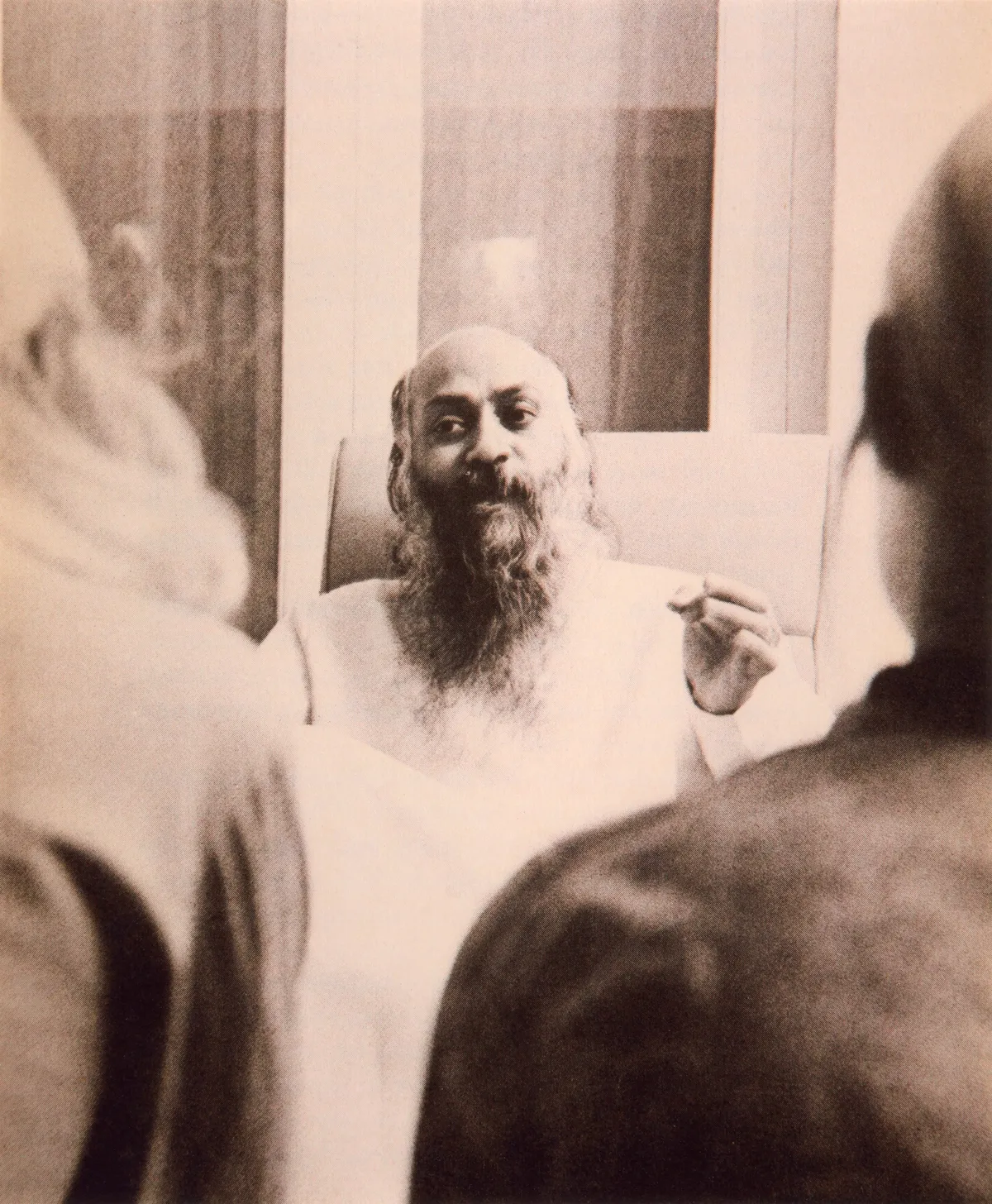
According to Osho, Zen cannot be grasped intellectually; it is realized by transcending mind into no-mind through meditation and alert witnessing. True Zen is a direct, joyous tasting of nothingness—freedom beyond logic—that includes thought for the limited but rests in thought-free awareness for the unlimited. It is experiential, immediate, and transforms fear of emptiness into spacious, purposeless freedom.
You don’t think your way to Zen—you sit silently, watch, and when thoughts drop, the open, peaceful nothingness is clear.
From the Discourses
Passages where Osho speaks to this question — each links to the complete discourse.
Osho, what is zen?
Sagar, IT IS ALMOST IMPOSSIBLE TO ANSWER because Zen is not a philosophy, it is not a doctrine. It is an experience, an experience of your own interiority, of your own subjectivity -- not an objective experience. If it were some object outside you, there would be a possibility of describing it, of analyzing it, of defining it. It is indefinable by its very nature; it is not within the grasp of intellect. It is an experience of dropping out of your mind, disappearing from your mind into your being, slipping out of the mind and entering into your being. The mind is a false entity; your being is your real face, your original face. The mind is created by the society, hence there are different kinds of minds -- Hindu mind, Christian mind, Jewish mind -- but the being is one; it is neither Christian nor Hindu nor Mohammedan.…
Osho, I cannot understand the philosophy of zen. What should I do to understand it?
When all words are gone, your mirror has no more dust on it, no more mist on it. When you look at things you collect impressions; that is the dust -- that's what you call thinking. When you see a rose flower, the rose flower is outside you but it makes a reflection inside you. The rose flower will fade away by the evening, the petals will fall and disappear, but the inner rose flower, the rose that has become imprinted in your memory will continue. It will remain forever with you, you can always remember it. And if you are a sensitive, aesthetic, artistic person you can visualize it again and again; you can imagine it as if it is true. In fact, if you try you will be surprised: you can even experience the fragrance of the rose again. If you create the whole situation in your imagination:…
Osho, do you really think zen is full of zest, zip, zap and zing?
The father, not wanting to leave his son without an answer, says, 'Listen to the following, son. Let us suppose that two men come into a restaurant, one with dirty hands and the other with clean hands. Which one is going to go and clean his hands?' 'The one with dirty hands, of course, Daddy!' 'Very good,' says the father. 'Now let's suppose that the two men walk into a restaurant, one with dirty hands and the other with clean hands. Which one is going to go and wash his hands?' 'The one with dirty hands, Dad. I just told you!' 'No, not this time, son. The one who will go and wash his hands is the one who already has clean hands, because he is in the habit of cleaning them. The one with dirty hands is in the habit of keeping his hands dirty.' 'What a mess, Daddy!'…
Question: OUR BELOVED MASTER, SHOITSU SAID TO CHIZEN: IN THE SCHOOL OF THE ANCESTRAL TEACHERS, WE POINT DIRECTLY TO THE HUMAN MIND. VERBAL EXPLANATIONS AND ILLUSTRATIVE DEVICES ACTUALLY MISS THE POINT. NOT FALLING INTO SEEING AND HEARING, NOT FOLLOWING SOUND OR FORM, ACTING FREELY IN THE PHENOMENAL WORLD, SITTING AND LYING IN THE HEAP OF MYRIAD FORMS, NOT INVOLVED WITH PHENOMENA IN BREATHING OUT, NOT BOUND TO THE CLUSTERS AND ELEMENTS OF EXISTENCE IN BREATHING IN, THE WHOLE WORLD IS THE GATE OF LIBERATION. ALL WORLDS ARE TRUE REALITY. A UNIVERSAL MASTER KNOWS WHAT IT COMES TO, THE MOMENT IT IS RAISED. HOW WILL BEGINNERS AND LATECOMERS COME TO GRIPS WITH IT? IF YOU DON'T GET IT YET, FOR THE TIME BEING WE OPEN UP A PATHWAY IN THE GATEWAY OF THE SECONDARY TRUTH. SPEAK OUT WHERE THERE IS NOTHING TO SAY; MANIFEST FORM IN THE MIDST OF FORMLESSNESS.
Beloved Osho, in uruguay, evening has come. A small group of friends listen as silence speaks. Beloved master, what is the essence of zen?
Dhyan is the process of coming to yourself: leaving the body out, leaving the mind out, leaving the heart out, leaving everything out -- eliminating everything by "I am not this" -- until you come to a point where there is nothing to be eliminated. And the strangest experience is that when you have eliminated everything, you are also not there as the old person you used to be, the old ego, the old "I." It was the combination of all that you have eliminated. Slowly, slowly, without knowing, you have destroyed your ego. Now there is only pure consciousness, just light, eternal light. Dhyan was taken by the Buddhists to China, but in China a great transformation took place because China was under the great impact of Lao Tzu, and his whole teaching was "let-go." Gautam Buddha fights to enter into his own being; at the ultimate point he…