
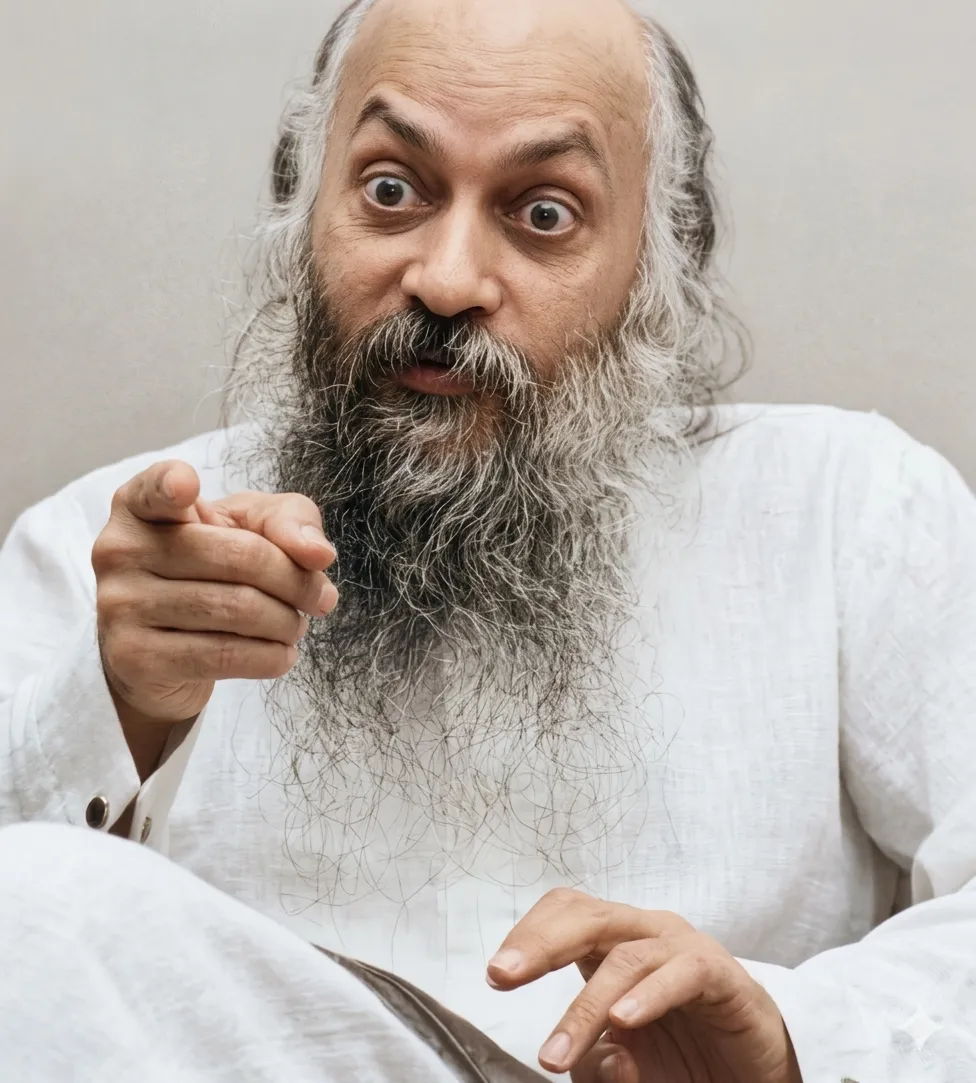
Always wanting to be somewhere or someone else makes you miss that you’re already whole—just stop chasing and be here now.
From the Discourses
Passages where Osho speaks to this question — each links to the complete discourse.
What exactly is the most fundamental disease of humankind according to zen?
Desire, desiring, becoming. Always hankering for something -- money, God, NIRVANA. Always hankering for something -- power, prestige, pull. Always hankering for something. Never being here, always being somewhere else: that is the fundamental disease, the disease called 'becoming'. You are a being. You are already that which you can become -- there is no need for you to become anything else. You are already that which you are now trying to become. That's why, if you go to a Zen master and you ask: 'I want to become a Buddha,' he will beat you. And he will say, 'If I don't beat you, the world will laugh at me. You are a Buddha -- and you ask how to become a Buddha?' You are gods and goddesses: that is the most fundamental here. All that is needed is a recognition -- nothing else is needed. You are not to…
Grouping of mind, vital breath, desire, essence and virtue with the associates is called panchvarga, or the five groups. A living being identified with the nature of the panchvarga cannot be free of them without knowledge or knowing. The disease arising out of the subtle elements like the mind and the rest of it seems to be covering the self, and it is called the seed body; it is also known as the knot, or complex of the heart. And the consciousness dwelling inside it is called the kshetragya, or the knower of the field.
Mind, this rishi says, is the first disease, the basic disease in a way. Why is mind a disease? -- because mind is just a disturbance. Mind is just a disturbance in consciousness. It is not your nature; it is just a disturbance. The moment there is no disturbance, there is no mind. And this state of no-mindedness is the state of consciousness -- the expansion of consciousness. You drop into yourself: not into dreaming, not into projections, into yourself. Consciously, with full alertness, you come to your center the moment mind is not there. Meditation means how to be not a mind. How to be not a mind! Meditation means how to create the state of no-mindedness. It doesn't mean unconsciousness. It means conscious and still, without any disturbance in the consciousness; conscious with no ripples, with no waves, with no vibrations; conscious as a deep, calm, silent pool…
A master was asked by a curious monk: 'what is the way?' 'it is right before your eyes,' said the master.'why do I not see it for myself?' asked the monk.'because you are thinking of yourself,' said the master.'what about you,' said the monk, 'do you see it?' the master said: 'so long as you see double, saying I don't, and you do, and so on, your eyes are clouded.' 'when there is neither I nor you, can one see it?' said the monk.'when there is neither I nor you, who is the one who wants to see it?' replied the master.
The Way is there, and you are thinking about yourself: 'Why can't I see?' Nobody can see who is filled so much with the ego. Put it aside, because the ego means your whole past, all that you have experienced, all that you have been conditioned for, all that you have known, studied, collected, gathered -- information, scripture, knowledge -- all that is your ego, the whole lot, and if you are concerned with it, you cannot see it.'WHAT ABOUT YOU?' SAID THE MONK. Whatsoever a master says, every answer could lead to a satori -- if the person is right. Just the first thing, when he said, 'IT IS RIGHT BEFORE YOUR EYES,' would have become an enlightenment if the right person had been there. But he missed; otherwise the next statement would have been an understanding. 'WHY DO I NOT SEE IT FOR MYSELF?' HE ASKED.'BECAUSE YOU ARE…
Osho, Would you like to say something on this sutra?—Nāsti kāmasamo vyādhiḥ, nāsti mohasamo ripuḥ; nāsti krodhasamo vahniḥ, nāsti jñānāt paraṁ sukham. There is no disease like desire, no enemy like delusion, no fire like anger, and no joy higher than knowledge.
Kāma means unconsciousness. As long as man is unconscious, he is not truly human; he is animal. Animals can be forgiven—they lack the capacity to awaken. Man cannot be forgiven, for he has the capacity and does not use it. No animal is a sinner; only man can be. Sin means: neglecting the opportunity you have. Virtue means: using it well. Human life offers the capacity to awaken. Kāma is unconsciousness. It breaks only through meditation. Meditation is the method to end the trance. Kāma is animality, craving, the race for more. Meditation is coming to rest, being free of more; content, delighted, grateful as things are. Even for what we already have we feel no gratitude; only complaints and thorns of grievance we sow. Even prayer is complaint: “Why not this? It should have been so!” Have you ever gone just to say, “Thank you; as it should be,…
The contemporary ideal of living completely within the present moment, no less than the classical mystical notion of living totally within the divine eternal, is as impossible as it is inhuman. It results in a diseased rather than a graceful present. Graceful existence integrates present, past and future.
Buddha is saying: To be in desire is to be miserable. He is not saying desire about what: desire as such creates misery -- because in desire you start moving from the present, you start thinking of the future. You start thinking of dreams -- you are going to do this, and this is going to happen; and if this happens you will be happy, and if that happens you will be very very miserable. The moment you start dreaming and desiring you have missed contact with life; you disconnected. You are no more living in those moments of desire. Those moments of desiring are death moments. Life has stopped flowing. You are frozen. Whenever you are in desire you are not alive. Life and desire can't exist together. They are two gestalts, you can have only one at one time. If you move into desire, life disappears; if you…