
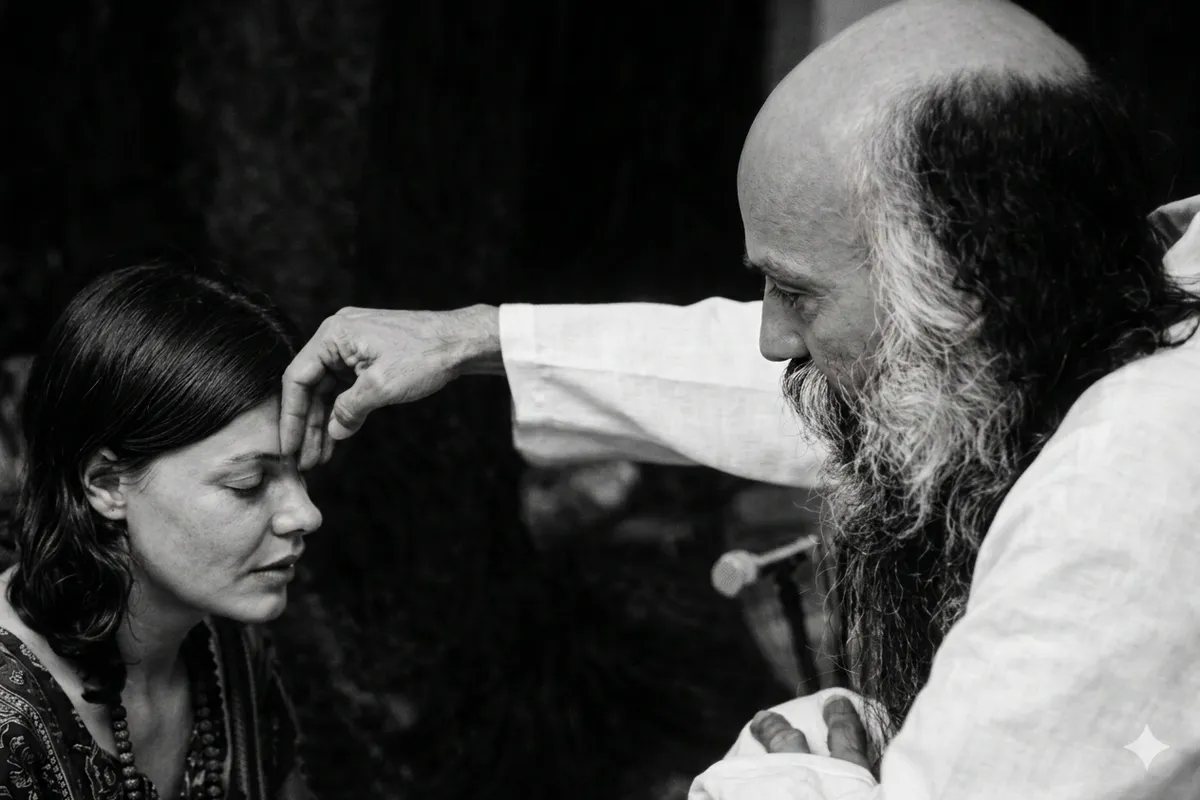
When your mind gets very quiet, even thoughts of your teacher must be let go—pretend to cut them away—so you can be completely empty and free.
From the Discourses
Passages where Osho speaks to this question — each links to the complete discourse.
Beloved Osho, many times I have heard you tell the zen story that, "if you meet the master on the way, kill him." Osho, does it really have to be like that? If we meet on the path, can we not just laugh, and chat a little while, and then if we must part, do so gracefully, with a namaste and a smile?
The story is not about any actual path, and not about any actual meeting with the master. The story is about when you are meditating and things are disappearing from the mind -- it is becoming silent. The last to go will be the one you have loved most. That is, the last will be the master. It is in your meditation, when everything else is gone, that still you will be seeing the master. Now, chit-chatting will disturb your meditation, and preparing a cup of coffee will not help. The saying looks hard, but it is true: Cut the head of the master! It is in your imagination that you are cutting. By chit-chatting or laughing or talking, you will not get rid of the master. You have to be very simple and straight; you need a sword, and cut the head of the master and pass on. Don't…
Beloved master, to meet the buddha on the way and kill him also implies the death of the disciple. Can you say something about the master-disciple experience and being in the presence of the master?
Everybody who is present is not present in the sense that I am telling you to be present. You can be present as yourself for years and nothing will happen, and you can be present the way I am telling you just for a single moment -- and you will be reborn. The presence of the master is a fire in which you have to be burned, but whatever is gold will remain and whatever is not gold will be burned. To be twenty-four carat gold is a sheer joy. Utter purity like a flower will start surrounding you. A new energy that you had not known, although it is your own but has been asleep, dormant, becomes radiant. You start to glow in a new style of life and love, in a new way you dance and sing and celebrate. If the master's presence does not become a dance…
The zen masters say, "kill your parents, " and even, "if you meet the buddha on the way, kill him immediately. "is it not shocking?is it not irreverent?
And remember, if you are free from your father and mother in the unconscious, you will be capable of communing with your father and mother for the first time, because then there will be no barrier. In fact, you will be able to love them for the first time. You will be able to forgive them for the first time. You will be able to feel compassion for them, how much they have done for you. When you are mature, when you are free of them, when their presence is no more a heavy weight on your heart, you can feel them for the first time. You can be with them in a loving space. So it is shocking, but it is not irreverent, one thing. The second thing: they say, "If you meet the Buddha on the way, kill him immediately." And these people who have said these things,…
Osho, if I should meet bhagwan shree rajneesh walking down the road, should I kill him?
In the middle of the night, with the fire and the crackling of the wood and the smoke, the priest awoke: "What is happening? What is going on?" He saw this monk who was a stranger, who had asked for shelter and was given shelter, and what had he done? Three Buddhas gone! Naturally he was in a rage. He said, "Are you mad or something? You have burnt three Buddhas!" Ikkyu took his staff and started searching. Now there was nothing left, just ashes; he was searching for something in the ashes. And the priest asked, "What are you searching for?" He said, "For Buddha's bones." In India, in the East, the bones are called flowers, symbolically. So he said, "I am searching for the flowers, for the bones of Buddha." Now it was the priest's turn to laugh. He said, "You are really mad! How can you find…
'if you meet a buddha on the road, kill him immediately!' -- what about you? How do I both love you and kill you.
Do the same to me. First try to find me and then when you have found me -- kill me immediately. Because that's how you will attain to your own perfection. Even if I am there the duality will remain. An object in the mind is a disturbance. Drop that object also. When you have killed me you have completely followed me. When I have disappeared only then will you be grateful to me. Only then will you understand that the work of the Master is very contradictory. First he has to create a situation in which you fall in love with him. He has to create a situation in which you start allowing him to guide you. This is the first part. When it starts functioning he has to create a situation in which you have to drop him. It is just like a ladder: you go on the…