
Upanishads are like learning by holding a wise teacher’s hand; Zen is like finding it alone—but both reach the same mountain top.
From the Discourses
Passages where Osho speaks to this question — each links to the complete discourse.
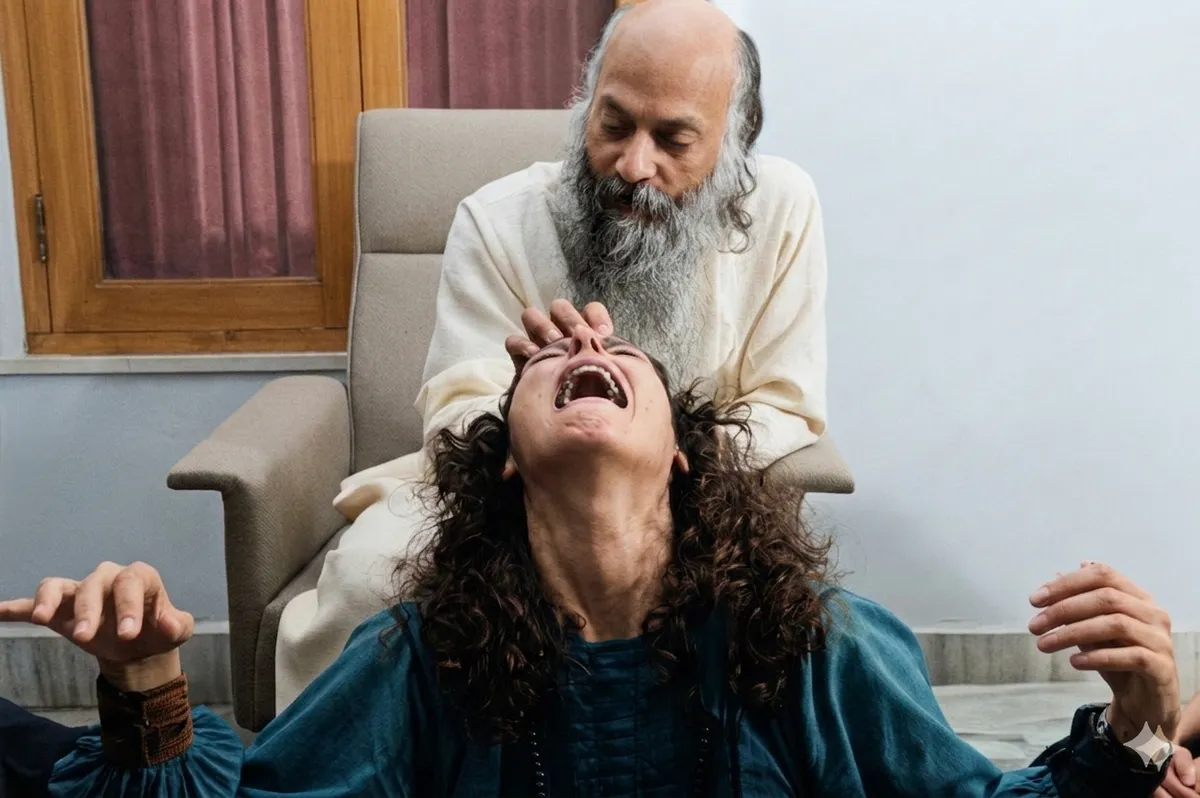
Question: BELOVED OSHO, ARE THE UPANISHADS AND ZEN THE SAME? They are not. The upanishad is a happening between the master and the disciple, Zen is the happening in the disciple himself. The master may help him, may create devices, show the path -- but Zen is basically an individual experience. It is not like love. It happens in your aloneness. It is not a relationship. Upanishad is the greatest relationship. It cannot happen if the master is alone. He may be full, overflowing; but it cannot happen because the receiving end is absent. It cannot happen if the disciple is alone, however open, however available -- but available to what? Open to what? Upanishad is a more human phenomenon than Zen. It is closer to human reality because it is closer to love.
Osho, your discourse on the isa upanishad was so beautiful. I have heard it said that the upanishads are commentaries on or extensions of the vedas. Is this true? I bow to you.
Knowledgeability is not wisdom; knowledgeability is, on the contrary, a hindrance to wisdom. The more knowledgeable you become, the less is the possibility of attaining your own experience, because knowledge deceives -- it deceives others, it deceives you. It goes on giving you the sense as if you know, but that "as if" has not to be forgotten. That "as if" can easily be forgotten and one can be deceived. Remember one very significant saying in the Upanishads: Those who are ignorant, they are bound to be lost in darkness; and those who are knowledgeable, they are bound to be lost in a far more and far bigger darkness than the ignorant ones. The ignorant person is at least sincere: he knows that he does not know; at least this much truth is there. But the knowledgeable covers up his wounds, his ignorance, his black holes. He covers them by…
Osho, what is zen?
He knows that all is illusory so there is no need to escape. It is unfounded, you need not be worried about it. It is a rope -- it appears to be a snake. So why escape? Why renounce? Let it appear to be a snake, let it be there as a rope. Whatsoever it is, the appearance is unfounded, hence there is no need to renounce. Zen does not teach renunciation. It teaches understanding, awareness, alertness, the capacity to see things as they are. And then there is no need to escape from anywhere. Wherever you are, Zen helps you to relax. And there is no need to search for God, to search for satori, samadhi, enlightenment -- the very search is a barrier. We search for things only if they are not within our being; if they are within our being, there is no need to seek and…
What is the difference between waiting for godot and waiting for god?
It is as if the sun has risen in the morning and you are sitting in your room with closed doors and windows, in darkness. Open the doors, you become available to the sun. The sun was already available -- just the meeting happens. You cannot wait for God. All waiting is for Godot. Godot means the one who never comes, who CANNOT come, whose arrival is impossible. And the only impossible thing is that which has already happened -- how can it happen again? You are alive, and you are waiting for life, Now, this is ridiculous. The real man of religion does not think in terms of God. He thinks in terms of life or, even better, of living -- because life can again become an abstract idea. Living, moment-to-moment living. In that very living, one knows what God is, because one knows who one is. Your idea…
Osho, according to the Paingala Upanishad there are four mahavakyas. First: tat tvam asi, That thou art; second: tvam tadasi, Thou art That; third: tvam brahmasmi, Thou art Brahman; and fourth: aham brahmasmi, I am Brahman. Osho, kindly explain the meanings and the subtle differences among these mahavakyas.
Kabir has said: the Master is a dyer. But before he dyes, he cleans; he washes, he brightens, he removes the grime from the cloth. Only when the cloth is clean can it be dyed; only then will the colors reveal their fullness. When these two points are complete—when it is clear that the disciple has understood: “I am not; Existence is”—then he is told the second point: do not fear, you too are that Existence. Yet the word “That” is still used. When it is understood that Existence, That, is all, the matter can be taken a little deeper, into the most subtle. “Tvam brahmasmi.” You are not only That; you are Brahman. Brahman means: now we have given “That” a face, personhood. We have endowed That with consciousness, with life. Now it is no longer an object, no longer a mere idol in a temple; now there is…