
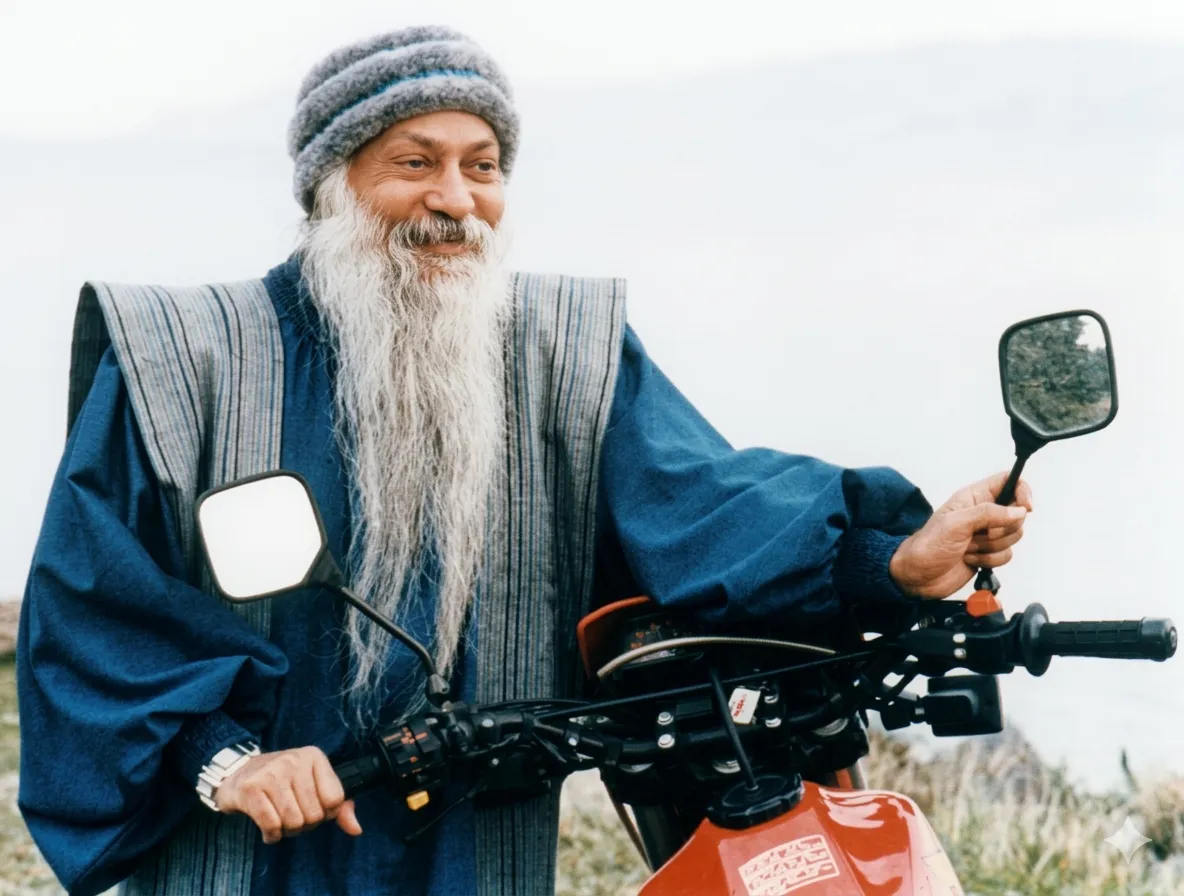
According to Osho, Jesus' call "Come, follow me" (echoed by Buddha, Krishna, and others) is a psychological exploitation that cripples human freedom. It invites dependency, imitation, and blind belief, making people see through another's eyes and lose their unique integrity. Such following breeds masks and suffering. He proposes instead: don't follow—share, learn, and trust your own intelligence to discover a path uniquely your own.
Don’t copy any leader—even holy ones—because you’ll stop using your own eyes; listen, share, but walk your own path.
From the Discourses
Passages where Osho speaks to this question — each links to the complete discourse.
Beloved Osho, jesus says, "come follow me." you're against this statement. What would you like to say about it?
And why are the followers with him? They are seeing his contented, authoritative statements, his determined effort, unwavering. Now, when Jesus says, "I am the only begotten son of God," with authority, naturally the poor people.... Who were the people who followed him? Have you ever thought about it? The twelve apostles -- who were these people? All uneducated: fishermen, farmers, woodcutters, carpenters. Only Judas was a little educated; so he betrayed him. All the others were absolutely uneducated, poor people in search of somebody who could hold their hand and could give them a certain strength that they were lacking in themselves. The followers feel it is a mutual conspiracy. Perhaps both are unaware: the leader is unaware that he needs followers to feel comfortable with his own idea, with his own fiction, and the follower is unaware of why he is following this man. He is following because…
What does christ really mean when he says, "come follow me"
Exactly what he says: "Come follow me." TO FOLLOW JESUS A DEEP TRUST, SURRENDER AND LOVE IS NEEDED BUT TODAY A DEEP SKEPTICISM IS PREVALENT ALL OVER THE WORLD. WHAT IS THE WAY? This is from Swami Yoga Chinmaya. Think about yourself. Is deep skepticism within you? That's the question to be asked. A deep skepticism is prevalent all over the world: who are you to be worried about the whole world? This is a way to escape the real problem. Skepticism is deep within, the worm of doubt is there in your heart, but you project it; you see it on the whole world's screen. "The world is skeptical -- what is the way out?" Now you are transferring the problem. Look within yourself. If there is doubt, then find it out. Then something can be done. The world won't listen to you, and there is no need, because…
[NOTE: This is an unedited tape transcript of an unpublished darshan diary, which has been scanned and cleaned up. It is for reference purposes only.] (Don't follow and imitate Christ, love and flower as Christ yourself, Osho told Veet Christiane.) Following is something wrong. The follower becomes an imitator. He becomes like a parrot. He starts repeating the master's words without attaining the consciousness that the master had. It is beautiful to be a lover of Christ because love is vast; you can be a lover of Christ and at the same time a lover of Buddha and a lover of Lao Tzu and a lover of Zarathustra and a lover of me. Love is so vast that it can contain all the masters. But following is very narrow. The follower of Christ cannot be a follower of Buddha, the follower of Buddha cannot be a follower of Christ.
A seeker of truth becomes a philosopher but he never becomes a mystic. The mystic knows and the philosopher only assumes, infers, guesses, argues. The philosopher simply goes on making castles in the air. In fact he has no roof over his head. He makes great systems of thought, he is very skillful with words, but he has not experienced anything. That is the difference between a Hegel and a Buddha, between a Kant and a Lao Tzu, between an Aristotle and a Jesus. Truth has to be experiences, truth has to be lived, and the only way to experience it is to live herenow, to withdraw all your projections from the future. No past has to be allowed to hang around you and no future either. When you live in the pure present you are truth.
Beloved master, krishna said to arjuna, "surrender and I promise you moksha." jesus also said to his disciples, "come follow me and I will take you to the kingdom, to god." but you say to us that you can only show the facts. Why don't you promise us nirvana?
And naturally, and logically, he thought, "If my name helps him so much I must be a great master." And he thought, "If my name helps him, then what miracles can I not do?" He tried to walk on the water, and he started drowning and had to be saved by his disciples. That moment Milarepa saw his own master drowning, and the whole idea of surrender to a fake, to a fraud, disappeared. He said to the master, "At least you should not have done it in front of us. You have destroyed our trust, our surrender. You have destroyed us so deeply that now it will be difficult for us to trust in anyone. You have made us skeptical. I came to you in innocence, and I am going absolutely corrupted." There is no criterion. Surrender, if it is total -- which is very difficult, almost impossible; only…