
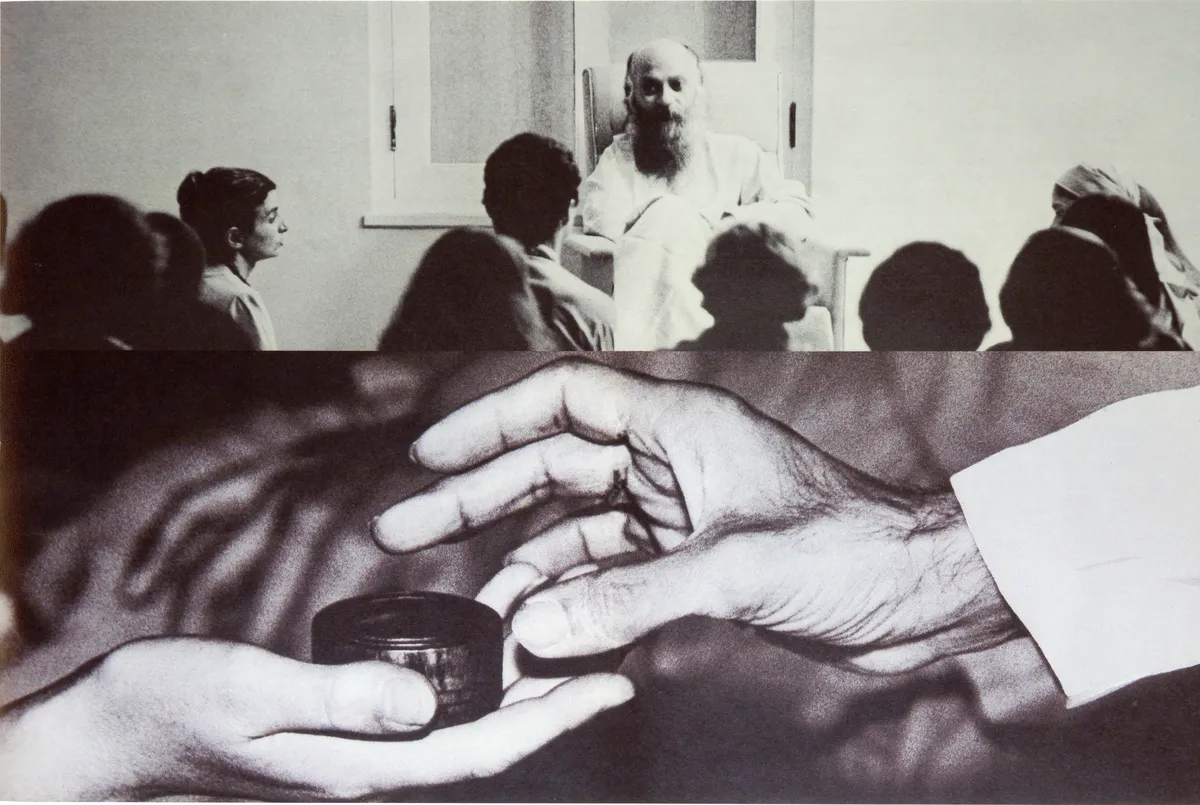
The guru is a safe ladder to the Infinite, and the student lets go of “me” to climb and finally merge with the sky.
From the Discourses
Passages where Osho speaks to this question — each links to the complete discourse.
What is the guru/disciple relationship?
Wittgenstein has said somewhere that what cannot be said can be shown. Saying needs no patience, but showing needs much patience. If I want to say something to you, I can say it this very moment. Your patience, your preparation is not needed. I can say it, and you will hear it. But if I want to show you something then you will have to make great preparations in order to see it. I cannot show it to you unless you have the capacity to see. The guru is basically not saying anything but trying to show something; and if the disciple is aware, then things become clear by not intervening. Things are always clear, but the mind is confused -- and a confused mind confuses things. As far as worldly things are concerned your mind cannot distort them too much because they are so objective that they do not…
Osho, yesterday you explained that with joyful awareness (sukh-purvak surati) resolution happens on its own. Yet I find myself having to go through great effort, practice, and labor—why? How long, and why, must a seeker pass through so much effort, toil, and austerity?
If there is laziness in the mind, even little things feel like great effort. It’s a matter of your interpretation. In truth, you are not exerting at all. I tell you, those who are near me and engaged in “practice” are the people on earth who are laboring the least. You have no idea what real effort is. When a person is deeply lazy, even trivial things seem like toil. What are you actually doing? What is it you keep calling “great effort”? Which great effort are you making? You dance a little—and you call that great effort? Is dancing an effort? Dancing is joy! But your perspective is wrong. If you take joy to be effort, you have missed. Dancing is celebration, a juicy happening. Where is the effort in it? If even dancing is effort for you, then what would non-effort be? If I tell you, “Just sit…
छठवां प्रश्न: ओशो, कल आपने समझाया कि सुखपूर्वक सुरति से समाधान घटता है, परंतु, मुझे तो बड़े प्रयास, अभ्यास और श्रम से गुजरना पड़ रहा है, क्यों? साधक को बहुत प्रयास, श्रम और तपश्चर्या से कब तक और क्यों गुजरना पड़ता है?
आलस्य हो मन में, तो छोटी-छोटी चीजें बड़ा प्रयास मालूम होती हैं। तुम्हारी व्याख्या की बात है। कुछ भी तुम्हें श्रम नहीं करना पड़ रहा है। मैं तुमसे कहता हूं कि मेरे निकट जो लोग साधना में लगे हैं, पृथ्वी पर सबसे कम श्रम उन्हें करना पड़ रहा है। तुम्हें श्रम का कुछ पता ही नहीं है। मगर महाआलसी व्यक्तित्व हो; तो छोटी-छोटी बातें श्रम मालूम पड़ती हैं। कर क्या रहे हो तुम? किस बात को तुम बार-बार कहते हो कि बड़े प्रयास। कौन सा बड़ा प्रयास कर रहे हो? थोड़ा नाच लेते हो, इसको बड़ा प्रयास कहते हो? नाचना प्रयास है? नाचना तो आनंद है। लेकिन तुम्हारी दृष्टि गलत है! आनंद को प्रयास समझोगे, चूक गए। नाचना तो उत्सव है, एक रसपूर्ण घटना है, प्रयास क्या है? अगर नाचना भी प्रयास है, तो फिर अप्रयास क्या होगा?
Beloved Osho, you have said: not in thousands and thousands of years has such an opportunity come to this earth. And you have also said: this age is like any other. You have said: surrender to a stone and it will happen. And you have said: it is essential to tread this dangerous path only with the guidance of a true master. You have said: surrender and I will do the rest. And you've said: I do nothing. For us here and now, and for those in the west who will read these words, would you talk to us some more about the guru/disciple phenomenon.
It is simple because the relationship exists only on the part of the disciple. On the part of the master there is no relationship, because the master doesn't exist. He is there no more. He is a nobody. It appears to you that he is. This appearance will persist unless you surrender. Once you surrender, once you become a non-being, suddenly you will see that the master has never been there. The master is an absence. But the absence can be seen only when you have also become an absence. Only two absences meet. If you are present, you go on projecting on the master also that he is. It is your projection, because your ego cannot see non-ego. Only the similar can respond to the similar. Your ego can only see egos everywhere. That is a way to protect your own self. Wherever you look, immediately you project an…
To be a disciple is a great art. One can even say the greatest, because Its requirement is the surrender of the ego Which is the hardest thing in life. One can do everything for the ego: One can climb mountains and go to the moon. Everything is easy if it is for the ego. But to drop the ego is really an uphill task It goes against our natural instinct. But it is the beginning of real spirituality. The first requirement for a disciple Is to surrender, to say to the master 'Now I am no more, only you are!' A total yes to the master, an absolute trust -- That's what makes a disciple. There are many students but very few disciples. And only disciples can be transformed Students can only be informed.
Osho, the day you spoke about the chance meeting of the river and the boat, the world fell away. And when, on your birthday, you gazed upon this devotee with unblinking eyes, from that moment even my attachment to you dropped. You have descended into me to such an extent that I have no words for it. I have become only yours. And you have taken your seat within me. Whom should I thank? I am not worthy, and yet your grace keeps showering. Taru has asked:
Mahavira said there are two fords to reach the Divine—shravaka and sadhu—or four: shravaka-shravika, sadhu-sadhvi. Shravaka means: one who knows by hearing; one who, hearing the guru’s word—hears here, and it happens there. Sadhu means: one who hears and then practices. The sadhu is number two. But the irony is that the doer has “won,” and the sadhu sits above—and tells the shravaka he is lower. In truth, now the shravaka is no longer a shravaka, and the sadhu is no longer a sadhu. The original meaning of shravaka was precisely this: one for whom it happens simply by hearing. Buddha said the same. Buddha had a shravaka, Vimalakirti. His stories are very beautiful. He remained a householder; he never left home, never left his wife, never left his shop. And even Buddha’s great bodhisattvas—Sariputra, Moggallayana, Mahakashyapa—such eminently gifted monks—were afraid of Vimalakirti. Once Vimalakirti fell ill, and Buddha said…
पांचवां प्रश्न: ओशो, जिस दिन आपने नदी-नाव-संयोग की चर्चा की उस दिन संसार छूट गया। और जब आपने अपने जन्म-दिन पर इस भक्त को अनिमेष नयन से निहारा तब से आपका मोह भी छूट गया। आप इस कदर मुझमें उतर गए हैं कि उसको कहने के लिए मेरे पास शब्द नहीं हैं। मैं बस आपकी ही हो गई हूं। और आप मेरे भीतर विराजमान हो गए हैं। किसको धन्यवाद दूं? मैं लायक तो नहीं हूं तो भी आपकी कृपा बरसती रहती है। पूछा है तरु ने।
महावीर ने कहा है कि परमात्मा तक पहुंचने के दो तीर्थ हैं--श्रावक और साधु। या चार--श्रावक-श्राविका, साधु-साध्वी। श्रावक का अर्थ होता है: जो सुन कर ही जान ले। श्रावक यानी श्रवण से जान ले। जो गुरु की बात सुने, इधर सुने, उधर हो जाए। साधु का अर्थ होता है: जो सुने, फिर अभ्यास करे। साधु नंबर दो है। मगर मजा यह है कि करने वाला जीत गया और साधु ऊपर बैठ गया है। और साधु श्रावक से कहता है तुम नीचे हो। असल में श्रावक श्रावक नहीं है और साधु भी साधु नहीं है अब। श्रावक का मतलब ही यह था जो सुन कर हो जाए जिसे। बुद्ध ने भी यही कहा है। बुद्ध का एक श्रावक था, विमलकीर्ति। …