
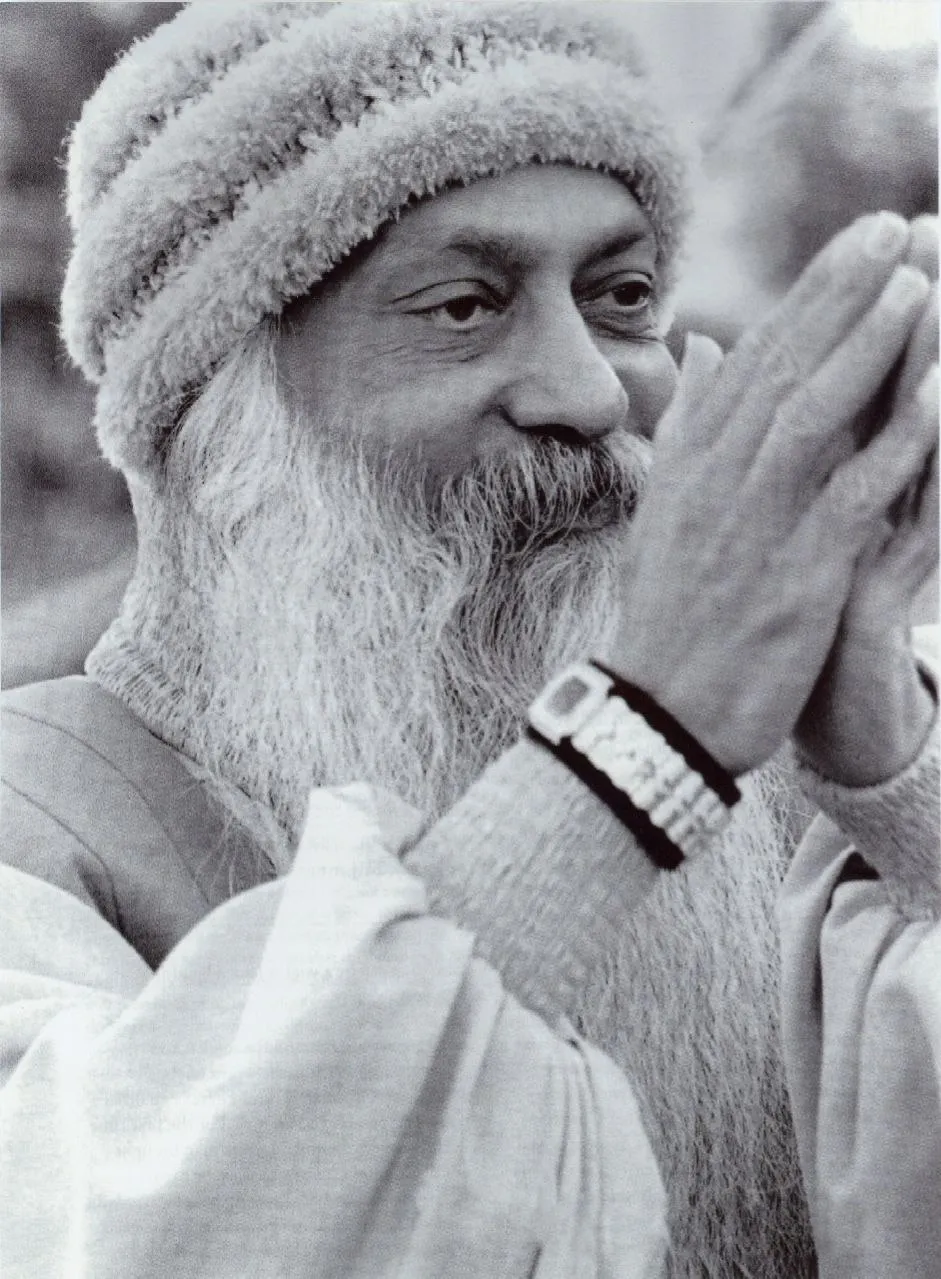
If thoughts pop up, it’s because you’re keeping the mind busy—stop doing anything, breathe gently, and they’ll settle on their own.
From the Discourses
Passages where Osho speaks to this question — each links to the complete discourse.
It has been asked: It has been asked, Osho, you tell us to think—yet what will come from thinking alone? As I keep thinking, I get drowned in thoughts themselves, and my conduct does not change. My conduct remains exactly the same. So please tell me, how is conduct to be changed?
Commonly it is said, “What value is there in thought? The real value is in conduct.” This is utterly false and futile. It is false and futile because conduct, deep down, is nothing but the expression of thought. Where there is no seed of thought, there can be no plant of conduct. Yes, it is possible to throw a false conduct over oneself from the outside. But false conduct has no value whatsoever, except that it deceives others and destroys one’s own life. The question asked is: “What will happen by thought alone?” This is why I ask, and why the question arises—if I were to pray to you, I would say: as yet no thought has been born in you. You are taking others’ thoughts to be your own. Hence the problem of trying to bring thought and conduct into harmony. If the thought were truly yours, it would…
A friend has asked: Osho, you said about a wayward son that one should let him pass through his experiences, and he will learn on his own. But even after experiencing, he still prefers the same thing—someone is asking about his wayward son—no matter how much suffering he has to endure, even if death itself should come, still he does the same. After stumbling again and again, he repeats it. What can be done? How to reform him?
You will not be able to reform him. If life cannot reform him, if even death cannot reform him, what will you be able to do? If what you say is true—that again and again, even after suffering, he does the same thing; even if death comes, he will still do the same thing, and he does not change—then take your hands off. You will not be able to reform him. You cannot be stronger than death. And one who does not learn from suffering—what will he learn from you? Do not call him a wayward son. You have found yourself a Jadabharata. Because those whom suffering does not reform, whom even death does not reform—these are great, arrived masters; they are in the ultimate state. Do not even try to reform such a one. And why are you so eager to reform another? It is enough to reform yourself.…
Thus, by meditation, they achieve the ultimate reality , which is unthinkable, unmanifest; the one of endless forms, the ever-auspicious, the peaceful, the immortal, the origin of the creator, the one without a beginning, a middle and an end; the only one, the non-dual, the all-pervading, the consciousness, the bliss, the formless, the wonderful.
To use a name as a repetition has its own difficulties. It is easy to throw out all else, but then it is difficult to throw out itself. If you have used "Rama" to throw out all other thoughts, it will become rooted in you, and then you cannot throw it out. It will be very difficult and very painful. Then something else will be needed to throw it out. As far as I am concerned, I never suggest this method. It is better to begin with no word. Then how to begin? Take the total energy of your body and mind as the beginning. Let you total body-mind energy be involved in it. Make it so active -- let your body energy, your mind energy becomes so active, so active at the peak -- that thoughts dissolve, because thoughts cannot exist at the peak. When your energy is moving…
Osho, then I think many things will clear up on their own.
Yes, they will clear up on their own; there’s not much to it. Take this common notion that one must be silent in meditation—there is no need for such a notion. We are silence already, and whatever is happening is happening outside us. Thoughts are happening too; they are happening outside us. We do not have to become silent; we are silence already. Whatever is moving is moving outside us. By mistake we made it one with ourselves; there the error occurred. When you sit in meditation, thought is moving. We made the mistake of taking up an identity, an identification: “This thought is me, it is mine.” That was the error. This is a thought, and I am I. And this thought is circling around me—like a fan whirring, like a fly buzzing… this thought is circling. This is this, and I am I; what have I to do…
Osho said that there was no need to try to still the mind, to stop the thoughts. He said that just as the traffic goes by and one remains on the sidewalk, unaffected, just a watcher, so one should simply witness the thoughts as they went by. We are not our thoughts, and recognising that we are the witness is enough. The very acceptance of the thoughts makes one more relaxed. The relaxation helps to create a distance, to separate oneself. To evaluate a thought as good or bad means that you are attached to your thoughts -- so one should not put labels on them.] ... put yourself aside, sit under a tree, and just watch the traffic. Soon, one day, the traffic disappears and the road is empty. Suddenly there is an interval and in that interval is meditation. But that interval cannot be created or cultivated.