
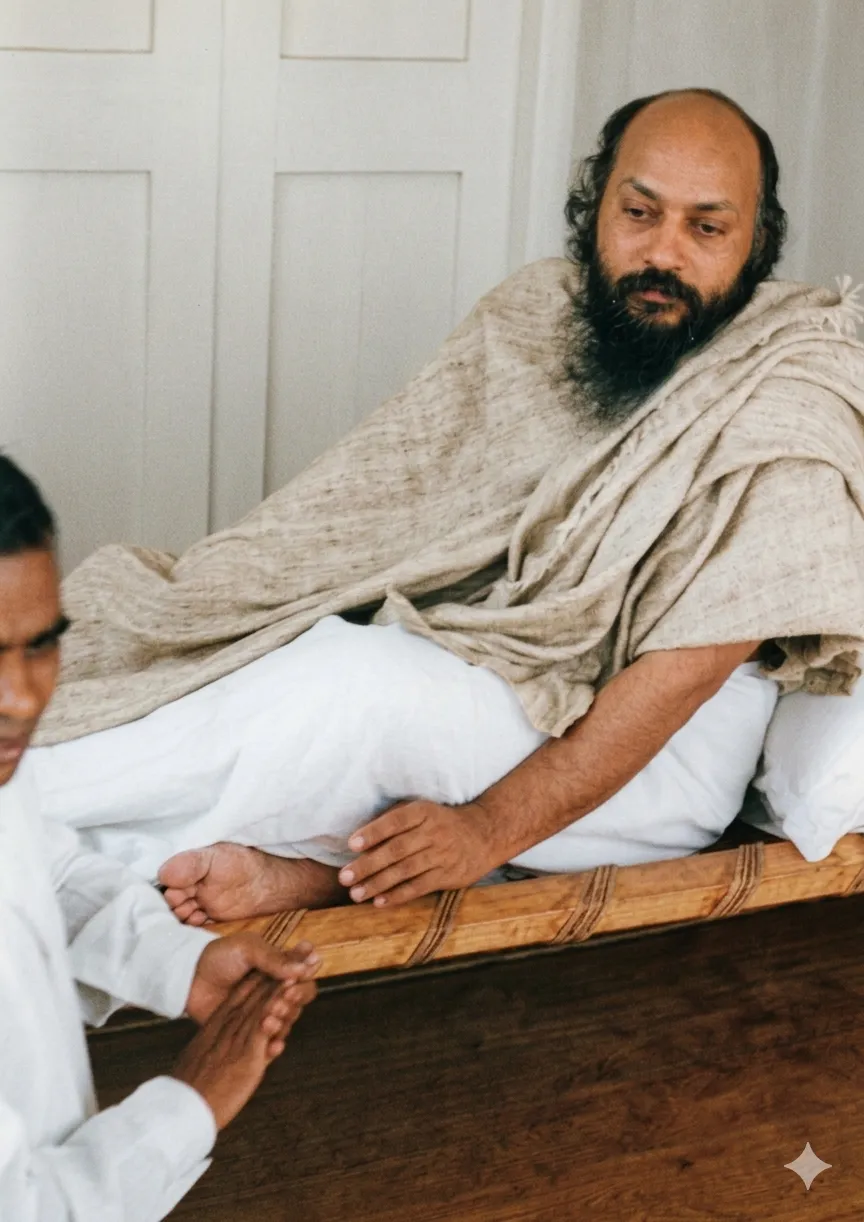
Don’t fight your busy mind; just watch thoughts come and go like cars, and they lose power—your teacher can show this, but you have to do the watching.
From the Discourses
Passages where Osho speaks to this question — each links to the complete discourse.
Osho, there is such a crowd of thoughts inside that even after finding a guru like you, I cannot muster hope of arriving in this very life. I weep without reason, I cry, I scream and shout, yet when the moment comes I can save myself neither from the ego nor from the inner babble. Osho, if I do not arrive even in this birth, will the next path remain just as blank? Will you also not be able to help?
No, there is no reason at all to worry. Yes, there is a crowd of thoughts. Getting free is not easy. But because it is not easy, do not conclude that the crowd of thoughts is very powerful. No! It feels difficult because you have started fighting the crowd of thoughts—there is the mistake. The power is not in the thoughts; it is in your wrong approach. As if a room were filled with darkness and you tried to shove it out by pushing. Darkness will not leave that way; so you will feel the darkness is very strong, very powerful. It is true: push at it for lifetimes and it will not go. But that does not mean darkness is powerful. It only shows that pushing is not the right method. Put the same energy you use for pushing into lighting a lamp. Look for a lamp. A small…
An old man asked: I am constantly harassed by thoughts. This was not so till I started meditating. Day and night, all twenty-four hours, I am conscious of disturbed state of my mind; in fact, at times I doubt if I am sane! Please tell me what I should do; show me the cure for my feverish mind.
This experience has its benefits, because when you feel disturbed by the constant traffic of thoughts, you realise the futility of over-thinking. You are fortunate, because others not in the same category as you, are so dull, they do not feel disturbed by such mental hyperactivity. Your disturbance is a welcome sign; it shows that the trouble can be remedied. Normally, so long as you are carried away by your speeding thoughts, you do not feel disturbed by the thoughts. But if you pause in-between, and study your mind, you realise how feverishly it works, and disturbs your peace. This pause is essential for curbing the over-activity of mind. You have to halt and watch your thoughts; for, if your thoughts are running fast, you cannot know your mind. Therefore, I reiterate, your experience is a good omen. Do not be worried about it, on the contrary, be glad. But…
Osho said that there was no need to try to still the mind, to stop the thoughts. He said that just as the traffic goes by and one remains on the sidewalk, unaffected, just a watcher, so one should simply witness the thoughts as they went by. We are not our thoughts, and recognising that we are the witness is enough. The very acceptance of the thoughts makes one more relaxed. The relaxation helps to create a distance, to separate oneself. To evaluate a thought as good or bad means that you are attached to your thoughts -- so one should not put labels on them.] ... put yourself aside, sit under a tree, and just watch the traffic. Soon, one day, the traffic disappears and the road is empty. Suddenly there is an interval and in that interval is meditation. But that interval cannot be created or cultivated.
Osho, I was severely tormented by thoughts, so I asked a holy man for a method of meditation. He told me to remember the Ram-Ram mantra continuously. The thoughts did disappear, but now the Ram-Ram runs on and on like a rote chant. I find myself muttering Ram-Ram while sitting, while getting up—always. And even if I try to stop, I cannot. A constant stream keeps running inside. It has made me feel almost deranged. Please guide me; I want to be free of this mantra.
I read a story yesterday. In Chandulal’s family a peculiar problem arose. His three-year-old grandson, Munna, said “Lam-lam” for “Ram-Ram.” The neighbor, friend Dhabbhuji, took this as a challenge in speech-psychology. To train Munna’s tongue to roll the “r,” he devised a linguistic technique. First he taught him to say “dhirr”—to practice the r-sound. “You can turn ‘Ram’ into ‘Lam,’ but you can’t turn ‘dhirr’ into ‘dhimm,’ can you?” So he trained him: “Dhirr… dhirr…” Munna learned it. One day, while saying “dhirr, dhirr,” suddenly he blurted out, beaming with joy, “Dhirr Ram-Ram!” Dhabbhuji was delighted—success at last. But now the problem is: if you say “Ram-Ram,” he says “Dhirr Ram-Ram.” How to free him from the “dhirr”? You taught it—and now, no matter how much you coax him, whenever he says “Ram-Ram,” first comes “dhirr.” That is what has happened with your mantra—“Dhirr Ram-Ram.” You’re stuck on the “dhirr.”…
A friend has asked: Osho, you said about a wayward son that one should let him pass through his experiences, and he will learn on his own. But even after experiencing, he still prefers the same thing—someone is asking about his wayward son—no matter how much suffering he has to endure, even if death itself should come, still he does the same. After stumbling again and again, he repeats it. What can be done? How to reform him?
You will not be able to reform him. If life cannot reform him, if even death cannot reform him, what will you be able to do? If what you say is true—that again and again, even after suffering, he does the same thing; even if death comes, he will still do the same thing, and he does not change—then take your hands off. You will not be able to reform him. You cannot be stronger than death. And one who does not learn from suffering—what will he learn from you? Do not call him a wayward son. You have found yourself a Jadabharata. Because those whom suffering does not reform, whom even death does not reform—these are great, arrived masters; they are in the ultimate state. Do not even try to reform such a one. And why are you so eager to reform another? It is enough to reform yourself.…