
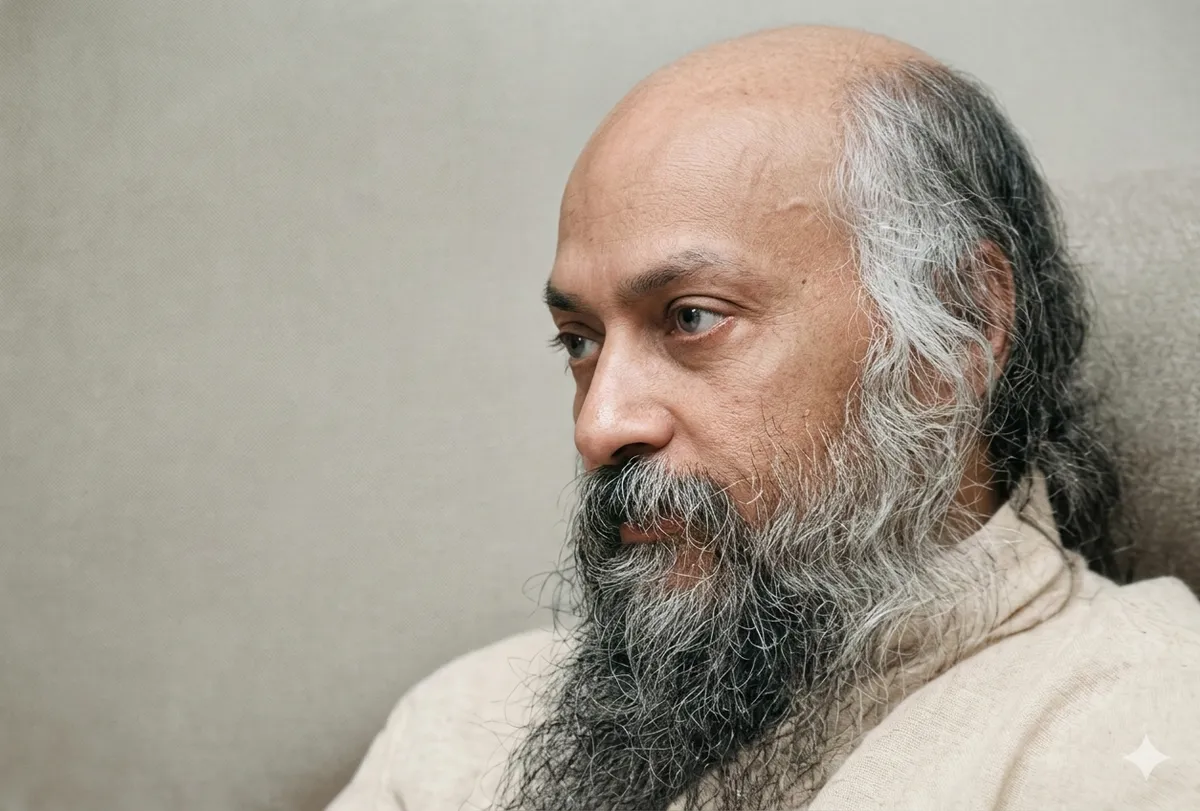
Let go of every thought, even the nice ones, so your quiet mind can show you who you really are.
From the Discourses
Passages where Osho speaks to this question — each links to the complete discourse.
You also ask us not to hold on to thoughts. Does this apply to good thoughts as well?
If you want to know your real being you must rid yourself of both good and evil and become empty, without content. Thoughts, both of good and of evil, are all acquired things. They come from outside: they pour in from the outside. Your real being is hidden under there, under this load of chains. It is necessary to break these chains. It makes no difference whether the chains are of iron or of gold. Whatsoever comes from without is an acquired thing, an acquisition -- but inside us there is a state of pure consciousness where no outside impressions can enter. The soul comes into its own only in the absence of all one's outer trappings, of all one's outer conditionings. To discover your soul you must have an unconditioned mind. But we are full of thoughts and those who are religious are even fuller, always adding to the…
Question: Third question: Osho, how can one control thoughts? He came back dancing. He placed his head at Buddha’s feet and said: You have given me a very deep message. Today I have found a sutra. I will use this same sutra with the mind. Today a great thing has become clear within me. Your great compassion sent me back. I was not willing to go—but a revolution has happened—just sitting on that bank. Sitting by that spring I understood: had I stepped into the water—had you not told me otherwise—I would have tried to purify it, and in doing so I would only have made it more impure. The moment I stepped in, more mud would have risen. You spoke rightly: sit on the bank and wait. Do nothing; just keep watching. The spring will clear by itself. So too I will do with my mind.
The song continues:
IF ONE SEES NOUGHT WHEN STARING INTO SPACE; IF WITH THE MIND ONE THEN OBSERVES THE MIND, ONE DESTROYS DISTINCTIONS AND REACHES BUDDHAHOOD. THE CLOUDS THAT WANDER THROUGH THE SKY HAVE NO ROOTS, NO HOME; NOR DO THE DISTINCTIVE THOUGHTS FLOATING THROUGH THE MIND. ONCE THE SELF-MIND IS SEEN, DISCRIMINATION STOPS. IN SPACE SHAPES AND COLORS FORM, BUT NEITHER BY BLACK NOR WHITE IS SPACE TINGED. FROM THE SELF-MIND ALL THINGS EMERGE, THE MIND BY VIRTUES AND BY VICES IS NOT STAINED. A buddha is a person who lives without the mind; then he's not responsible. That's why in the East we say that he never accumulates karma; he never accumulates any entanglements for the future. He lives, he walks, he moves, he eats, he talks, he is doing many things, so he must accumulate karma, because karma means activity. But in the East it is said even if a…
A friend has asked: Osho, you said about a wayward son that one should let him pass through his experiences, and he will learn on his own. But even after experiencing, he still prefers the same thing—someone is asking about his wayward son—no matter how much suffering he has to endure, even if death itself should come, still he does the same. After stumbling again and again, he repeats it. What can be done? How to reform him?
You will not be able to reform him. If life cannot reform him, if even death cannot reform him, what will you be able to do? If what you say is true—that again and again, even after suffering, he does the same thing; even if death comes, he will still do the same thing, and he does not change—then take your hands off. You will not be able to reform him. You cannot be stronger than death. And one who does not learn from suffering—what will he learn from you? Do not call him a wayward son. You have found yourself a Jadabharata. Because those whom suffering does not reform, whom even death does not reform—these are great, arrived masters; they are in the ultimate state. Do not even try to reform such a one. And why are you so eager to reform another? It is enough to reform yourself.…
I was extremely troubled by thoughts so I made the mistake of asking a hindu monk, a sadhu-maharaj, for a method of meditation. He told me to continuously remember the mantra, ram-ram. Through this, thoughts have gone, but now the repetition of ram-ram goes on and on. Now I go on repeating ram-ram every moment. And if I want to stop it I cannot stop. Its continuous stream keeps moving inside. An insane state is arising from this. Please guide me, I want to get free of this mantra.
This happens often. One gets rid of the disease and gets fettered to the medicine. It is called addiction. This is why physicians are so concerned -- as soon as the disease is gone, they want to quickly stop the medication. Otherwise dependence on the medication begins. A mantra is not something to be repeated continuously. If it is used for an hour or two there is no damage. Medicine should be taken in doses. The one who gave you the mantra didn't know anything about the science of mantras. But this has not happened only to you, many people have come here like this. One Sikh was brought to me. He was in the army, of high rank. And his condition had become poor because someone had told him, just keep on chanting, continuously repeating. So he kept repeating the Japji mantra inside. Slowly slowly people began to wonder…