
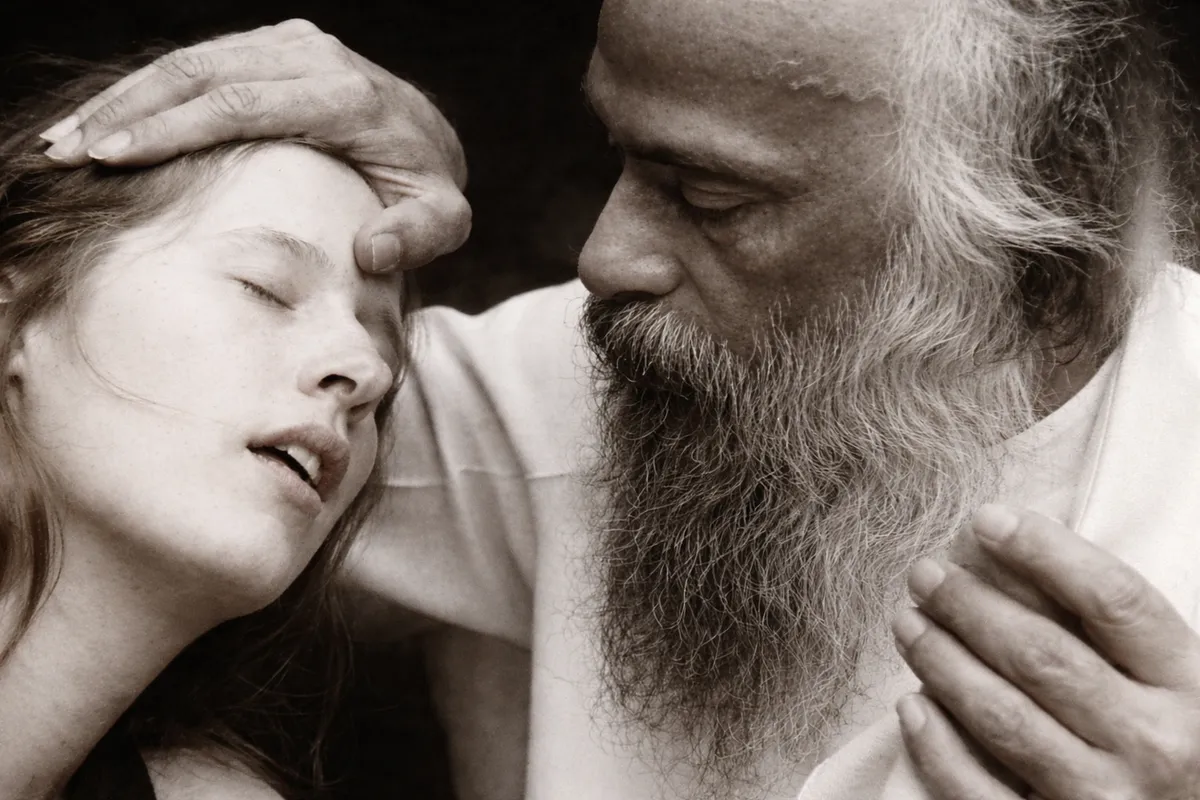
It’s like one person still walking to the city and another who has already reached and lives there; the road is the same, but one is traveling and the other is home.
From the Discourses
Passages where Osho speaks to this question — each links to the complete discourse.
Osho, what are the similarities and differences between the sthitaprajna and the devotee? This too was in the earlier part of the question.
What is the difference or similarity between the sthitaprajna and the devotee? Sthitaprajna means one who is no longer a devotee—he has become God. Devotee means one who is on the journey toward becoming God. The devotee is on the path; the sthitaprajna has arrived. The path is the same; the arrival is the same. But “sthitaprajna” is the name for one who has reached the destination, and “devotee” is the name for the traveler who is still moving. There must be similarity, because the path and the goal are connected—otherwise how would the path reach the goal? There must be similarity, because the goal is simply the completion of the path. Where the path is complete, the destination appears. There must be similarity, because the one on the path is, in a sense, already at the destination—only a little distance remains, that’s all. It’s a matter of distance. The…
ओशो, स्थितप्रज्ञ और भक्त में क्या समानता है और क्या भिन्नता है, यह भी प्रश्र्न के पिछले अंश में था।
स्थितप्रज्ञ और भक्त में क्या भेद या समानता है? स्थितप्रज्ञ का अर्थ है, जो अब भक्त नहीं रहा, भगवान हो गया। भक्त का अर्थ है, जो भगवान होने की यात्रा पर है। भक्त रास्ते में है, स्थितप्रज्ञ पहुंच गया है। रास्ता वही है, पहुंचना वहीं है। लेकिन यह मुकाम पर पहुंचे हुए आदमी का नाम है, स्थितप्रज्ञ। और भक्त यात्री का नाम है जो चल रहा है। समानता होगी ही, क्योंकि रास्ता और मंजिल जुड़े होते हैं। अन्यथा रास्ता मंजिल तक कैसे पहुंचेगा? समानता होगी ही, क्योंकि मंजिल सिर्फ रास्ते की पूर्णता है। जहां रास्ता पूरा हो जाता है, वहां मंजिल आ जाती है। …
Questioner: a comparative study of a sthitaprajna, one settled in his intelligence, and a devotee, remains to be made by you.
For this reason I say the lovers of today are devotees of tomorrow; they have no way but to turn to devotion. When they know for themselves that it is impossible to be one with an embodied person, they will turn to God, who is bodiless, because it is quite possible to be really one with him. So sooner or later every lover is going to turn into a devotee, and every word of love is going to turn into a prayer. This is how it should be. Otherwise there is no escape from the torture and misery of love. A lover who refuses to be a devotee is bound to be in everlasting anguish. Ironically, while his longings are those of a devotee, he is trying to fulfill them through ordinary love. His aspirations are running in one direction and his efforts in another, and so frustration is inevitable.…
Beloved Osho, I feel and know in my heart, I am your disciple. I don't feel I am yet a devotee although I aspire to be one. Is it the nature of being a devotee that one knows one has become one? Or does the innocence of the devotee make the awareness of it not possible?
Just drop the aspiration and there is no hindrance for your transformation. You will be transmuted from disciplehood into the wider world of a devotee. Certainly you have stumbled upon a beautiful fact which cannot be possible just through intellect. You say, "Is it in the nature of being a devotee that one knows one has become one or does the innocence of the devotee make the awareness of it not possible?" The second part of your statement is correct; the very nature of the devotee makes it impossible for you to recognize it. There is no space left to stand aside and see. Every knowledge, every awareness needs a distance. You have to stand away; then you can see and watch, and you can know and you can be aware. But the devotee has lost all distances between himself and his knowing. He himself has become awareness. Now who…
Question: The first question: Osho, are prayer and devotion different? They are both distinct and inseparable. They are distinct in that where prayer is complete, devotion begins. They are inseparable in that without prayer there can be no devotion. Understand it like this: a classical musician first tunes his instrument. Once the instrument is tuned, music can arise. Tuning is not the music, but without tuning music will not happen—it is the prelude. Prayer is like that. Prayer is the tuning of the instrument. Prayer is moving toward the Divine through the medium of words.
भिन्न भी हैं और अभिन्न भी। भिन्न इसलिए हैं कि जहां प्रार्थना पूर्ण होती है, वहां भक्ति प्रारंभ होती है। अभिन्न इसलिए हैं कि बिना प्रार्थना के कोई भक्ति नहीं। ऐसा ही समझो कि कोई शास्त्रीय संगीतज्ञ पहले अपना साज बिठाता है। साज बैठ जाए तो संगीत पैदा हो। साज बिठाना ही संगीत नहीं है, लेकिन साज बिना बिठाए भी संगीत पैदा न होगा--भूमिका है। ऐसी ही प्रार्थना है। प्रार्थना यानी साज बिठाना।
Osho, you did accept that there is no difference between the total “I” and the “no-I,” but earlier in your talk you had said that sadhana leads toward the total I and upasana leads toward the no-I. And you drew a sharp distinction between sadhana and upasana. But later you seem to regard the two as one.
No, I did not say that sadhana leads toward the total I. I said: sadhana leads in the direction of the I. If sadhana were to lead toward the total I, then it would be no different from upasana. But sadhana cannot take you there. And that is why one day the seeker has to lose the I as well. It only moves in the direction of the I. Because the total I can be only when the I is lost. Therefore, at the end the seeker will have to take one more leap. By doing sadhana he will find the I, he will attain the self; and in the end he will have to take the leap of losing even the self. If he does not, he will stop one step short. The leap the devotee takes on the very first day, the seeker will have to take on…
ओशो, आपने यह तो स्वीकारा कि पूर्ण ‘मैं’ और ‘ना-मैं’ में कोई फर्क नहीं है, लेकिन इसके पहले आप अपनी चर्चा में यह कह चुके हैं कि साधना पूर्ण मैं की दिशा में ले जाती है और उपासना ‘ना-मैं’ की दिशा में ले जाती है। और आपने साधना और उपासना में बहुत फर्क किया। लेकिन बाद में आप दोनों को एक मान रहे हैं।
नहीं, मैंने यह नहीं कहा कि साधना पूर्ण मैं की दिशा में ले जाती है। मैंने कहा, साधना मैं की दिशा में ले जाती है। अगर साधना पूर्ण मैं की दिशा में ले जाए, तो फिर उपासना में कोई फर्क नहीं है। लेकिन साधना नहीं ले जा पाती। और इसलिए साधक को एक दिन मैं को भी खोना पड़ता है। वह मैं की ही दिशा में ले जाती है। क्योंकि पूर्ण मैं तभी हो सकता है जब मैं खो जाए। इसलिए साधक को एक छलांग और लगानी पड़ेगी अंत में। एक साधना करके वह मैं को पाएगा, आत्मा को पाएगा; उसे अंत में आत्मा को भी खोने की छलांग लगानी पड़ेगी। …