
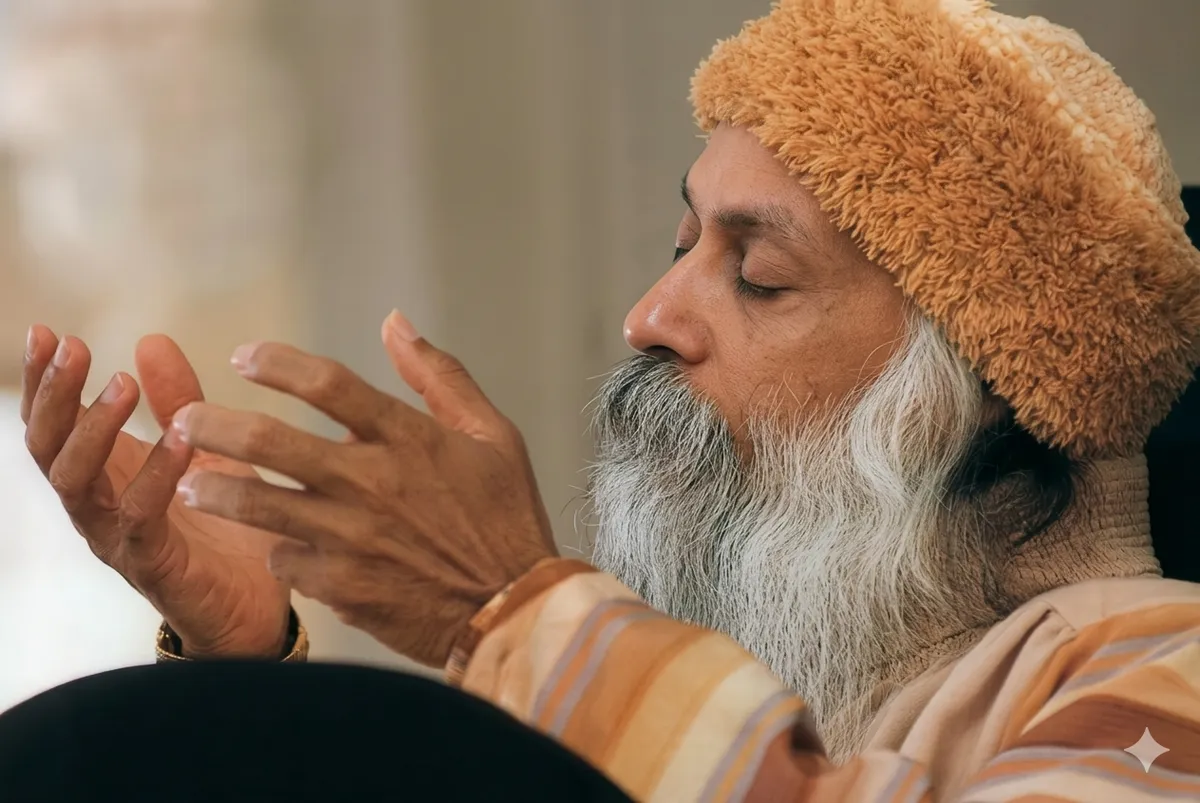
No—his ecstatic singing and dancing awakened the still, silent center inside, while today’s routine kirtans often miss that living essence.
From the Discourses
Passages where Osho speaks to this question — each links to the complete discourse.
Osho, was Chaitanya’s dance and kirtan also an intoxication?
No. Through kirtan and bhajan Chaitanya certainly attained exactly what I am talking about. Chaitanya danced his way to that which Buddha and Mahavira attain by standing still. Both ways are possible. There are two ways to catch hold of the axle-pin. One way is to become so still that no vibration remains in you—utterly unmoving, steady, in a state of just standing; then you reach the pin. The other way is to move so totally, to be in such velocity, that the whole wheel runs and the pin becomes obvious. The second is easier. When the wheel spins fast, it’s easy to spot the pin. Very few can recognize the pin when the wheel is still. Mahavira recognizes it by standing still; Krishna, by dancing. And Chaitanya danced more than even Krishna. There is simply no comparison. There has perhaps been no dance like Chaitanya’s on this earth. The…
ओशो, चैतन्य का नृत्य-कीर्तन भी क्या इनटॉक्सीकेशन था?
ये दोनों बातें हो सकती हैं। कील को पकड़ने के दो रास्ते हो सकते हैं। एक रास्ता तो यह हो सकता है कि आप इतने खड़े हो जाएं कि आपमें कोई कंपन ही न रह जाए। कंपन ही न रह जाए कोई, इतने ठहरे हो जाएं, इतने थिर हो जाएं, जस्ट स्टैंडिंग की हालत रह जाए--तो उस हालत में आप कील पर पहुंच जाएंगे। या दूसरा रास्ता यह है कि आप इतने मूवमेंट में हो जाएं, इतनी गति में हो जाएं कि चाक पूरा चल पड़े और कील पहचान में आ जाए। आसान दूसरा ही होगा। चाक जोर से चले तो कील को पहचानना आसान होगा। बहुत कम लोग हैं जो खड़े हुए चाक में और कील को पहचान पाएं। महावीर खड़े होकर पहचानते हैं, कृष्ण नाच कर। और चैतन्य तो कृष्ण भी जितना नहीं नाचे उतना नाचे हैं। चैतन्य का तो कोई मुकाबला नहीं। चैतन्य के नृत्य का तो कोई हिसाब ही नहीं है। शायद पृथ्वी पर ऐसा कोई नाचा ही नहीं। पर ध्यान में लेने की बात इतनी ही है कि हमारे भीतर दो...हमारी परिधि जो है, गतिमान है, परिवर्तन है वहां; और हमारी जो गहरी आत्मा है वहां शाश्र्वतता है, इटरनिटी है, वहां कोई परिवर्तन नहीं, वहां सब चुप और शांत और सदा खड़ा रहा है, वह कील की भांति है, वह थिर है। उस थिर को, उस परिवर्तन-अतीत को किस भांति पहचान लें!
Questioner: do you think chaitanya's singing and dancing was nothing more than a way of intoxication?
No, Chaitanya achieved the highest through singing and dancing. He achieved through dancing exactly what Mahavira and Buddha achieved through meditation, through stillness. There are two ways to come to the axle, the center, the supreme. One of the ways lies in your being so steady and still -- just at a standstill -- that there is not a trace of trembling in you and you arrive at the center. The other way is just the contrary: you get into such terrific motion that the wheel runs at top speed and the axle becomes visible and knowable. And this second way is easier than the first. It is easy to know the axle if the wheel is in motion. While Mahavira comes to know it through stillness, through meditation, Krishna knows it through dancing. And Chaitanya surpasses even Krishna in dancing; his dance is magnificent, incomparable. Perhaps no other person…
Question: Third question: Osho, please explain a little about kirtan-meditation. Kirtan is not for understanding—it is for doing. The secret is hidden in the very word: do! Do it and you will know. Understanding has nothing to do with kirtan. In fact, only when you set understanding aside will kirtan happen. If you try to do kirtan by figuring it out, it will not happen. If you do it through cleverness, you will miss. Drop the concern to understand. If you truly want to understand, do—understanding will come from behind. Dive! Kirtan-meditation is the name of total absorption. It is the expression of ahobhava—the “Ah!” of wonder—of blessedness. The wonder that I am! The wonder that the Divine has created me! The wonder that for a little while the eyes opened and I saw light, saw flowers, heard birdsong, beheld the dance of sun, moon, and stars!
कीर्तन समझने की बात नहीं--करने की बात है। कीर्तन शब्द में ही छिपा है राज--करने की बात! करो तो जानोगे। समझ से कीर्तन का कोई लेना-देना नहीं। वस्तुतः तो समझ को रख दोगे एक किनारे तभी कीर्तन कर सकोगे। तो समझ-समझ कर अगर कीर्तन किया तो होगा ही नहीं। समझकर किया तो चूक ही जाओगे। अगर बुद्धिमानी के द्वारा किया, वहीं गलती हो जायेगी। समझने की फिक्र छोड़ो। अगर सच में ही समझना चाहते हो तो करो, समझ पीछे से आयेगी। डूबो! कीर्तन-ध्यान तल्लीनता का नाम है। कीर्तन-ध्यान अहोभाव की अभिव्यक्ति है। धन्यभाव की! यह अहोभाव कि मैं हूं! यह अहोभाव कि परमात्मा ने मुझे सृजा! यह अहोभाव कि थोड़ी देर आंखें खुलीं, रोशनी देखी, फूल देखे, पक्षियों के गीत सुने, सूरज, चांद-तारों का नृत्य देखा!
Osho, you have titled this series of talks “Sahaj Yoga.” Do “sahaj” and “yoga” not seem mutually opposed?
Anand Maitreya! They don’t just seem opposed, they are opposed. But no ultimate truth of life can manifest without contradiction. Life is made of opposites—darkness and light, day and night, woman and man, negative electricity and positive electricity, birth and death. The very structure of life is woven of opposites. Hence the opposites are not only opposed; they are complementary to each other. If you have labored hard all day, you will be able to sleep deeply. Labor and rest are opposites, yet only the one who has worked can rest deeply—and the one who has not worked cannot. So the opposites are not only opposed, they complete each other. And only the one who has rested deeply at night can rise in the morning and engage in work again. One who has not rested through the night will not be able to work in the morning. Look closely at…
पहला प्रश्न: ओशो, आपने इस प्रवचनमाला का शीर्षक दिया है--सहज-योग। क्या सहज और योग परस्पर-विरोधी नहीं लगते?
आनंद मैत्रेय! विरोधी लगते ही नहीं, विरोधी हैं। लेकिन जीवन का कोई भी परम सत्य बिना विरोधाभास के प्रगट हो ही नहीं सकता। जीवन बना है विरोधों से--अंधेरा और प्रकाश, दिन और रात, स्त्री और पुरुष, ऋण विद्युत-धन विद्युत, जन्म-मृत्यु। जीवन की संरचना विरोधों से है। इसलिए विरोधी विरोधी ही नहीं हैं, एक-दूसरे के परिपूरक भी हैं। दिन भर श्रम किया खूब तो गहरी नींद सो सकोगे। श्रम और विश्राम विरोधी हैं, पर जिसने श्रम किया है वही गहरा विश्राम कर सकेगा। और जिसने श्रम नहीं किया वह गहरा विश्राम भी न कर सकेगा। तो विरोधी विरोधी ही नहीं हैं, एक-दूसरे के परिपूरक भी हैं। और जिसने रात्रि गहरा विश्राम किया है वही सुबह जागकर फिर श्रम में संलग्न हो सकेगा। जो रात-भर विश्राम नहीं कर सका वह सुबह श्रम में भी न लग सकेगा।
Question: Fourth question: Osho, for an hour to an hour and a half after the daily discourse, a kind of intoxication descends. In that time, far from talking, I don’t even feel like looking at anyone. A strange smile spreads on my face. Sometimes tears come, and then I want to be alone. If anyone disturbs me at that time, I feel irritable. Please say something. It’s going well. This is exactly how it should be. This is no temple; this is a tavern. If the intoxication doesn’t come here, then nothing has happened. If you don’t get blissfully drunk here, you’ve missed. There is no preaching on scriptures going on here; here wine is being poured. Here it’s the work of drunkards. The weak have no passage here.