
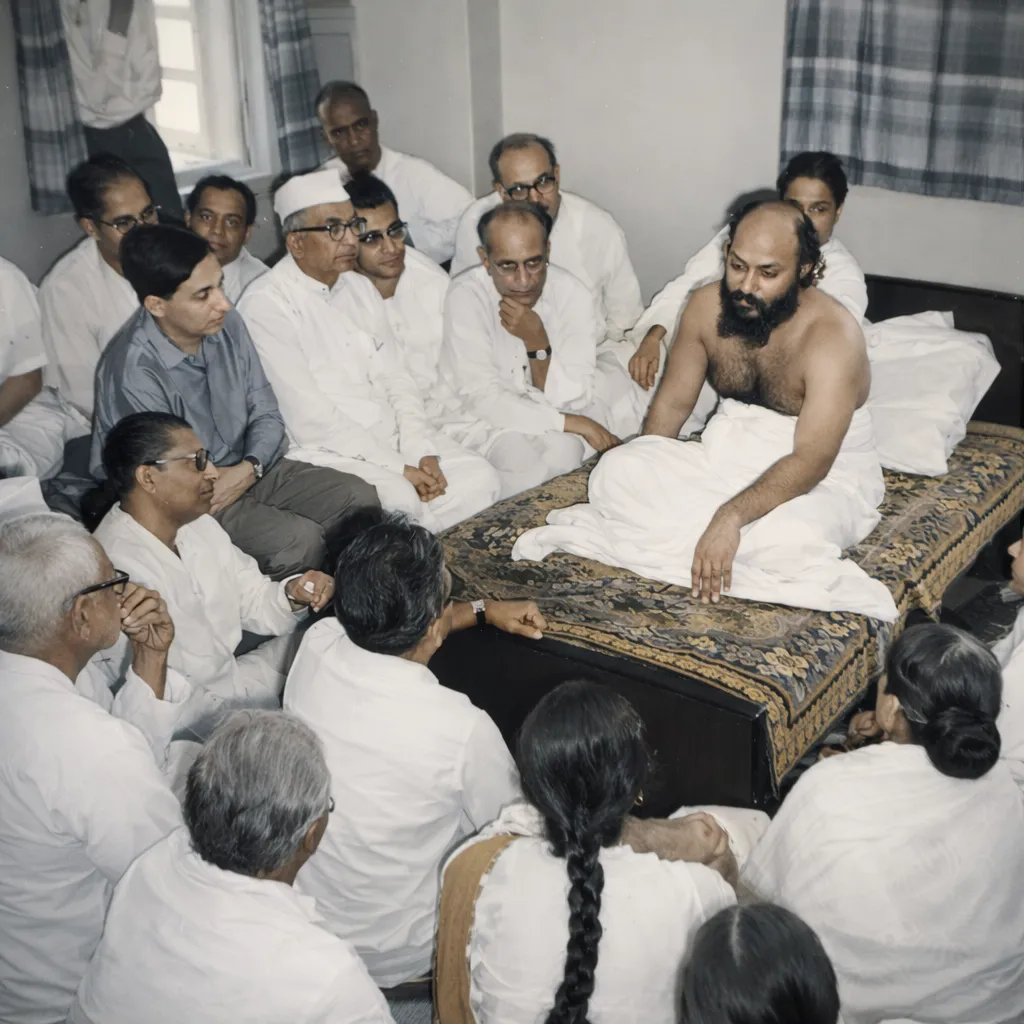
You start looking for God because you want something, but you find God only when you stop wanting and even stop looking.
From the Discourses
Passages where Osho speaks to this question — each links to the complete discourse.
Osho, you said that science cannot reach religion because science is a causal search. Then is the search for religion done without cause?
At that time you won’t be able to suppress it. The mantra will have fallen away, and desire will show itself. You would be astonished: those whom you call sadhus—if you could see their dreams, only then would you know whether they are sadhus or not. The dreams of sadhus are often most unsaintly. The dreams of the unsaintly may sometimes be saintly—but the saint’s dreams are almost never so. A criminal in jail may sometimes dream, “I should renounce everything; I’ve indulged and suffered enough. Let me take a begging bowl and go forth. Shall I walk the path of Buddha or of Mahavira?” But go to those you see ostensibly walking the path of Buddha and Mahavira—the monks and renunciates—and ask them to tell you their dreams. At night they dream of the world. They fast in the day, and at night they are invited to the emperor’s…
Osho, you say, “As He wills, let us become mere instruments; whatever role in life we have been given, let us fulfill it.” But letting what happens happen—i.e., flowing along with the body, mind, and ego—gives rise to suffering. So should we keep applying the principle of instrumentality even in relation to the body, mind, and ego, and go on suffering? How do we solve the riddle between the principle of instrumentality and the continuous reality of suffering?
That supreme bliss is beyond both pleasure and pain. It is neither like night nor like day. It is twilight. The sun has set, night has not yet come; the light remains—very gentle, sweet, non-aggressive—that is twilight. Morning has come, the sun is not yet risen, the night has gone—such is the twilight. One who abides in that twilight—that is what we call prayer. That is why Hindus call their prayer sandhya. Sandhya means one who has stopped in between the dualities, who has found the truce between the two. Between pleasure and pain, love and hate, victory and defeat, night and day, life and death—one who has found the pact and stands in that concord. Seek that interval of conjunction. Krishna says, it is simple to find. If you cease to be the doer, you will find it instantly. It is only through your doer-ship that you keep missing.…
A friend has asked, Osho, why should we be religious when neither the beginning nor the end is known, and there is no trace of God or soul? The enlightened ones speak of truth—if that truth is real, why can’t they make everyone experience it?
No one is telling you to be religious—at least Lao Tzu would not. The so-called religious people have created so much disturbance that it is better you do not become one of them. Lao Tzu does not say, “Be religious.” He simply says: be what you are. You may ask, why should I be what I am? Because that is the only thing you can be. There is no way to be anything else. Yes, you can try to be something else—and in that trying your life can be wasted. You may then say, why not waste life? No one can stop you. And precisely for this reason even the enlightened ones are defeated and cannot give you the knowledge of truth—because you say, why should we know the truth? What can the enlightened do? They can speak. They can try to awaken in you the thirst for the joy…
Osho, what is the definition of God?
Words are very small. If you say God is light, then what of darkness? The scriptures have said that God is light. Suppose we accept this as a definition—then what about darkness? Where will darkness go? Darkness is too; in fact it is far more than light. Light sometimes is and sometimes is not; darkness is always, eternal. Where will you place darkness? If you say God is light, darkness is left out. If you say God is darkness, then light is left out. If you say God is both darkness and light, a contradiction arises: they cannot be together. Try to have both darkness and light in the same room. If you bring in light, darkness disappears; if you preserve darkness, you cannot have light. Then how can both be together? That becomes an impossibility. So you cannot say “both” either. Then the fourth device is to say: it…
First of all, a friend has asked: yesterday I said that the search has to be dropped. And if we drop the search, would science then never be born?
What I said—“the search has to be dropped”—was said for attaining the truth that is within us; to seek it is futile, it is a hindrance. But there is truth outside us as well. And the truth that is outside can never be found without search. So there are two directions in life: one that goes outward from us. If one wants to inquire into the outer world—the realm science explores—then one will have to search. Without search no truth of the outer world can be attained. There is also an inner world. If one wants to know the inner truth, then searching must be dropped absolutely. If you search, it becomes a hindrance, and the inner truth will not be available. These two truths are parts of one greater truth. Inner and outer are two extensions of the same reality. But for one who wants to start from the…