
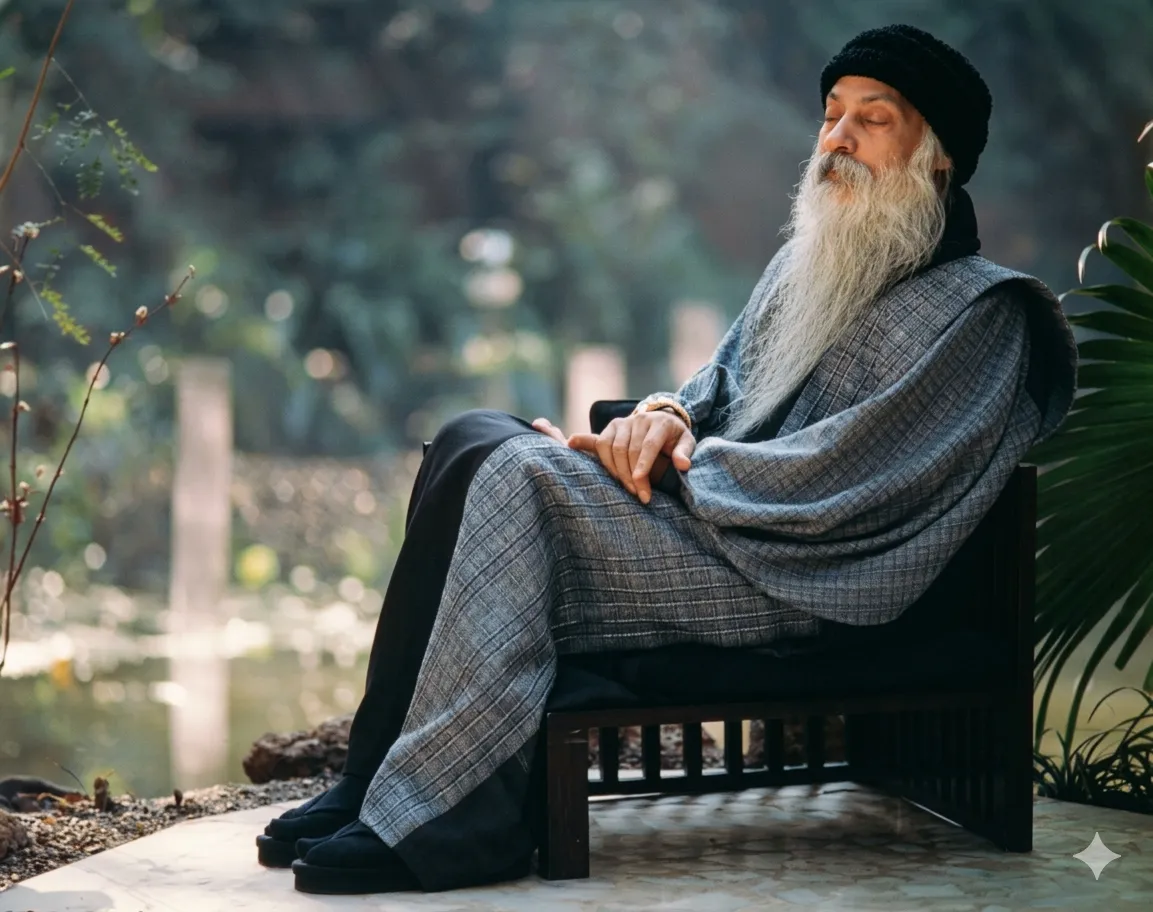
Enlightenment is quietly knowing you exist without needing any thoughts; unenlightenment depends on thoughts to feel real.
From the Discourses
Passages where Osho speaks to this question — each links to the complete discourse.
Beloved Osho, you said that the master is like the sky; he appears to be, but he is not. I think I am, therefore I am. Is this the only difference between enlightenment and unenlightenment?
It is one of the most significant differences. In the Western philosophy there are few names which are more important than the name of Descartes. Descartes' whole philosophy is based on the single statement, "I think, therefore I am." But it is obviously very childish because you are not thinking constantly, still you are; you are not thinking while you are asleep, still you are; you may be in a coma, you are not thinking, still you are. "I think I am, therefore I am." Thinking seems to be the most significant part. It is a conclusion of thinking that "I am," but when you are not thinking, what happens? In meditation there will be no thinking. And those who have meditated for thousands of years, their experience has to be compared. They say, "When thinking ceases, then I am;" just the opposite of Descartes -- because thinking is a…
Question: BELOVED OSHO, HOW DO YOU EXPERIENCE YOUR ENLIGHTENMENT? But in this whole changing, riverlike being... who are you? Only the stupid will speak out; the wise will remain silent. One who knows not will say, "I am this; I am a man, I am a woman, I am young, I am Hindu, I am a Christian..." Only the stupid will speak out. The wise will become absolutely silent. He is also answering -- his silence is the answer. Buddha calls this silence "right remembrance"... sammasati. You are saying, "I go on remembering all kinds of things you have said, and my own insights..." Agyeya, I had no idea that you also have insights! But... okay. Remembering all kinds of things that I have said, and what you have imagined as your intuitions... just try to find a single intuition that is yours, and you will be surprised.
Is it possible to be conscious of enlightenment, and be enlightened? Can the thought of being enlightened create ego in one? Kindly explain.
THE first thing to be understood is: what is ego. The ego is not very substantial. In fact it is not. It is just an idea, a substitute without which it will be difficult for you to live. Because you don't know who you are, you have to create a certain idea about yourself; otherwise you will simply go mad. You have to fix some indicators so that you can know, "Yes, this is me." I have heard, once a fool came to a big city. He stayed in a dharmasala. There were many people there; he had never slept before with so many people. He was a little worried and scared. The fear was that when he will fall asleep, in the morning when he will be awake again, how will he recognize that he is really himself. So many people. He had always slept in his room, alone,…
Osho, what is the difference between surrender and blind imitation?
So be careful: the freedom you allow yourself, allow the other too. You have no right to judge another as blindly credulous or as a surrendered being. Drop that concern. You cannot judge anyway—how will you enter another’s heart? How will you know? Think only about yourself. See within whether, up to now, you have lived by blind belief or by surrender. Decide only there; leave worrying about others. Otherwise, all your judgments will be wrong. Jesus said: Judge not; do not set yourself up as a judge in relation to another. To the friend who has asked: if you are asking for yourself, good. Drop worrying about others. Look within and see: whatever I have been clinging to till now—have I ever staked my life to hold it? Have I meditated for it? Have I loved for it? Or am I just clutching what culture, society, civilization handed me?…
You said that existence is a wholeness, that everything is related, that things are melting into each other, that the tree cannot be without the sun and the sun also cannot exist without the tree. In reference to the above, please explain how ignorance and enlightenment are related to each other.
They are related. Enlightenment and ignorance are two polar opposites. Enlightenment can exist only because there is ignorance. If ignorance disappeared from the world, enlightenment would disappear simultaneously. But because of our dualistic thinking we always think that opposites are opposites. They are complementary, they are not really opposite. They are complementary because one cannot exist without the other. So they are not enemies. Birth and death are not enemies because death cannot exist if there is no birth. Birth creates the base for death to exist but if there were no death, birth could not exist. Death creates the base -- so whenever someone is dying, someone else is being born. At one point there is death, at the next point immediately there is birth. They look opposite, they work in opposition as far as the surface is concerned, but deep down they are friends helping each other. It…